

What if the medical examination you need depends not only on your destination, but also on your visa category? It’s easy to assume every visa medical follows the same steps, yet instructions can differ. Booking the wrong assessment or arriving without the required forms may cause avoidable stress. An immigration doctor carries out the medical assessment; the relevant immigration authority makes the visa decision.
Before arranging an appointment, use the destination country’s current instructions to identify the examination required for your application. The right immigration doctor support starts with understanding those requirements, rather than assuming one standard set of tests applies to everyone.
This guide explains the doctor’s role, why requirements vary and what you may encounter during an appointment, from paperwork to clinical checks and the handling of results. It also covers how to prepare and reduce the risk of an incomplete examination. Hatmed Medical Centre provides immigration medical examinations in South Africa, with patient-centred support to help make an unfamiliar process clearer.
Key Takeaways
- An immigration doctor conducts the medical assessment, while the relevant immigration authority decides the visa application.
- Your destination, visa category and official instructions help determine which examination and documents you need.
- Use a checklist to match the required examination to your visa route and any doctor category specified by the authority.
- Clinical checks and follow-up steps can differ between applicants, so prepare for a flexible appointment process.
- Hatmed Medical Centre provides immigration medical examinations to support applicants through the medical stage of their application.
What Does an Immigration Doctor Do for a Visa Medical Examination?
An immigration doctor conducts a medical assessment requested as part of an immigration process. The examination follows the instructions for a particular destination and visa route. The doctor assesses the relevant health information, completes the required clinical steps and records the findings accurately. The term doesn’t automatically mean that every doctor is authorised to complete every country’s immigration examination.
The doctor works within the scope set by the application instructions. These may specify a provider category, forms to complete or tests to undergo. One applicant may be asked for a physical assessment, while another may also need laboratory tests, a chest X-ray, vaccination records or other documents. Requirements can differ even for applicants travelling to the same country if their visa routes or circumstances vary.
What does the doctor assess and document?
The assessment follows the relevant immigration instructions, not a universal checklist. The doctor reviews the requested information, conducts the specified examination and documents the clinical findings. Depending on the destination and application, the process may also involve reviewing medical records or vaccination history, or completing additional tests. Check your instructions before the appointment and bring the forms and records they request.
Some countries use named provider categories for particular application processes. The United States, for example, refers to civil surgeons in some immigration medical procedures; its process is not a template for other destinations. A general overview of the medical examination for immigration to the United States illustrates why destination-specific instructions matter, but it shouldn’t be treated as guidance for another country.
What an immigration doctor cannot decide
The doctor records and reports medical information; they don’t grant or refuse a visa. Your role is to follow the examination instructions and provide accurate information, while the doctor carries out and documents the clinical assessment required for the process.
The immigration authority considers the medical information alongside the rest of your application and applies its own rules. A medical report is one part of the process, not a promise of a particular outcome. If further information or steps are requested, follow the instructions from the relevant authority or clinic. Clear records and an examination matched to the application can help you complete the medical stage, but they can’t guarantee visa approval or acceptance of a report.
Before booking, identify your destination and visa route, then check the current official instructions. Note the required examination, any named provider category and the forms or tests specified. This helps you distinguish an immigration assessment from a routine GP appointment and arrange the process your application requires.
Why Immigration Medical Requirements Differ by Destination and Visa
A medical examination is shaped by the immigration process it supports. The destination country sets its health requirements, while the visa category and the applicant’s circumstances can determine which forms, tests or supporting records are needed. A checklist for one country or visa route may not apply to another.
Follow the current instructions for your destination and visa route. Don’t assume a medical checklist from another application applies to yours. This helps you avoid preparing for the wrong examination or relying on outdated forms. An immigration doctor carries out the clinical assessment, while the application instructions establish which process is relevant.
Which instructions should applicants follow?
Start with the destination’s official immigration authority or the application guidance provided for your visa route. Check which forms and examination steps are required, whether a particular provider category is specified and how results should be handled. Medical guidance can change, so use instructions relevant to your current application rather than relying only on an old checklist or advice written for a different visa.
For a visa or immigration process within South Africa, consult the Department of Home Affairs’ official guidance where relevant. For another destination, follow that country’s authority. Keep the instructions with your application paperwork so you can refer to them when arranging the examination and preparing for the appointment.
Why one medical report may not fit every application
Some parts of medical assessments may be familiar, such as a physical examination or a review of health history. Other requirements are conditional. One application may call for laboratory tests, chest imaging, vaccination records or a destination-specific form, while another may not. The right combination depends on the instructions and individual circumstances, not on a universal immigration medical package.
Provider arrangements can differ, too. For certain US immigration processes, applicants are directed to a civil surgeon; USCIS explains how to find USCIS-designated civil surgeons. That is a US-specific example, not a general rule for South Africa or other destinations. Check whether your own route names a provider category or sets a particular process.
A report prepared for one destination may not satisfy another country’s requirements. Authorities can use different forms, request different examinations or set distinct arrangements for submitting results. Even within one destination, visa routes may have different instructions. When comparing guidance, confirm that the destination and visa category match your application.
For broader context, look for guidance on visa medical certificate requirements in South Africa, then use the relevant destination authority’s instructions to identify what applies to your case. Hatmed offers immigration medical examinations for applicants seeking a medical assessment in South Africa.
How to Choose an Immigration Doctor: A Destination-Fit Checklist
Choosing an immigration doctor is less about finding a familiar-sounding title and more about matching the medical assessment to your application. A general medical service and a provider category specifically required by an immigration authority aren’t automatically interchangeable. Use this sequence to identify what your visa process calls for before arranging an appointment.
- Identify your destination and visa route. Note the country you’re applying to and the specific visa category. Requirements can differ between routes to the same destination, so a checklist for another visa may not fit yours.
- Read the current official instructions. Use the destination authority’s guidance or the medical instructions supplied with your application. Look for named forms, examination steps, provider categories and directions for submitting results.
- Match the examination to those instructions. Arrange the assessment that fits the stated process and prepare the requested documents. Don’t assume a routine GP consultation or another country’s medical process will meet the requirement.
Match the examination to the official application instructions
Begin with the authority responsible for your visa, rather than a generic online list. Instructions can change, so check that the guidance relates to your current application and route. If it names a doctor category, treat that as a specific part of the process. A general practitioner consultation, for example, is not necessarily a substitute for an examination that must be completed by a provider category named by the destination authority.
Keep the instructions accessible when arranging the medical assessment. This helps you separate the examination itself from supporting paperwork, such as forms or health records, and gives you a clear reference if you’re unsure what the appointment involves. Don’t transfer requirements from one country to another, even if the examinations appear similar.
Look for clear communication and patient support
Practical guidance can make an unfamiliar appointment feel more manageable. Be clear about which instructions to bring and how to prepare, while remembering that clinical steps may differ between applicants. Reviewing the right application guidance before you attend can help you avoid confusion about the process.
Completing the examination doesn’t mean the visa will be accepted. The clinician provides medical information for the process, while the immigration authority assesses the application under its own rules. An examination arranged in line with the instructions can help you complete the medical stage, but it can’t guarantee acceptance of a report or visa approval.
Hatmed Medical Centre provides immigration medical examinations with a patient-centred approach, helping applicants take a clear step through the assessment process. Explore Hatmed’s immigration medical examination service.
What Happens at an Immigration Medical Appointment?
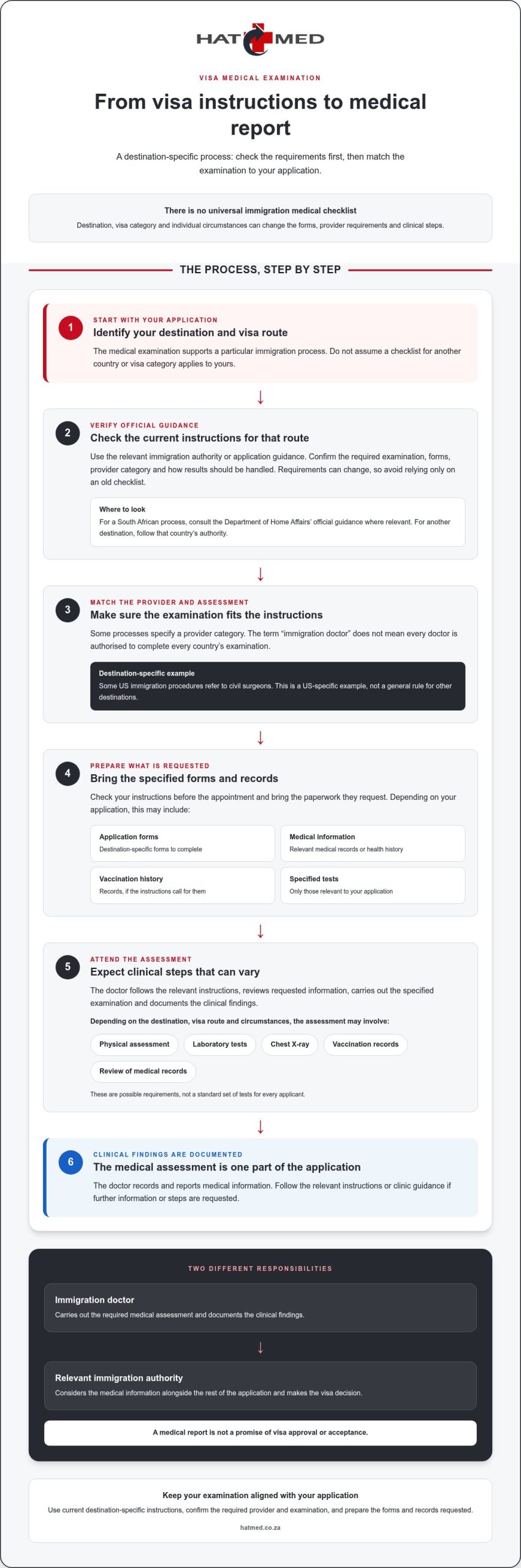
An immigration medical appointment generally follows a practical sequence: review the application instructions, attend the clinical assessment, complete any tests required for your route, then follow guidance on reports and next steps. It isn’t one fixed package. The destination, visa category and individual circumstances shape which clinical components apply, so another applicant’s experience may not match yours.
Before the appointment
Use the current instructions from the relevant immigration authority to prepare. Check which forms and documents are requested, and bring the health information or records specified for your examination. Keep your visa route details and appointment information together so you can refer to them if a question comes up.
Generic checklists may describe another destination’s process. Use your own application instructions to establish what applies to you, and organise the requested paperwork before the appointment.
During and after the assessment
At the appointment, the immigration doctor reviews the relevant instructions and conducts the required medical assessment. Depending on the application, clinical steps may include a physical examination, a review of health information or further tests. Some tests may be arranged as part of the process, while others won’t be needed. The exact sequence and components vary, so no single set of checks applies to every applicant.
If you have questions about a form or requested record, raise them during the appointment. Sharing relevant information clearly helps the clinician complete the assessment and document the findings. Don’t assume every test will happen on the day; follow the guidance for your specific examination.
Afterwards, follow the clinic’s instructions about any further steps and how the report should be handled. The process may involve additional tests, documents or directions from the relevant authority. Don’t assume you’ll receive a particular certificate, that results will be ready by a set time, or that the medical assessment alone determines the visa outcome. The application instructions and clinic guidance explain what to do next.
A calm, organised approach can help you feel prepared: review the instructions, bring the requested information, attend the assessment and keep track of follow-up directions. Hatmed Medical Centre provides immigration medical examinations for applicants in South Africa. Arrange an immigration medical examination with Hatmed.
Arrange an Immigration Medical Examination with Hatmed
Once you’ve identified the medical requirements for your application, arranging the examination is a practical next step. Hatmed Medical Centre provides immigration medical examinations in South Africa. The service gives applicants a professional clinical assessment as part of the wider visa process.
An immigration medical appointment can feel unfamiliar, particularly when you’re managing forms and application instructions at the same time. A patient-centred approach can help make the clinical part feel more straightforward. The examination remains one part of your application: the doctor assesses and records medical information, while the relevant immigration authority makes decisions about the visa.
A supportive clinical setting for an unfamiliar process
Approach the appointment as a medical assessment guided by your application, not as a decision on your future plans. Have your destination and visa route in mind before arranging it. This gives you a clear starting point for referring to the current official instructions and identifying which examination your application calls for.
Hatmed provides immigration medical examinations for this assessment. Take the process one step at a time: establish the relevant requirements, arrange the medical examination and follow the instructions for your application. The appointment completes the clinical assessment required for the medical stage; it doesn’t predict the visa outcome.
Take your next step with confidence
Keep the destination authority’s current guidance close at hand as you arrange the examination. Visa instructions and medical requirements are specific to the application, so avoid relying on a checklist written for another country or route. If you have forms or health information requested for your assessment, organise them for the appointment.
Being prepared doesn’t mean you need to know every clinical detail in advance. It means having a clear idea of your destination and visa route, and using the official instructions as your reference. This preparation can help you approach the appointment with less uncertainty and focus on the next step.
Hatmed Medical Centre offers immigration medical examinations with professional, patient-centred care. To arrange your assessment, contact Hatmed to book an immigration medical examination. Continue following the official instructions for your destination and visa route, including guidance about forms, tests or report handling.
Take the Next Step with a Clear Plan
Your next step can be simple: keep your destination’s current medical instructions beside your application details as you arrange the examination. This gives you a practical reference before the appointment and helps you focus on the medical requirement, rather than trying to predict the visa decision.
An immigration doctor supports the clinical part of the process. Hatmed Medical Centre provides immigration medical examinations, alongside patient-centred general practice and specialised medical assessment services. Treat the appointment as one step in a wider application, with the relevant official guidance shaping what’s required.
When you’re ready, arrange your immigration medical examination with Hatmed. Bring your application route into the process, follow the destination’s instructions and take each stage at a steady pace. With a clear plan and professional medical support, you can move forward with greater confidence.
Frequently Asked Questions
Is an immigration doctor the same as a visa officer?
No. An immigration doctor carries out the medical assessment and records findings, while a visa officer or immigration authority considers the full application and makes the immigration decision. The medical report doesn’t guarantee approval. If you receive a request for extra medical information, read it carefully and note which part concerns the examination and which relates to the wider application, so you can follow the right instructions.
Can any doctor complete an immigration medical examination?
Not necessarily. Some application routes require a particular provider type, clinic or procedure, while others may set different conditions. Before booking, check whether the instructions name a provider category or specify how the examination must be arranged. A doctor who can perform a general health consultation may not meet a destination’s stated requirement. A form or provider accepted for one country may not be suitable for another.
How do I find an immigration doctor for my visa application?
Start with the official visa guidance for your destination and category, then identify any required examination, form or provider arrangement. Use those details to arrange a suitable medical assessment, rather than relying on a search result written for a different route. Hatmed Medical Centre provides immigration medical examinations. Keep a copy of your application instructions handy so you can refer to the exact requirements relevant to your case.
What happens if my immigration medical report does not meet the destination’s requirements?
The appropriate next step depends on the authority’s instructions and the reason for its response. Read any notice closely, paying attention to whether it asks for clarification, additional information or another action. Don’t automatically repeat the same examination, as that may not address the issue raised. A medical professional can assess and document health information, but only the relevant authority can explain how it will handle your report within the application.
Do immigration medical examinations include the same tests for everyone?
No. The required clinical steps can vary with the destination, visa route, official instructions and individual circumstances. One application may request a physical examination, while another may call for additional tests or vaccination information. Don’t use a friend’s experience as your checklist, even if you’re applying to the same country. Follow the instructions attached to your application and the clinic’s guidance for your assessment.
Can an immigration doctor guarantee that my visa will be approved?
No. A doctor can complete the requested medical assessment and record relevant findings, but cannot decide whether an immigration application succeeds. The authority assesses the application under its own requirements, and medical information is only one part of that process. Be cautious of anyone promising that a medical examination will secure approval. Provide the information requested and follow the official process carefully.
What should I bring to an immigration medical appointment?
Bring the forms and documents specified in the current instructions for your destination and visa route. If the guidance asks for relevant health information, organise it beforehand so it’s easy to refer to during the assessment. Requirements can differ, so don’t rely on another applicant’s packing list. Use your own application instructions for the final details of what to bring.