

Seeing a private doctor can be about more than getting an appointment. A GP can support your health over time, from assessing a new concern to discussing preventative care and ongoing needs. It’s understandable to wonder how private GP care works, what it may cost and whether medical aid will contribute.
A private GP can help with everyday health concerns as well as preventive care and ongoing needs. Returning to the same doctor can build familiarity with your health history, making it easier to discuss changes and chronic conditions in context. The right next step depends on what you need and how you plan to pay.
This guide explains what a private doctor can help with, how ongoing care can work and what to consider before booking. Consultation fees and medical aid benefits vary by practice and scheme. At Hatmed Medical Centre, GP consultations include support for routine and acute concerns, chronic disease management, mental health and preventative healthcare, including vaccinations. Understanding these options can help you make a considered choice for yourself or your family.
Key Takeaways
- A private doctor provides care through the private healthcare system. A GP is often a first point of contact for everyday health questions.
- Continuity can help your GP understand your health history and changing concerns over time.
- Before booking, consider your care needs and budget, and review how your medical scheme handles consultations and benefits.
- Prepare for a private doctor consultation by noting your symptoms, when they started, what has changed and any questions you want to raise.
- Hatmed Medical Centre provides patient-centred GP consultations, including support for check-ups, acute concerns and preventative care.
What does a private doctor do in everyday healthcare?
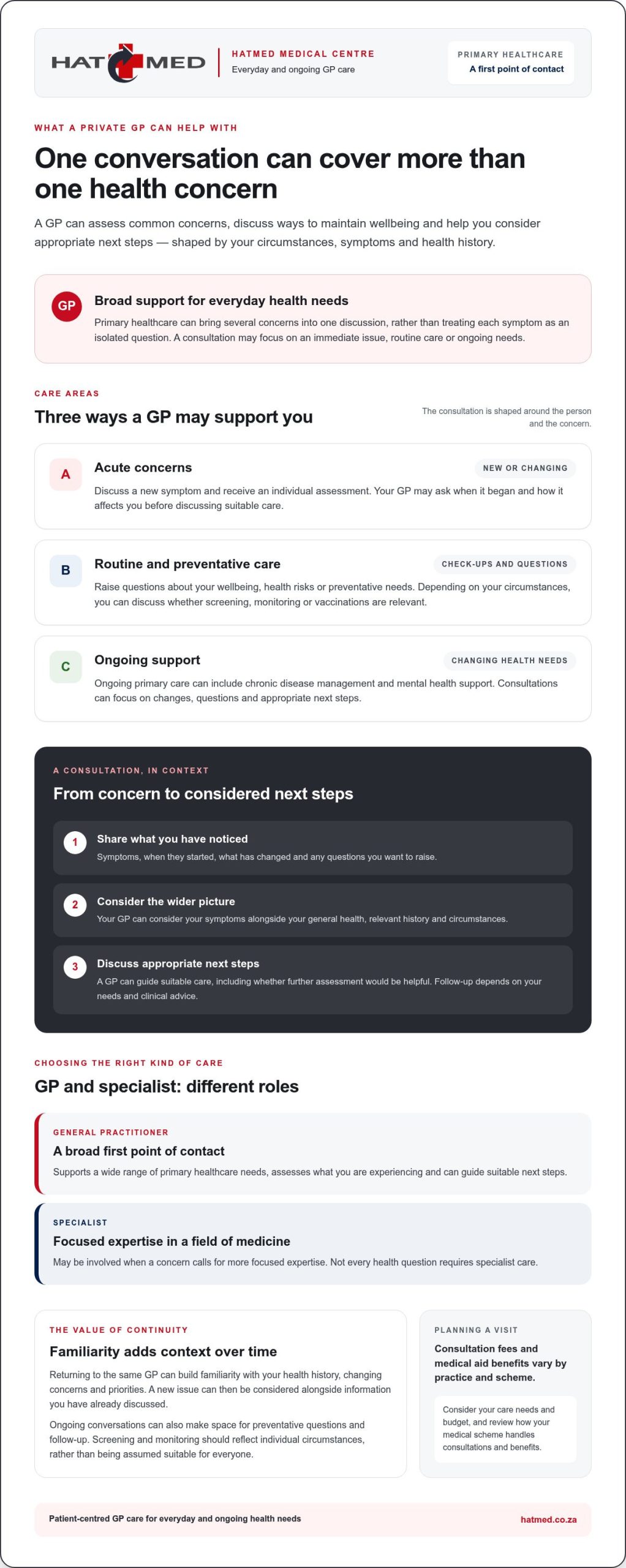
A private doctor is a medical practitioner you consult through private healthcare, either about a particular concern or for general guidance. General practice covers a broad range of primary healthcare needs: a GP can assess common health concerns, discuss ways to maintain wellbeing and help you consider appropriate next steps. The consultation is shaped by your circumstances, symptoms and health history.
Primary healthcare is a first point of contact for everyday health needs, prevention and ongoing care. It can bring several concerns into one conversation rather than treating each symptom as an isolated question. One consultation may focus on an immediate issue. Returning to the same GP can also build familiarity with your health and priorities over time.
This approach is often associated with Family Medicine, which takes a broad view of health and care across different stages of life. For patients, that can mean having a place to discuss a new symptom, a routine check-up or a question about an existing condition.
How is a private doctor different from a specialist?
General practitioners support a wide range of primary healthcare needs. A specialist focuses on a particular field of medicine and may be involved when a concern calls for more focused expertise. Not every health question requires specialist care. A GP can assess what you’re experiencing, consider relevant aspects of your health and guide suitable next steps, including whether further assessment would be helpful.
For example, if a symptom has changed, a GP can ask when it began and how it affects you before discussing an appropriate course of care. The aim is to understand the concern, not to assume in advance which type of care you need.
What kinds of concerns can a private GP help with?
A GP consultation can help with an acute concern, such as a new symptom, as well as routine and preventative care. It can also give you space to raise health questions you’ve been putting off. Hatmed Medical Centre provides patient-centred GP consultations for everyday and ongoing health needs.
- Acute concerns: Discuss a new or changing symptom and receive an individual assessment.
- Routine and preventative care: Raise questions during a check-up and discuss appropriate ways to maintain your health.
- Ongoing support: Chronic disease management, mental health support and routine vaccinations can form part of primary healthcare.
What happens in a consultation depends on the person and the concern. Your GP may ask about your symptoms, general health and relevant history. Being open about what you’ve noticed helps make the conversation useful, whether you’re seeking advice about one issue or discussing broader health needs.
How can an ongoing private doctor relationship support your health?
A continuing relationship with a private doctor can add context to each consultation. As you return to the same GP, conversations can build familiarity with your health history, what has changed and what matters to you. You may not need to explain every detail from the beginning each time, and the GP can consider a new concern alongside information you’ve already discussed.
Continuity of care connects routine consultations with clinically appropriate follow-up, helping a GP consider new concerns in the context of your health history. Follow-up might involve reviewing how a concern has changed, discussing next steps or considering whether an existing plan needs reassessment. The approach depends on your health needs and clinical advice, rather than following the same schedule for everyone.
Routine conversations also give you a chance to raise questions before they become pressing. A change in how you feel, a concern about a long-term condition or uncertainty about a health habit may be easier to discuss when you have an established point of contact. The South African Academy of Family Physicians offers information about family medicine and its role in healthcare in South Africa.
How does continuity help with preventative care?
A routine check-up can create space to discuss health risks, changes in your wellbeing and preventative needs. Depending on your circumstances, you might ask whether screening or monitoring is relevant, or raise questions about vaccinations and other ways to look after your health. Your GP can consider your history and offer clinical guidance. Screening and monitoring should be based on individual circumstances, not assumed to be necessary or suitable for everyone.
How can a GP support changing or long-term health needs?
Health needs can shift over time. Ongoing consultations can support the monitoring and management of chronic conditions, including conversations about changes, questions and appropriate next steps. You can also raise mental health concerns with a GP. Emotional wellbeing is part of your overall health, and it’s reasonable to ask for support when something is affecting daily life.
For a long-term condition, keeping track of what has changed since your last appointment can make follow-up discussions more focused. Note new symptoms, questions about your care or difficulties following an agreed plan. These details help your GP understand your experience and consider what to discuss next. Hatmed Medical Centre provides chronic disease management and mental health support as part of its patient-centred GP care. Read the chronic disease management guide for more on ongoing support.
If you’re looking for a continuing point of contact for everyday or long-term health concerns, explore Hatmed’s patient-centred GP consultations.
Is a private doctor worth considering? Weigh care needs and affordability
Private GP care involves fees, so weigh the cost against the support you need. A private doctor may suit someone who values a continuing point of contact for routine or ongoing health concerns. Private care is not automatically the right choice for everyone, and it should not require you to stretch your household budget beyond what feels manageable.
Start by considering the care you’re seeking. Is this a once-off concern, or would you value a GP who can support check-ups and follow-up conversations? Think about practical access too, such as whether you can attend consultations in a way that fits your routine. Continuity can be helpful, but its value depends on your circumstances and priorities.
How should you think about medical aid and consultation costs?
Consultation fees vary between practices, while medical scheme contributions and benefits differ between plans. Don’t assume that a consultation will be covered in full or that the same benefit applies to every type of visit. Review your scheme’s benefit information, including any applicable limits, rules or co-payments, so you can anticipate possible out-of-pocket expenses.
If you’re paying directly, include consultation costs in your healthcare budget and consider what you can sustain if you need more than one visit. Planning ahead can help you make a considered decision without relying on assumptions about reimbursement. Your scheme’s information is the best guide to the benefits available to you.
When might ongoing private GP care suit your needs?
Ongoing GP care may be worth considering if you want a familiar point of contact for routine questions, changing health concerns or support with a long-term condition. It may also suit people who prefer to discuss several aspects of their health with a GP over time. If you’re weighing up what matters in a GP relationship, this guide to finding a general practitioner offers further considerations.
For a one-off issue, a single consultation may be enough to address the immediate concern. You can decide later whether ongoing care would be useful. A long-term relationship doesn’t mean you need to book regular appointments regardless of need. Follow-up should be guided by your health circumstances and clinical advice.
A GP consultation is not a substitute for urgent care in an acute or severe emergency. If a situation needs immediate attention, seek appropriate urgent medical care rather than waiting for a routine appointment.
To decide, weigh three things: the health support you need, the value you place on continuity and what you can afford. Hatmed Medical Centre provides patient-centred GP consultations for everyday and ongoing health needs. Explore patient-centred GP care if this support fits your priorities.
How do you prepare for a private doctor consultation?
A little preparation can help you explain what’s troubling you and make good use of your time with the GP. You don’t need to arrive with a diagnosis or a perfect account of every detail. Focus on what you’ve noticed, what you’d like help with and any information that may give useful context.
Use this simple sequence to organise your thoughts:
- Identify your main concern. Decide what you most want to discuss, whether it’s a new symptom, a routine check-up or an ongoing health question.
- Gather relevant information. Note when the concern began, what has changed and how it affects your daily life. Bring relevant medication details and medical records if you have them.
- Prepare your questions. Write down anything you want clarified, including questions about possible next steps or follow-up.
A few notes on your phone or on paper can help if you feel nervous or find it difficult to remember details during the appointment. If you’re seeing a private doctor about more than one issue, list each concern and mark the one you most want to address first.
What information is useful to bring?
Relevant context helps your GP understand the concern. Bring the names of current medicines and any allergies you know about. Previous test results or medical records can also be useful if they relate to the reason for your visit. You don’t need to gather every health document you own; focus on information connected to your current concern or ongoing care.
- A short timeline of symptoms, including when they began and any changes you’ve noticed.
- Notes on how the concern affects sleep, work, activity or other parts of daily life.
- Questions you want answered, so they’re easy to refer to during the consultation.
If you have a long-term condition, note changes or questions about its management. Mental health concerns are also valid topics for a GP conversation. You can write down how you’ve been feeling and what has been difficult, in whatever words feel comfortable.
How can you make the consultation easier to navigate?
Start with your main concern and share the most important details first. Your GP can ask questions to build a clearer picture. If a medical term or suggested next step isn’t clear, ask for it to be explained in plain language. Before you leave, briefly summarise what you’ve agreed to do and any follow-up discussed, so you know what to expect next.
If you’re ready to discuss a concern or plan a check-up, explore Hatmed’s GP consultations.
How Hatmed supports private GP care and your next steps
Choosing a private doctor is about finding care that fits your current concern and the support you may need over time. Hatmed Medical Centre is a general practice providing patient-centred GP consultations for everyday and ongoing health needs. Bring a specific concern to a consultation or use it to discuss your health more broadly.
What’s appropriate depends on your circumstances and the reason for your visit. Start by identifying what you want help with, then share the relevant details with your GP. This gives you a focused starting point without needing to know the answer or next step in advance.
What can you discuss with a Hatmed GP?
GP consultations at Hatmed can cover routine check-ups, acute health concerns and preventative care. If you have a new symptom, explain what you’ve noticed and how it affects you. For a check-up, raise your health questions or discuss preventative needs. The consultation is an opportunity to talk through the concern and consider appropriate care for your situation.
Support can extend beyond a single issue. Hatmed provides chronic disease management and mental health support, so ongoing health questions can form part of a GP conversation. Routine vaccinations are also part of the centre’s healthcare services. If you’re managing a long-term condition, concerned about your mental wellbeing or seeking vaccination care, explain this when discussing your reason for a consultation.
These services offer different kinds of support, rather than a one-size-fits-all pathway. A routine check-up may focus on general health questions, while a consultation about an acute concern centres on what has changed. Ongoing discussions about a chronic condition or mental health can focus on the concerns and priorities you bring. Your GP can consider your individual needs during the consultation.
What is a sensible next step for your healthcare?
Start by naming your main concern. Is it a symptom you want assessed, a check-up you’ve been meaning to arrange, a preventative health question or support with an ongoing condition? If you have several things to discuss, choose the one you most want to raise first. A short note about what you’ve noticed and what you hope to understand can help you prepare.
Then consider the kind of support you’re looking for. You might want to address one immediate question, discuss a routine health need or begin a continuing conversation about your wellbeing. You don’t need to arrive with a diagnosis. Sharing what matters to you gives the consultation a practical starting point.
Hatmed Medical Centre offers patient-centred GP consultations across routine, acute and ongoing care needs. Explore Hatmed’s general practice services and choose a next step that feels appropriate for your health. An open conversation is a useful place to begin.
Make your next health step one you can manage
Choosing a private doctor doesn’t mean planning every future appointment today. Start with the health question that matters most now, and think of care as a conversation that can develop as your needs change. A considered first step can make it easier to seek support without feeling you need all the answers first.
At Hatmed Medical Centre, patient-centred GP consultations provide space to discuss your health, including chronic disease management, mental health support and routine vaccinations. Begin by identifying the concern you’d like to raise and considering the care that may suit you.
Explore Hatmed’s GP consultations and healthcare services to consider a suitable next step for yourself or your family. Taking time to ask for support is a positive start, and you can move forward at a pace that feels right for you.
Frequently Asked Questions
Can I see a private doctor without medical aid?
Yes, you can see a private doctor without medical aid by paying the consultation fee yourself. Factor the cost into your budget and ask about the fee before booking so you know what to expect. If you have medical aid, check your plan’s rules for GP consultations, including any limits or co-payments. Cover varies, so don’t assume a visit will be reimbursed in full.
Can a private doctor prescribe medication?
Yes, a GP may prescribe medication when it’s clinically appropriate following an assessment. A prescription isn’t automatic: the doctor will consider your symptoms, medical history, current medicines and any relevant risks before deciding what care is suitable. Tell the GP about medicines you already take, including non-prescription products, and mention any known allergies. If you’re unsure how to use a prescribed medicine, ask for clear instructions.
Can a private doctor refer me to a specialist?
Yes, a GP can recommend a specialist referral if your assessment suggests more focused expertise may be helpful. A referral can include relevant information about your concern and the care considered so far. It doesn’t mean every symptom needs specialist attention; many concerns can first be discussed with a GP. If a referral is suggested, ask what it is for and what information you should take with you.
Can I change private doctors if my needs change?
Yes, you can change GPs if your circumstances or preferences change. You may want a different approach to ongoing care or a practice that better fits your practical needs. To help maintain continuity, keep a record of current medicines, diagnoses and important test results, and arrange for relevant records to be transferred where appropriate. You can also bring a concise summary of your health history to your first consultation.
Is what I tell a private doctor confidential?
Information you share with a GP is treated as confidential and should be handled with care. There can be limited circumstances where relevant information needs to be shared, such as with your consent or where disclosure is required for legal or serious safety reasons. If you’re worried about privacy, ask how your information is handled before discussing a sensitive matter. You can also tell the GP what feels difficult to share.
When should I seek emergency care instead of seeing a private doctor?
Seek urgent emergency care for a potentially life-threatening problem rather than waiting for a routine GP consultation. Examples include severe difficulty breathing, heavy bleeding, loss of consciousness or sudden symptoms that may suggest a stroke. If you’re uncertain but someone appears seriously unwell, prioritise immediate medical help. A GP consultation is intended for assessment and ongoing primary care, not as a substitute for emergency response.
Can a private doctor help me discuss mental health concerns?
Yes, you can raise mental health concerns with a GP, including persistent low mood, anxiety or difficulties affecting daily life. You don’t need to have a diagnosis or know exactly what support to request. Explain what you’ve been experiencing and how long it has been affecting you. Hatmed Medical Centre provides mental health support as part of its care, and a GP can discuss appropriate next steps with you.