Finding the right diabetes care clinic starts with knowing what you want from ongoing support: a place to discuss concerns, review changes over time and ask questions about your health. A continuing relationship with a GP can provide space for these conversations as your needs change, rather than leaving every new concern until a single appointment.
Ongoing care can include discussing your health history, current priorities and the support that may suit your circumstances. This article explains what to consider when choosing a care setting and how to prepare for an appointment. Hatmed Medical Centre offers GP consultations and chronic disease management, including personalised treatment plans and ongoing monitoring. Its team of six general practitioners and 30+ years of service provide a setting where you can discuss your longer-term health needs with a GP.
Key Takeaways
- A diabetes care clinic should give you opportunities to discuss diabetes-related health needs over time, not just at a single visit.
- A GP can help you discuss changing concerns as part of your general and chronic-condition care.
- Before an appointment, note your concerns, gather relevant health records and medication information, and prepare questions.
- Hatmed Medical Centre offers GP consultations and chronic disease management, including personalised treatment plans and ongoing monitoring.
What should you expect from a diabetes care clinic?
A diabetes care clinic is a healthcare setting where you can discuss health needs related to diabetes with a healthcare professional. Depending on your circumstances, an appointment may include talking through your concerns, reviewing relevant health information and considering what care or monitoring may be appropriate.
Ongoing support gives you opportunities to revisit concerns as your health or circumstances change. It is not a fixed checklist that applies to everyone. Your health history, current priorities and questions can guide discussions with your healthcare professional. For a broader overview of topics that may form part of comprehensive diabetes management, see the Wikipedia summary of diabetes management.
What does ongoing diabetes care mean?
Ongoing diabetes care involves conversations and monitoring over time, rather than expecting one appointment to answer every question. You can discuss what has changed since your previous visit, what you find difficult to manage and what you would like help understanding. As your needs shift, you can raise new concerns and review what remains relevant to you.
There is no single schedule or set of discussions that suits everyone. Your personal circumstances and health needs shape what you and your healthcare professional focus on. To make the conversation useful, explain what matters most to you and ask how your concerns fit into your care.
Does everyone need a specialist diabetes clinic?
No single care setting is right for everyone. A GP can be part of ongoing chronic-condition care, giving you a place to discuss your general health and diabetes-related concerns over time. General practice does not replace specialist care when that is appropriate, but it can support conversations about your needs as part of your wider medical care.
If you are unsure whether additional professional input may be suitable, raise the question with your GP. They can discuss your circumstances and help you consider the next steps. Be clear about what you are concerned about and what you would like to understand, so the discussion can focus on your needs.
How can a GP fit into your diabetes care team?
A GP can support your general medical care and chronic-condition management, providing a place to discuss diabetes-related concerns alongside other aspects of your health. A diabetes care clinic may include primary care or specialist services, which have different roles. A GP provides general medical care, while specialist services focus on particular areas of health. The professionals involved depend on your needs and circumstances.
Continuity can make it easier to talk through changes over time. If your concerns, priorities or wider health circumstances shift, you can raise them during ongoing care instead of treating each visit as an isolated conversation. The National Institute of Diabetes and Digestive and Kidney Diseases offers guidance on managing diabetes and routine checkups, including working with healthcare professionals as part of care.
When might your care involve more than one professional?
Some people have health needs that involve more than one area of care, so discussions may include input from different healthcare disciplines. This does not mean everyone needs the same team or care arrangement. If you are unsure whether another professional’s perspective may be useful, raise the question with your GP, who can consider it in the context of your health.
What makes ongoing support feel personalised?
Useful discussions start with your experience. Share relevant health history, current concerns and goals, including what you find difficult and what you would like to understand better. This gives the conversation a clear focus and helps you take an active role in considering your care.
At Hatmed Medical Centre, chronic disease management includes personalised treatment plans and ongoing monitoring. These are part of the practice’s general chronic-condition care. You can discuss your diabetes-related concerns and individual needs with a GP. If you would like to talk through your ongoing health needs, schedule a consultation with Hatmed Medical Centre.
How do you prepare for a diabetes care appointment?
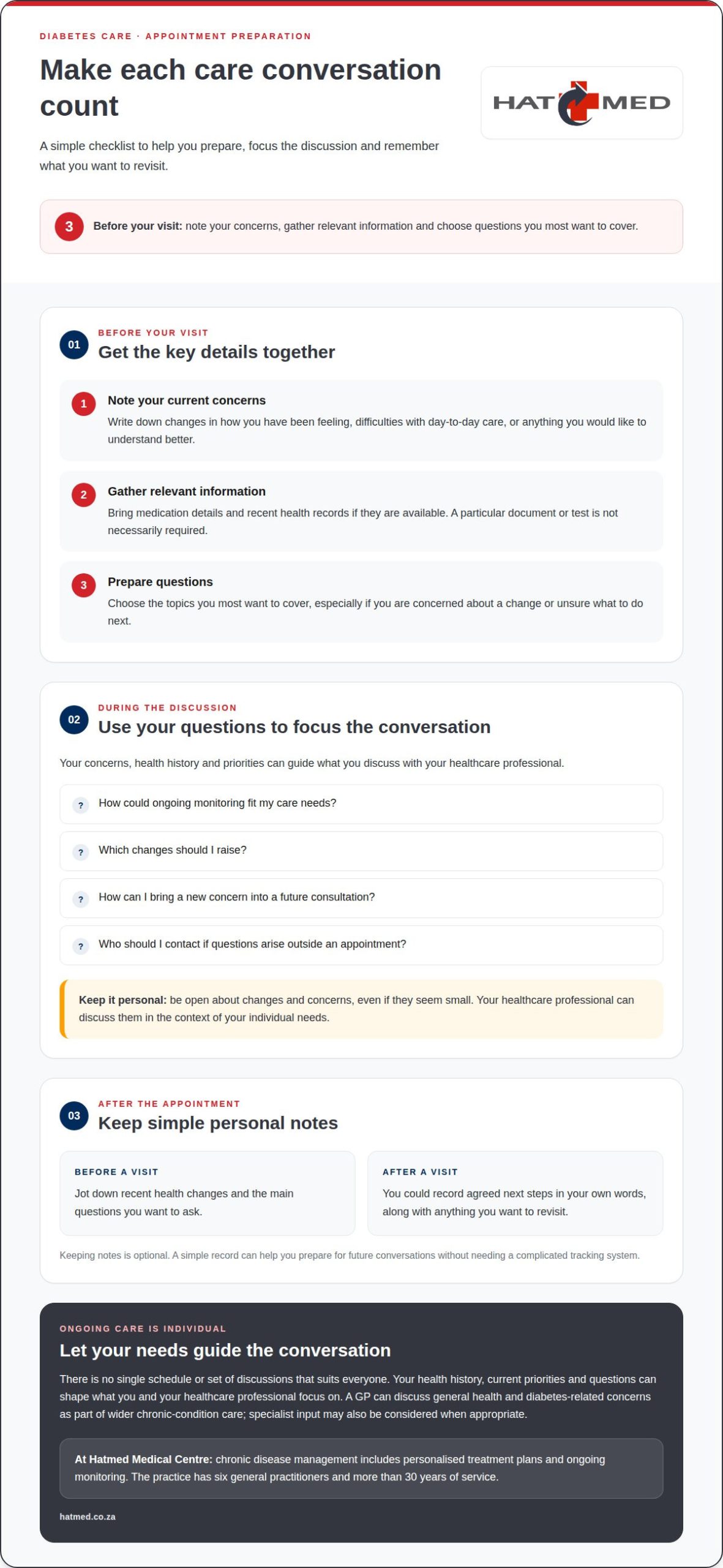
A little preparation can help you use your appointment time to discuss what matters most. Before visiting a diabetes care clinic or speaking with a GP, follow these steps:
- Note your current concerns. Write down changes in how you have been feeling, difficulties with day-to-day care or anything you would like to understand better.
- Gather relevant information. Bring medication details and recent health records if they are available. These can help you explain your health history, but a particular document or test is not necessarily required.
- Prepare questions. Choose the topics you most want to cover, especially if you are concerned about a change or unsure what to do next.
Be open about changes and concerns, even if they seem small. Your healthcare professional can discuss them in the context of your individual needs.
Which questions could you take to your appointment?
Questions can turn general concerns into a more focused discussion. You might ask how ongoing monitoring could fit your care needs, which changes to raise, or how to bring a new concern into a future consultation. You can also ask who to contact if questions arise outside an appointment. The answers depend on your circumstances and care arrangements, so use the conversation to clarify what applies to you.
How can you keep track of your care discussions?
Keeping personal notes is optional, but it can help you remember what you wanted to ask and what was discussed. Before a visit, jot down recent health changes and your main questions. Afterwards, you could record any agreed next steps in your own words, along with anything you want to revisit. This simple habit can help you prepare for future conversations without needing a complicated tracking system.
If you are ready to discuss ongoing chronic-condition care with a GP, schedule a consultation with Hatmed Medical Centre.
How can Hatmed support ongoing chronic-condition care?
Hatmed Medical Centre offers GP consultations and chronic disease management. You can discuss diabetes-related health needs with a GP as part of your general medical care. The practice’s chronic disease management includes personalised treatment plans and ongoing monitoring, supporting continued conversations as your health needs evolve. Care is discussed in light of your circumstances rather than assuming the same approach suits everyone.
What can patients expect from Hatmed’s general practice?
Hatmed offers General Medical Services, including chronic-condition management, with a patient-centred focus on personalised support. The practice has a team of six general practitioners and 30+ years of service. During a consultation, you can explain what is concerning you and discuss your ongoing health needs with a GP. This gives you the opportunity to talk through your circumstances instead of assuming one approach fits everyone.
A diabetes care clinic may suggest a specialist setting, but you can also discuss ongoing support in general practice. Hatmed’s chronic disease management includes ongoing monitoring, giving you an opportunity to revisit your needs with a GP over time. Raise your questions about what support may suit your situation.
How can you take the next step?
You do not need to have every question organised before arranging a consultation. Think about what you would like to discuss and bring relevant information if it is available. Use the website’s “Click Here to Schedule a Consultation” link to arrange a consultation with Hatmed. You can talk through your health concerns and discuss ongoing chronic-condition support.
Schedule a consultation with Hatmed Medical Centre to discuss your ongoing care.
Make your next care conversation count
Choosing a diabetes care clinic or general practice is a starting point for ongoing conversations about your health. Be open about what matters to you, including concerns that arise between visits. You do not need to arrive with every answer or a fully formed plan. Start with the question that feels most pressing and discuss a practical next step for your care.
Your health needs and circumstances can change, so it is reasonable to revisit them during future conversations. If something changes, bring it up with your GP rather than assuming you have to manage it alone. An open dialogue can help you take part in discussions about your care and explain what support you are looking for.
When you are ready to begin that conversation, schedule a consultation with Hatmed Medical Centre. It is a practical first step towards discussing support that reflects your needs.
Frequently Asked Questions
What should I look for in a diabetes care clinic?
Look for a setting where you can raise changing concerns and discuss support in the context of your circumstances. A useful conversation makes room for your priorities rather than assuming one plan suits everyone. You could ask how to bring new concerns into future discussions and how to revisit what matters to you as your health needs change.
Can a general practitioner support someone living with diabetes?
Yes. A GP can contribute to general medical care and chronic-condition management. You can discuss how diabetes-related concerns fit alongside other health matters and share what has changed since your last consultation. A GP’s role differs from specialist care. If you are unsure whether additional professional input may be suitable, raise this with your GP so your circumstances can be considered.
How should I prepare for a diabetes care appointment?
Bring relevant medication information and recent health records if available, keeping them together so they are easy to refer to. Before the appointment, decide which concern you most want to discuss and write down questions you might otherwise forget. If you do not have records to hand, explain what you know and ask what information may be helpful.
Do people with diabetes always need to see a specialist?
No. The right mix of care depends on a person’s circumstances and health needs; not everyone requires the same arrangement. A GP can be part of general medical and chronic-condition care, and you can discuss whether additional professional input may be suitable. If your health or concerns change, mention this and ask what support may fit your situation.