

A medical fitness decision can have a direct effect on your work at sea. A maritime fitness certificate appeal to the Director-General is a route for challenging that decision, with eligibility and the review process shaped by the applicable South African requirements.
It is understandable to want clear answers about who may appeal, what happens at a hearing and what outcomes are possible. Restricted-service fitness also needs careful attention: a restriction may affect the duties you can undertake, so it is important to understand how that decision is considered.
This guide explains who can appeal a medical fitness decision and how the hearing and outcome process works. It also covers how fitness for restricted service may be reviewed, helping you understand the issues and possible next steps.
Key Takeaways
- Understand which medical fitness decisions may be challenged and what to clarify about your eligibility before pursuing an appeal.
- Learn how suspension and cancellation differ, and why the type of decision matters to the review process.
- Find out what to expect from an appeal hearing and how its outcome may affect your fitness for sea service.
- See how restricted-service fitness can be considered, and when a General Practitioner consultation may help you discuss your health concerns.
Appeals concerning suspension or cancellation of a medical certificate
A suspension temporarily limits a certificate’s effect, while cancellation withdraws it. That distinction shapes the issue being appealed. South African requirements must be kept separate from UK and Irish rules.
A maritime fitness certificate records the result of a seafarer’s medical fitness examination. In South Africa, the appeal question in this article concerns the Director-General, Department of Transport; the available facts do not identify the South African enactment governing that appeal. UK and Irish rules cannot establish South African law.
For a medical fitness examination, first identify the decision being challenged and the reasons given for it. The examination assesses health in relation to duties at sea, while national medical examination standards determine how fitness is evaluated. The examination and any appeal are separate steps.
Medical certificates are issued following maritime medical examinations, but the facts available here do not identify the South African issuing authority. Do not treat the Director-General, who is named as the appeal recipient, as the certificate issuer. The distinction matters when identifying the decision-maker and the appeal recipient.
Appeal submission and evidence
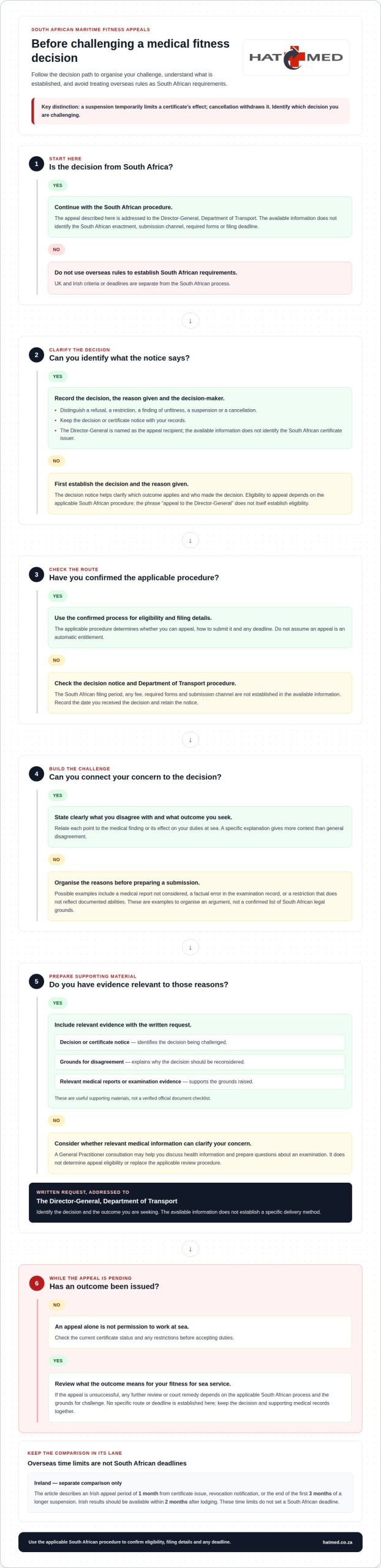
An appeal submission is a written request asking the Director-General to reconsider a medical fitness decision. Address it to the Director-General, Department of Transport, and identify the decision and the outcome you are seeking.
Attach the decision or certificate notice, explain the grounds for disagreement, and include relevant medical reports or examination evidence that supports those grounds. These are useful supporting materials, not a verified official document checklist. The South African submission channel and required forms are not established here, so no specific delivery method can be given.
Ireland offers a separate comparison, not a South African deadline: an appeal must be made within 1 month of certificate issue, revocation notification, or the end of the first 3 months of a longer suspension. Irish appeal results should be available within 2 months after lodging.
Working at sea and further remedies
While an appeal is pending, the decision has been submitted but no outcome has been issued. Do not treat the appeal alone as permission to work; check the current certificate status and applicable restrictions before accepting duties.
Check the current certificate status and any restrictions before accepting duties. If the appeal is unsuccessful, further review or court remedies depend on the applicable South African process and the grounds for challenge; no specific route or deadline can be established from the facts here. Keep the decision and supporting medical records together for any subsequent review.
Eligibility to appeal an Approved Doctor’s decision
Eligibility means having a recognised route to challenge a medical fitness decision. A maritime fitness certificate appeal to the Director-General depends on the applicable South African procedure.
Appeal eligibility
An appeal requests an authorised review of a decision; it is not an automatic entitlement. Whether a seafarer can make a maritime fitness certificate appeal to the Director-General depends on the applicable South African procedure and the decision being challenged.
Do not assume that overseas rules establish South African eligibility. In the UK, a seafarer, including a first-time ENG1 applicant, may seek a review if found permanently unfit, temporarily unfit for more than three months, or fit only for restricted service. Those are UK criteria, not South African rules.
Identify the decision-maker, the certificate decision and the authority named for any review. A refusal, a restriction and a finding of unfitness are distinct outcomes. The decision notice helps establish which applies and the reason given by the doctor. The phrase “maritime fitness certificate appeal to the Director-General” describes the challenge, but does not itself establish eligibility.
Grounds for appeal
Grounds for appeal are the specific reasons for challenging the decision. Explain why the medical finding or its effect on sea duties should be reviewed.
For example, you might point to a medical report that was not considered, a factual error in the examination record, or a restriction that does not reflect documented abilities. These examples can help organise your argument, but are not a confirmed list of South African legal grounds.
Relate each concern to the decision itself. If the certificate limits particular duties, identify the restriction you dispute and connect your concern to relevant medical evidence. A clear explanation of the disputed finding gives more context than general disagreement.
A General Practitioner consultation can help you discuss relevant health information and prepare questions about an examination. Medical context may clarify the evidence, but it does not determine appeal eligibility or replace the applicable review procedure.
Appeal hearing and results timeframe
The filing date, any fee and the decision period depend on the applicable appeal procedure. Keep South African requirements separate from Irish appeal rules.
Appeal lodging deadline
An appeal lodging deadline is the final date for submitting a challenge under the relevant process. For a South African maritime fitness decision, consult the Department of Transport procedure and decision notice to identify the applicable filing period.
Do not substitute an overseas deadline. In Ireland, an appeal must be lodged within 1 month of the certificate’s issue, notification of revocation, or the end of the first 3 months of a suspension lasting longer than 3 months. Those Irish time limits do not set a South African deadline.
Record the date you received the decision and keep a copy of the notice with your appeal. This creates a clear timeline showing when the decision was made and the challenge submitted. A hearing is when the appeal and supporting material are considered; its format depends on the applicable process.
Appeal fee and decision timeframe
A decision timeframe is the period between lodging an appeal and receiving its result. The South African appeal process determines whether a fee applies and how long a decision may take.
Ireland provides a separate comparison: an appeal should be heard and its result obtained as soon as practicable, and within 2 months after it is lodged. That timeframe is not a South African service standard. Do not use it to predict when the Director-General will decide a South African appeal.
To prepare for a hearing, organise the decision notice, grounds of appeal and relevant medical evidence. Link each document to the point it supports, such as a disputed restriction or examination finding. After the hearing, read the written outcome carefully. It should indicate whether the original decision stands or changes, and explain any conditions affecting the certificate. Keep the result with your appeal records for any next procedural step.
For seafarers in Ireland, the colour vision test result is valid for a maximum of 6 years; keep the result with the appeal documents when relevant.
Review of restricted-service fitness
Restricted-service fitness means being considered fit for sea service subject to limits. The key question is whether those limits match the seafarer’s health and the duties being assessed.
For a South African review, focus on the restriction recorded in the medical decision and the evidence relevant to it. Separate the disputed limit from any health finding you accept. For example, clarify whether you dispute the scope of permitted duties or the medical reason for limiting them. This keeps the review focused on the decision rather than a general request for unrestricted fitness.
The International Labour Organization’s medical fitness guidelines aim to support fair decisions about a seafarer’s ability to perform routine and emergency duties safely and effectively. They also take individual health-related capabilities into account. This offers a useful framework for understanding why a review should connect medical evidence with actual work demands.
In the UK, Category 2 means fit for sea service with restrictions. That category is a UK classification, not a South African rule. It illustrates the distinction between being unfit for all service and being assessed as fit within defined limits. Do not assume that the same category or appeal route applies in South Africa.
To explain a disputed restriction, organise the relevant information around the stated limit, the health evidence related to it and the duties affected. A medical report may clarify a diagnosis or describe functional abilities. The review can then assess whether that evidence addresses the specific restriction, rather than simply repeating the original examination result.
Make the outcome you seek precise. If you want different restrictions, identify the limits you challenge and explain why the evidence supports a change. If you seek unrestricted fitness, show how the medical information relates to the full range of duties being considered. Connecting evidence, capability and duties makes the restricted-service issue easier to assess.
Under the UK medical fitness categories, Category 3 means temporarily unfit for sea service, and the Approved Doctor must specify how long the unfitness lasts. Under the UK 2010 Regulations, a seafarer may seek a review if their medical fitness certificate is suspended for more than three months or cancelled.
Hatmed Medical Centre: General Practitioner Consultations
Hatmed Medical Centre offers General Practitioner Consultations to discuss health concerns that may relate to fitness for sea duties. A consultation can help you understand your health information and prepare questions about how a condition affects your daily functioning.
Bring relevant medical reports and a clear account of the concern you want to discuss, such as a condition connected to a certificate restriction. A General Practitioner can provide clinical context, but does not decide the outcome of an appeal to the Director-General. Keep the medical discussion separate from the formal appeal process and its submission requirements.
To discuss a health concern in relation to your fitness for work, contact Hatmed Medical Centre.
Take a considered next step
When considering a maritime fitness certificate appeal to the Director-General, keep your health questions distinct from the formal appeal. Clear medical context can help you understand the concerns behind a fitness decision and prepare for a discussion about your wellbeing and work at sea.
Hatmed Medical Centre offers General Practitioner Consultations, Seafarers / SAMSA Medical Examinations and Immigration Medical Examinations. These services address different needs, from discussing a health concern to attending a seafarer medical examination. A consultation does not replace the appeal process, but offers an opportunity to discuss relevant health information with a medical practitioner.
If you would like to discuss your health concerns or a seafarer medical examination, contact Hatmed Medical Centre. A clear, thoughtful next step can help you move forward with greater confidence.