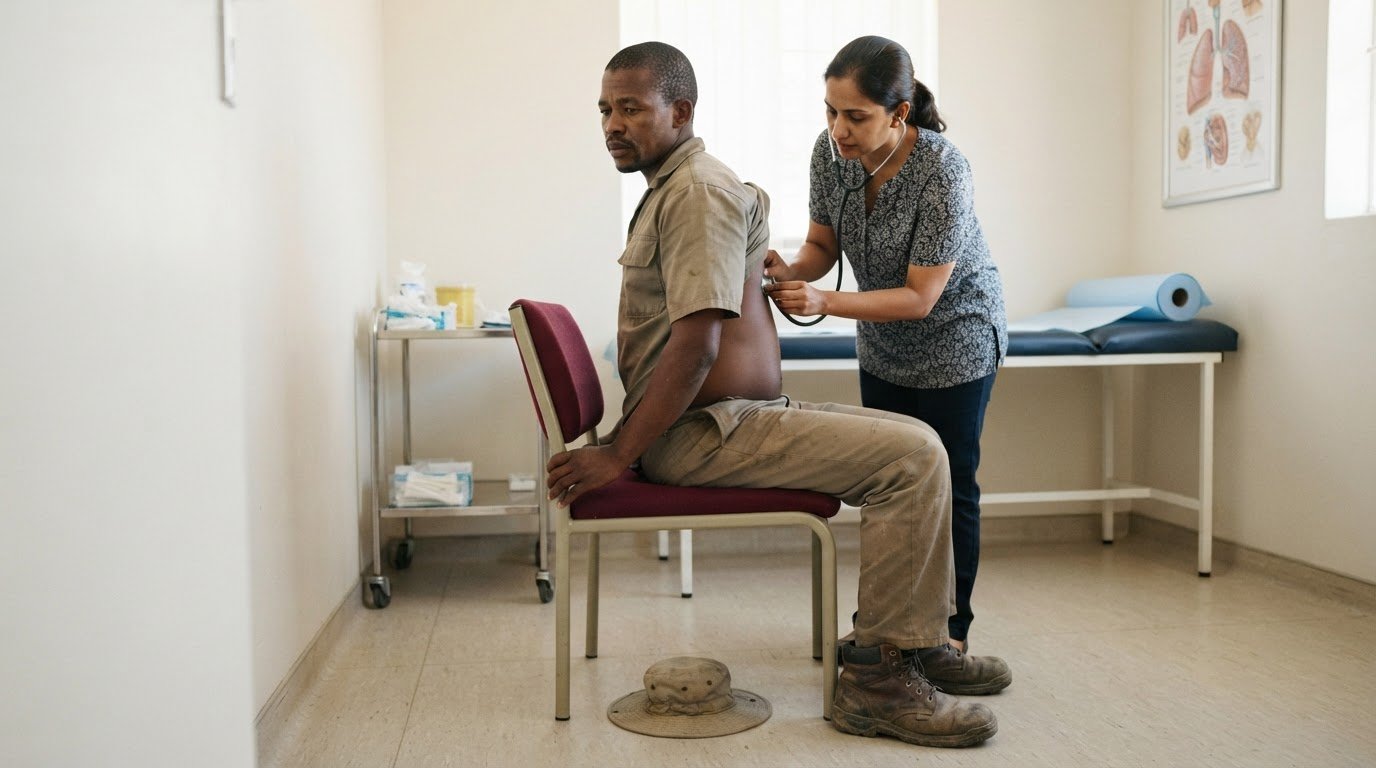

Your medical history is central to an offshore fitness assessment. For an offshore energy technician, medical fitness certification involves disclosing medications, diagnosed conditions and recent procedures so the examiner can assess your ability to work offshore. For most workers, a certificate is typically valid for two years, although renewal timing can vary.
It’s understandable to wonder whether a condition or medication could affect your certificate, or whether a weight limit applies. Honest, complete information helps the medical professional make an informed assessment. It does not mean you should assume the outcome before your examination.
This guide explains what the assessment covers, how weight rules relate to the applicable standard, and how long certification lasts before renewal is due. You’ll also learn what to expect from the examination and why the required certificate can depend on your offshore role and the rules that apply.
Key Takeaways
- Learn how an offshore medical relates to the demands of offshore work, and why the certificate needed can depend on the role and applicable standard.
- Understand how the OEUK weight rule applies from 1 November 2026, including its 124 kg limit for body weight in standard work clothing.
- See what can affect renewal timing, including the relevant medical standard, age and job requirements.
- Find out why certification must come from a physician approved to assess fitness under the applicable standard.
What is an offshore medical?
An offshore medical is a fitness assessment for work on offshore installations or vessels. It considers whether your health supports the requirements of your role and the relevant certification standard.
Offshore access fitness requirements
Offshore access fitness requirements are the medical conditions workers must meet to hold a valid certificate for offshore work. Employers and operators are responsible for ensuring workers have current certificates before boarding, so the applicable standard matters to your mobilisation plans. Offshore wind roles require a formal offshore medical, while onshore roles typically require a general fitness assessment. The certificate you need depends on your role and the applicable standard.
Occupations requiring medical fitness
Medical fitness applies to offshore workers, including contractors and subcontractors spending time on installations or vessels. Examples include wind turbine workers and 135/136/141 welders with offshore certification. For turbine work, distant vision should be at least 6/9 in the best eye, with corrective lenses if needed. Workers should have a medical fitness assessment before a physical capacity evaluation. The assessment helps establish whether the worker can meet the role’s physical demands.
Booking and obtaining certification
In South Africa, book an offshore medical with a physician approved under the applicable standard. Tell the provider which role and certificate you need, as offshore standards and seafarer certificates are not interchangeable. During the assessment, disclose medications, diagnosed conditions and recent procedures. The physician evaluates your health against the relevant requirements and issues certification when the assessment supports it. If an assessment identifies a concern, the certificate may not be issued. To challenge an adverse result, request the clinical reasons and provide relevant evidence for review under the applicable standard.
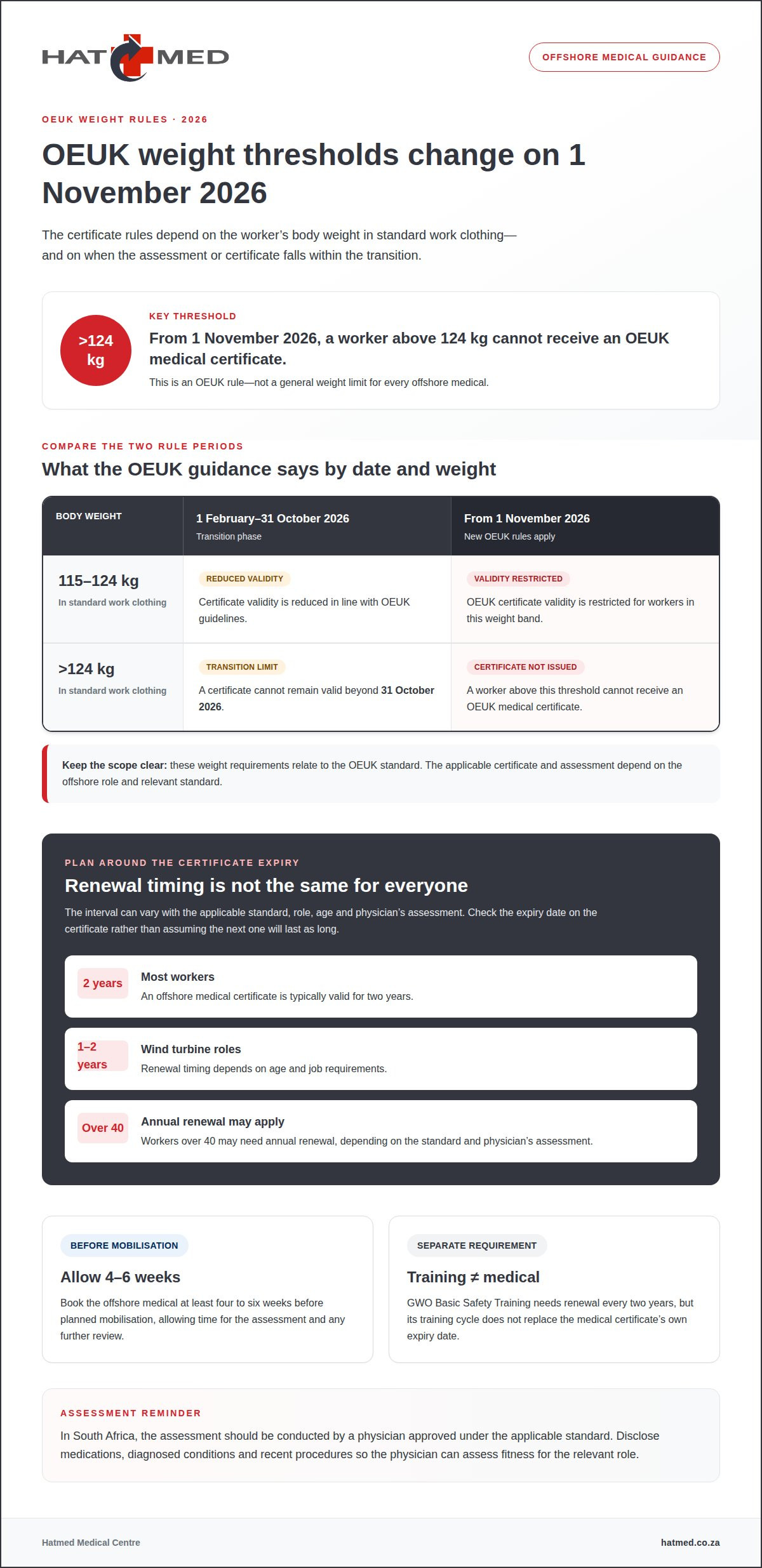
Weight requirements also depend on the certificate standard. From 1 November 2026, workers whose body weight in standard work clothing exceeds 124 kg cannot receive an OEUK medical certificate. This is an OEUK rule, not a general weight limit for every offshore medical. Confirming the required standard before booking helps ensure the assessment matches the work ahead.
Certificate validity and renewals
An offshore medical certificate is typically valid for two years for most workers. The applicable standard, your role and the physician’s assessment can affect the renewal interval. Wind turbine medical certificates typically need renewal every one to two years, depending on age and role. Use the expiry date on your certificate to plan ahead, rather than assuming every offshore position follows the same cycle.
Workers over 40 may need annual renewal, depending on the applicable standard and physician’s assessment. A previous two-year certificate therefore doesn’t establish the validity period of your next one. For turbine roles, age and job requirements also influence whether the interval is shorter or longer within the stated one-to-two-year range. Allow time for a new assessment before your existing certificate expires, particularly if mobilisation is approaching.
OEUK weight rules also affect certificate validity during their transition. From 1 February 2026 to 31 October 2026, workers weighing 115-124 kg have reduced certificate validity in line with OEUK guidelines. During the same transition phase, a certificate for a worker weighing over 124 kg cannot remain valid beyond 31 October 2026. From 1 November 2026, OEUK certificate validity is restricted for workers weighing 115-124 kg. These dates matter when a certificate’s expiry and planned offshore work fall on different sides of a rule change.
Medical certification is distinct from safety training. GWO Basic Safety Training needs renewal every two years, but that training cycle does not replace the medical certificate’s own expiry date. Workers are advised to book an offshore medical at least four to six weeks before planned mobilisation. This allows time for the assessment and any further review required under the relevant standard. When planning renewal, check both your certificate’s expiry and your role’s requirements to ensure they remain current for the intended offshore assignment.
Purpose of offshore medical fitness examinations
An offshore medical examination connects a worker’s health assessment with the demands of a specific offshore role. Its purpose is to support a reasoned fitness decision, rather than simply record general health. A wind turbine technician and a 135/136/141 welder may face different job requirements, so the assessment needs to relate to the work and relevant certification standard. The practical takeaway is that a certificate is meaningful only in the context of the role it covers.
For wind turbine work, the Energy Institute’s first-edition guidance, Medical fitness assessment for wind turbine workers, provides a framework focused on fitness for that work. Its ISBN is 9781787254664. A role-specific examination helps distinguish offshore fitness from a general fitness assessment used for onshore work. This matters when an employer is arranging access: an assessment for one type of work should not be treated as automatically suitable for another.
The examination also supports a clear decision about certification under the relevant standard. For example, medical examiners conducting assessments under OEUK Medical Guidelines Issue 8 are responsible for ensuring that examinations and certificates comply with applicable requirements. This links the clinical assessment to the certificate’s purpose: showing whether the worker meets the criteria for the applicable offshore work. The standard therefore shapes what the examiner assesses and what the resulting certificate can demonstrate.
For workers, a structured assessment before offshore duties begin can help identify health-related barriers before mobilisation. In wind turbine work, medical fitness assessments should precede physical capacity evaluations. This lets the medical assessment inform the next stage, rather than treating physical performance as a substitute for medical fitness. Offshore energy technician medical fitness certification is a role-linked decision: it considers the worker, the intended duties and the standard governing the certificate.
Who is authorised to conduct offshore medical fitness examinations in South Africa?
An offshore medical certificate must be issued by a physician approved to conduct fitness examinations under the applicable standard. The physician’s approval must match the certificate required for your intended work. A general medical appointment alone does not establish that the physician can issue a particular offshore certificate. The key distinction is whether the physician is approved under the relevant standard.
When arranging an examination, give the provider the certificate requirement stated for your role. This helps identify the standard the assessment needs to follow. Offshore oil, gas and wind assignments may have different requirements, so your job title alone may not identify the right certificate. The certificate requirement provided by your employer gives the medical provider a clearer basis for arranging the appropriate assessment.
Certificate types also matter. An offshore medical and a seafarer medical, such as ENG1, serve different purposes and are not interchangeable. A physician’s approval for one type should not be taken as approval to issue another. For instance, a worker assigned to an offshore installation needs the certificate required for that assignment, rather than assuming a maritime certificate will meet the same requirement.
During the assessment, the physician evaluates your fitness under the applicable standard and is responsible for ensuring the examination and certificate comply with its requirements. If you have a diagnosed condition or take medication, give the physician accurate information so it can be considered in the assessment. For general employment-related health checks, a pre-employment medical examination addresses a separate purpose from certification under an offshore standard.
Choose the right type of appointment by starting with the certificate requirement for your work. The relevant standard determines which physician approval applies and what the examination is intended to establish. This distinction helps prevent confusion between a general employment assessment, a seafarer medical and offshore certification.
Hatmed Medical Centre
Hatmed Medical Centre supports your wider health needs with General Practitioner Consultations and Chronic Disease Management. These services can help you discuss a diagnosed condition or ongoing treatment as you prepare for offshore work. Hatmed also offers Seafarers / SAMSA Medical Examinations, which have a different purpose from offshore certification under a specific standard.
If you need offshore energy technician medical fitness certification, the key step is an examination with a physician approved under the standard required for your role. A general consultation can support your healthcare, but the certificate must match the applicable offshore requirements. This distinction helps you choose the right medical pathway without confusing separate types of assessment.
For questions about your health needs or Hatmed’s medical services, contact Hatmed Medical Centre.
Take your next step with confidence
Plan your medical pathway around the certificate required for your role. Offshore energy technician medical fitness certification depends on an assessment under the applicable standard, so state that requirement when arranging your next medical appointment. Keeping your health information and employment requirements in view can help you approach the process in an organised way.
Hatmed Medical Centre offers General Practitioner Consultations, Immigration Medical Examinations and Seafarers / SAMSA Medical Examinations. These services address different healthcare and assessment needs, so the right appointment depends on your purpose. If you need guidance about your health or a related medical examination, contact the team to discuss an appropriate next step.
Contact Hatmed Medical Centre today to discuss your medical care. A clear starting point can make the next stage feel more manageable, and you can move forward with greater confidence.
Frequently Asked Questions
Do I need to disclose all medications and medical conditions during the examination?
Yes. Disclose your medications, diagnosed conditions and recent procedures during the examination. This gives the physician relevant health information to assess your fitness against the applicable offshore standard. Don’t assume a condition or treatment is irrelevant. For example, mention a recent procedure even if you feel ready to return to work, so the physician can consider it alongside your intended offshore duties.
What is the difference between OGUK and NOGEPA medicals?
OGUK is the offshore medical standard used in the UK North Sea, while NOGEPA applies in the Dutch sector of the North Sea. Each relates to a different sector and standard. Your certificate needs to match the requirements for your intended work. These names describe standards used in different North Sea sectors, not interchangeable labels for one universal offshore medical.
What medical fitness certificate is required for offshore energy technicians in South Africa?
The required certificate depends on the offshore role and the standard that applies to it. For offshore wind roles, examples include an OGUK certificate or an equivalent certificate. Ask your employer or operator which certificate applies to your assignment before arranging an examination. A seafarer medical, such as ENG1, is a separate certificate type and is not interchangeable with an offshore medical.
Which South African medical standards apply to offshore oil, gas, and wind workers?
The applicable standard depends on the certificate required for the work, rather than one standard applying to every offshore role in South Africa. OEUK Medical Guidelines Issue 8 are relevant to examinations conducted under OEUK requirements. OGUK relates to the UK North Sea, while NOGEPA applies in the Dutch sector. The required standard should align with your role and offshore assignment.
What tests are included in an offshore technician medical examination?
The examination is guided by the applicable standard and the worker’s role, so there isn’t one test list for every technician. For wind turbine workers, distant vision should be at least 6/9 in the best eye, with corrective lenses if needed. Medical fitness assessment should take place before a physical capacity evaluation. Disclose medications, diagnosed conditions and recent procedures as part of the assessment.
How long is an offshore medical fitness certificate valid?
For most workers, an offshore medical certificate is typically valid for two years. Wind turbine medical certificates typically need renewal every one to two years, depending on age and role. Workers over 40 may need annual renewal, depending on the applicable standard and physician’s assessment. Check the expiry date on your own certificate, as the period can vary with role and standard.