

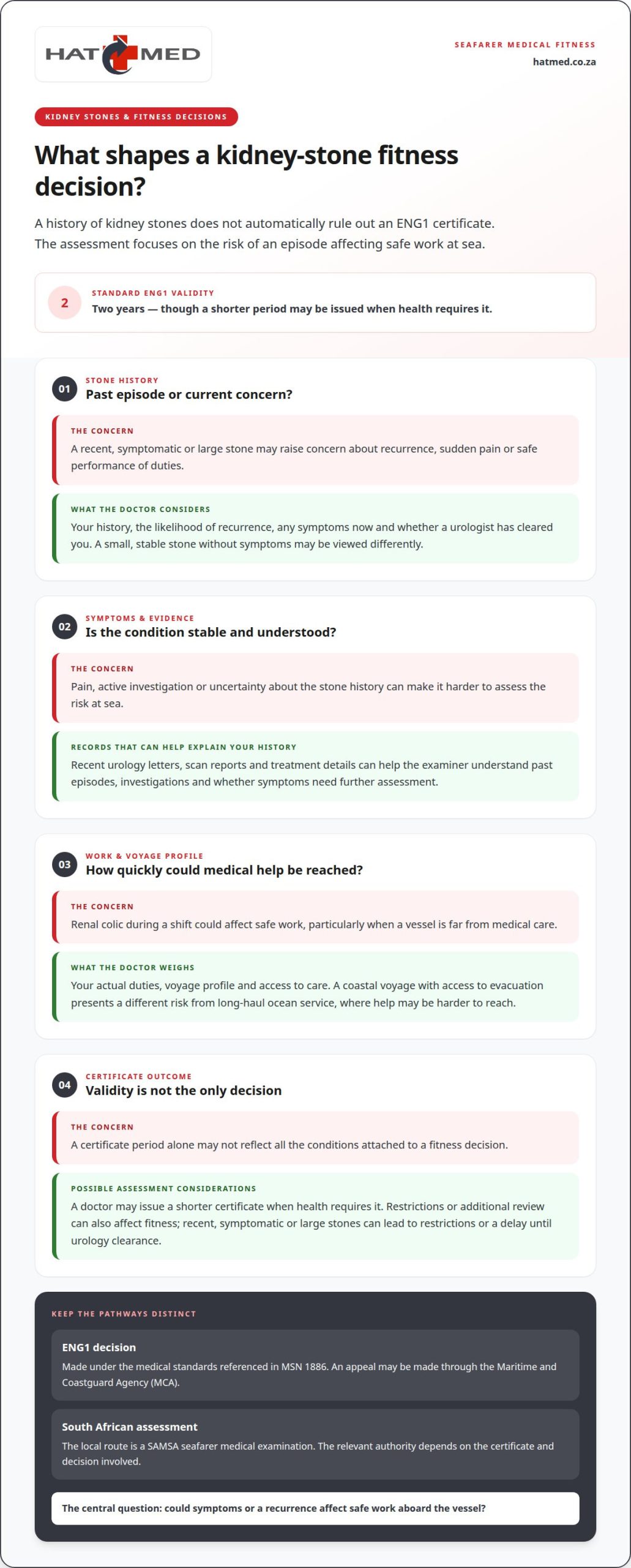
A history of kidney stones doesn’t automatically prevent you from being found fit for seafaring. A seafarer medical fitness assessment with a kidney stone history considers symptoms, recurrence, treatment and the risk of sudden pain at sea. A standard ENG1 certificate is valid for two years, though a shorter period may be issued when health requires it.
It’s understandable to worry that a past kidney stone, a recent episode or ongoing symptoms could affect your certificate. The key question is how your condition may affect your safety and ability to work at sea, not simply whether you have had a kidney stone.
This article explains what medical examiners may consider, which symptoms and records matter, how certificate validity can vary, and what an ENG1 appeal involves. It also clarifies the distinction between ENG1 decisions and seafarer medical assessments in South Africa, so you can understand the relevant next steps.
Key Takeaways
- A past kidney stone doesn’t automatically rule out an ENG1 certificate; symptoms, recurrence and the risk of an episode at sea all matter.
- A standard ENG1 certificate is valid for two years, but a shorter validity period may be issued when health requires it.
- Recent urology letters, scan reports and treatment details can help explain your medical history during an assessment.
- If you disagree with an ENG1 decision, you can appeal through the Maritime and Coastguard Agency; the relevant process depends on the decision.
Medical certificate validity
A medical certificate records whether a seafarer meets the medical fitness standard for the relevant work. For ENG1 assessments, the standard certificate period is two years, but an examining doctor may issue a shorter period when health requires it.
Kidney stone history affects ENG1 certification through the chance of recurrence and sudden pain at sea. The standards recognise that an unexpected episode could make duties unsafe. A small, stable stone without symptoms may be treated differently from a recent symptomatic stone, but ongoing monitoring or further assessment may be needed. The certificate period is therefore not the only decision: restrictions or additional review can also affect fitness.
Deck, engine-room and offshore duties do not have separate kidney-stone timelines in the information available here. The assessment considers your actual duties and voyage profile, including how far the vessel may be from medical care and how quickly help could be reached. This can affect the consequences of renal colic during a shift.
Ireland’s seafarer medical fitness certificate has a maximum validity of two years, or one year for people under 18. The Irish requirement applies to people aged 16 and over employed aboard an Irish seagoing ship, and took effect in July 2014. An Irish approved doctor may issue a shorter certificate when a health condition warrants it. A valid Irish certificate may also be reassessed within three months of expiry.
A reassessment is a new medical review of fitness, rather than an automatic extension of an existing restriction. In Canada, a seafarer whose certificate was limited to near coastal voyage, Class 2 before the kidney-stone bulletin was published may seek a new marine medical examination under its guidelines. Canada’s kidney-stone guidance uses timelines rather than stone size, so the time since the last stone and any current symptoms are relevant to review.
International requirements for seafarer medical examinations
Seafarer medical examinations assess whether a person meets the health requirements for work at sea. In South Africa, the relevant local route is a SAMSA seafarer medical examination; international standards provide context, but national rules can differ.
Seafarer medical examination scheme
A seafarer medical examination scheme sets out the medical checks and requirements used to assess fitness for maritime duties. The STCW Convention sets minimum medical fitness requirements, while states that have ratified it may establish higher standards in national regulations. Requirements can therefore depend on where you work and which certificate you need. Examination fees also depend on the applicable national scheme and examination type.
Updated kidney stone reports
An updated kidney stone report is current medical information about a seafarer’s stone history and condition. In Canada, seafarers with a history of kidney stones must provide an updated report during their marine medical examination. Relevant records can describe past episodes, investigations and treatment, helping the examiner understand whether stones remain active or symptoms need further investigation. Canada’s SSB 15/2021 uses timelines rather than stone size when assessing kidney stones, so the timing of episodes is important.
International and South African standards
International and South African standards set the medical requirements for fitness decisions under the relevant maritime system. The STCW Convention establishes minimum requirements, while ratifying states may apply higher national standards. In South Africa, the seafarer or SAMSA medical examination is the local assessment route. The certificate and requirements that apply depend on your employment context, so an international certificate should not be assumed to replace national requirements.
Medical fitness standards also consider communication at sea. STCW requires adequate hearing and speech to communicate effectively and detect audible alarms. For kidney stones, the practical focus is your medical history and current symptoms, alongside the examination requirements of the applicable scheme.
Approved doctors and medical fitness decisions
A medical fitness decision determines whether you can perform maritime duties safely. In South Africa, the South African Maritime Safety Authority (SAMSA) is the relevant authority for seafarer medical examinations and fitness certification.
An examining doctor weighs kidney stone history against the demands of the seafarer’s work. A history alone does not automatically prevent an ENG1 certificate. Small, stable stones without symptoms may be compatible with duty when ongoing monitoring is appropriate. Recent, symptomatic or large stones can lead to restrictions or a delay until a urologist has cleared the seafarer.
The central concern is whether renal colic or another episode could affect your ability to work safely aboard a vessel. The decision considers the likelihood of recurrence based on your medical history, whether you have symptoms now, and how quickly you could access medical care. A coastal voyage with access to evacuation presents a different risk from long-haul ocean service, where help may be harder to reach.
For example, a stable stone with no current symptoms presents a different picture from pain or an active investigation. The doctor considers the clinical details alongside your voyage profile, rather than treating every history of kidney stones alike. Treatment records and urology findings can help explain whether the condition is stable or still needs assessment.
An ENG1 decision is made under the medical standards referenced in MSN 1886. If a seafarer disagrees with an ENG1 decision, an appeal may be made through the Maritime and Coastguard Agency (MCA). This is distinct from the South African SAMSA examination route, so the relevant authority depends on which certificate and decision are involved.
For a history of kidney stones, the practical decision points are current symptoms, recurrence, treatment status and access to care at sea. These factors help explain why a certificate may allow duties, include restrictions or require further review before you return to work.
Investigation of symptoms and kidney stone history
Investigating symptoms helps establish whether kidney stones are active, recurring or likely to affect safe work at sea. The assessment connects your clinical history with current symptoms, treatment and the vessel’s access to medical care.
Symptom and history investigation
Renal colic, urinary obstruction and infection are symptoms or complications relevant to a seafarer’s fitness assessment. The examiner considers whether you have pain now, whether stones have recurred and how long you have been stone-free. Recurrent uric-acid or calcium stones, diabetes, obesity and high uric acid can provide additional context.
Previous procedures also matter. The assessment may consider lithotripsy, ureteroscopy or a stent, along with the reason for treatment and any continuing symptoms. A past procedure followed by a symptom-free period presents a different clinical picture from current pain or an unresolved investigation. Voyage conditions matter too: a long ocean passage can limit access to evacuation compared with a coastal route.
Required medical tests and records
Medical tests and records provide clinical evidence to clarify the cause, treatment and current status of kidney stones. No single test is identified here as necessary for every seafarer with a previous stone; the examination depends on your symptoms and medical history.
Recent urology letters, ultrasound or CT scan reports, and treatment details can help the examiner understand your case. Include information about stone episodes, procedures and follow-up, such as whether a stent was placed or removed. If you have symptoms, investigation can address possible obstruction or infection before a fitness decision. An updated report can also clarify whether stones have recurred or you remain stone-free.
Vision is another part of seafarer medical fitness, but it does not determine whether kidney stones are active. For a medical examination, clear records help distinguish a resolved episode from current symptoms requiring further investigation. Arrange a seafarer medical examination to have your medical history assessed in the context of maritime duties.
Hatmed Medical Centre: Seafarers / SAMSA Medical Examinations
Hatmed Medical Centre provides Seafarers / SAMSA Medical Examinations for people who need a South African seafarer medical fitness assessment. If you have had kidney stones, book an examination or review of your medical history for seafaring work.
Bring relevant urology letters, scan reports and treatment details, including information about any procedures and current symptoms. These records help place your history in context during the examination. A General Practitioner Consultation may also be appropriate for discussing kidney stone symptoms or ongoing health concerns, but it does not replace a seafarer medical examination or decide the outcome of an ENG1 appeal.
If you’d like to discuss a seafarer medical examination, contact Hatmed Medical Centre.
Take the next step with clear medical information
A seafarer medical fitness assessment with a kidney stone history is easier to approach when your next step matches the certificate you need. Before arranging an examination, identify whether your work requires a South African SAMSA assessment or an ENG1 decision. This helps keep the process focused on the relevant maritime duties and medical history.
If you have ongoing symptoms or your treatment is still being investigated, discuss this with a GP as part of your care. Hatmed Medical Centre offers General Practitioner Consultations alongside Seafarers / SAMSA Medical Examinations, supporting your health care and seafaring requirements. Immigration Medical Examinations serve a separate purpose and are not a substitute for a seafarer assessment.
For guidance on your next step, contact Hatmed Medical Centre. Having a clear plan can help you approach the process with greater confidence.
Frequently Asked Questions
Which medical conditions commonly need further assessment?
Kidney stones under investigation, recurring stones or current symptoms can prompt further assessment. The review may also consider related health factors, including diabetes, obesity and high uric acid, as well as whether stones are uric-acid or calcium-based. These details help distinguish an isolated past episode from a pattern that could affect your fitness at sea. Other medical concerns are assessed according to their effect on safe maritime duties.
How does a history of kidney stones affect seafarer medical fitness certification?
A seafarer medical fitness assessment with kidney stone history considers recurrence, symptoms, treatment and the time since your last episode. A history does not automatically prevent certification, but it can affect the decision or certificate conditions. A resolved episode with no ongoing symptoms presents differently from active pain or continuing investigation. The key concern is whether another episode could disrupt safe duties, especially where medical help is difficult to access.
What kidney stone symptoms or complications may make a seafarer temporarily or permanently unfit?
Renal colic, urinary obstruction and infection can affect fitness, especially if symptoms are active or need investigation. Current pain may interfere with your duties, while obstruction or infection can indicate a complication requiring medical attention. These issues may lead to a temporary restriction or delay while assessment and treatment take place. A history of kidney stones alone does not establish permanent unfitness; the decision depends on the condition’s effect on safe work.
Can a seafarer with recurrent kidney stones receive a restricted or time-limited fitness certificate?
Yes, a restricted or shorter-period certificate may be considered, depending on the applicable national rules and medical findings. In Canada, a stone or removal procedure within the past two years may warrant a provisional certificate limited to near coastal voyage, Class 2. A history with more than two years stone-free may warrant a provisional certificate without geographical limitations. These Canadian provisions are not South African certification rules.
How much does a seafarer medical examination cost in South Africa, and how long does certification take?
The examination fee depends on the case and is provided after a quote request; the work required and any additional assessment affect the cost. Certification timing depends on the examination findings and whether further investigation or medical reports are needed. A straightforward review may progress differently from one involving current symptoms or unresolved treatment. Allow time for relevant records and any additional clinical information to be considered.
What international seafarer medical standards address kidney stones, including STCW and ILO guidance?
The STCW Convention sets minimum medical fitness requirements for seafarers, while countries may impose higher national standards. International Labour Organization and World Health Organization seafarer examination guidance informs medical examinations, but national rules determine how certificates are issued. Kidney-stone-specific approaches can vary: Canada’s SSB 15/2021 uses timelines in its assessment guidance. This means an international framework does not replace the requirements applying to a South African SAMSA examination.