A running ship’s main-engine room can produce noise levels of 100-115 dBA, and ambient noise above 85 dBA can cause noise-induced hearing loss. The hearing loss thresholds for maritime engine room crew are assessed through audiometry, which records the quietest sounds a person can hear at different pitches; engine-room noise levels are not a hearing score.
Long exposure matters, especially in enclosed spaces where sound can be amplified. If you work around machinery, it is understandable to wonder how noise may affect your hearing and what a test can reveal.
This article explains common causes of hearing loss at sea, how audiometric thresholds are measured and what seafarer medical examinations can reveal. It also considers hearing-loss trends in crew screening, helping you understand why monitoring hearing matters for seafarer health.
Key Takeaways
- Understand why prolonged noise in enclosed machinery spaces can put engine-room crew’s hearing at risk.
- Learn how audiometry maps hearing at different pitches and helps identify changes over time.
- See what hearing findings may mean during a seafarer medical examination, and why they matter for fitness assessment.
- Find out how a Seafarers / SAMSA Medical Examination can support your next step in understanding your medical fitness.
Noise-induced hearing loss among engine-room crew
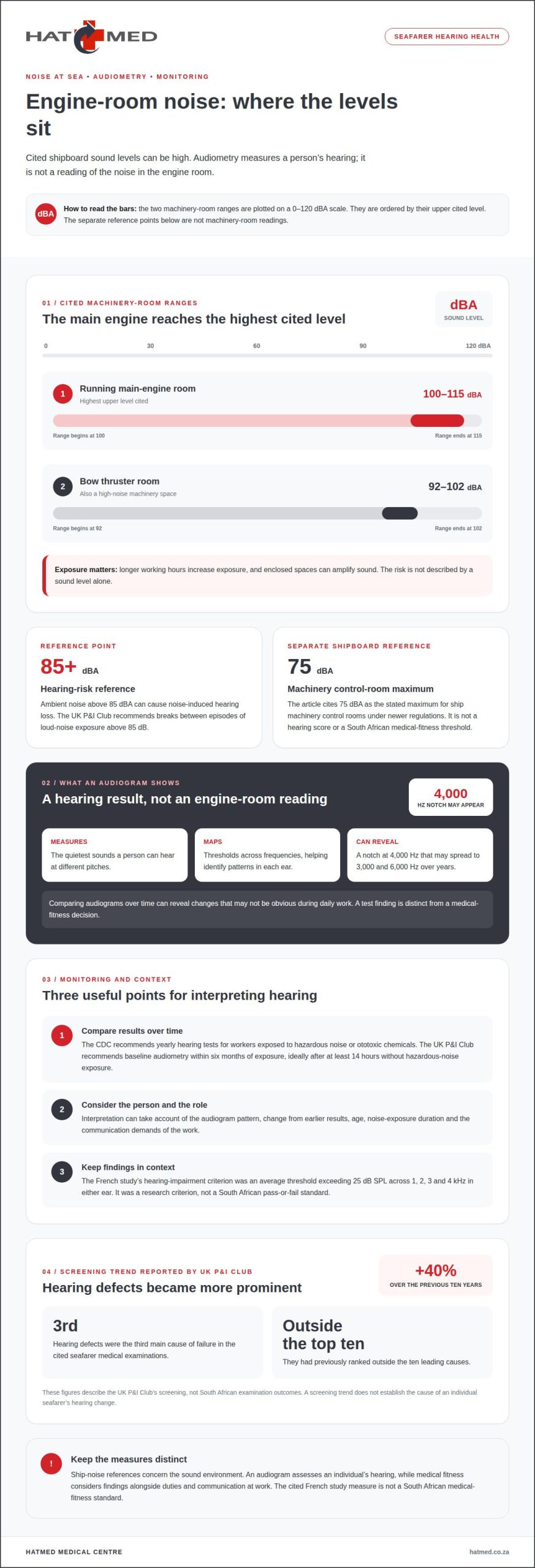
Engine-room noise can reach 100-115 dBA aboard a running ship, creating a risk that increases with exposure time. Understanding the source and duration of noise helps explain why hearing protection and regular monitoring matter.
Noise-related hearing risks
Noise-induced hearing loss is sensorineural damage to inner-ear nerve cells and tiny hairs caused by loud sound. It can develop gradually, so crew may not notice changes at first. Audiometry may show a notch at 4,000 Hz, which can spread to 3,000 and 6,000 Hz over years. Years of noise-related maritime work can cause irreversible loss, although some treatments may help.
Enclosed spaces can amplify sound, and longer working hours increase exposure. A running main-engine room may produce 100-115 dBA, while a bow thruster room may reach 92-102 dBA. These levels make time spent near operating machinery and the use of hearing protection especially relevant.
Maritime noise and hearing rules
Ship-noise measures cited for this topic include the International Maritime Organisation’s 2012 Code on Noise Levels on Board Ships, MSC Resolution 337 (911) with effect from 1 July 2014, and European Directive 2003/10/EC. These references concern shipboard noise; they should not be treated as a South African medical-fitness threshold or as a statement of SAMSA requirements.
The stated maximum for ship machinery control rooms under newer regulations is 75 dBA. This differs from the 85 dBA level identified as a point above which ambient noise can cause hearing loss. For an individual crew member, an audiogram assesses hearing; noise limits address the sound environment.
Prevention combines reducing exposure and using protection. The UK P&I Club recommends breaks between episodes of loud-noise exposure above 85 dB and mandatory hearing protection where loud exposure is unavoidable, such as engine rooms. Training can cover noise hazards, correct use of hearing protection and audiometric results. The Centers for Disease Control and Prevention recommends yearly hearing tests for workers exposed to hazardous noise or ototoxic chemicals.
Audiometric testing and standard threshold shifts
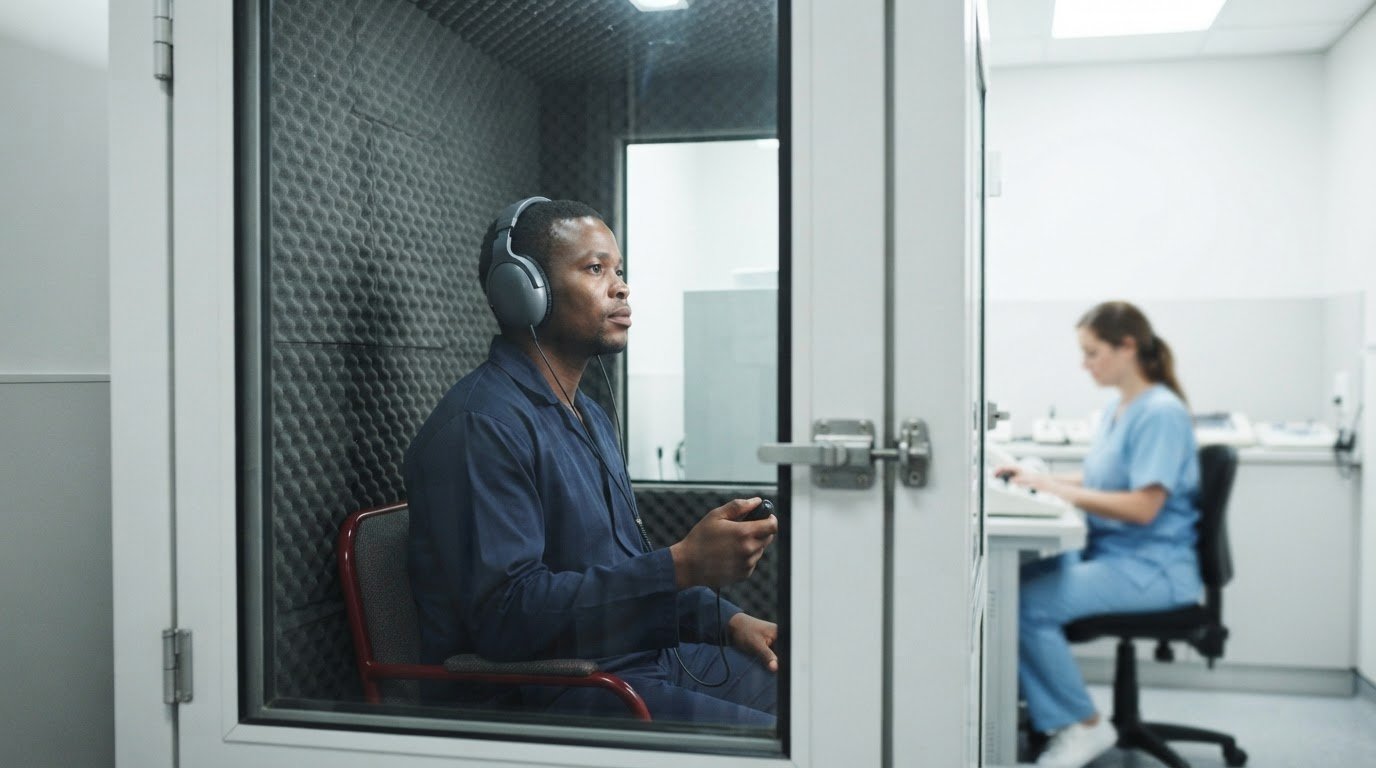
Audiometry records the quietest sounds a person can hear at different pitches. Comparing results over time can reveal changes that may not be obvious during daily work. Understanding hearing loss thresholds for maritime engine room crew means distinguishing a measured hearing result from a medical fitness decision.
Seafarer audiogram findings
An audiogram plots hearing thresholds across frequencies, helping identify patterns in each ear. A French study analysed 8,308 audiograms from merchant seafarers tested in 2018 or 2019. It defined hearing impairment as an average threshold exceeding 25 dB SPL across 1, 2, 3 and 4 kHz in either ear. This was the study’s research criterion, not a South African pass-or-fail standard. It shows why the frequencies included in a calculation matter.
Hearing standards for seafarer fitness
Medical fitness assessment considers hearing findings alongside a seafarer’s duties and ability to communicate at work. The French study’s 25 dB SPL criterion should not be used as a South African threshold for engine-room ratings. The audiogram’s pattern, any change from previous results, and the communication demands of the role all provide useful context. No single study measure replaces that broader assessment.
Timing of hearing tests
For workers exposed to hazardous noise or ototoxic chemicals, the Centers for Disease Control and Prevention recommends a hearing test yearly. The UK P&I Club recommends baseline audiometry within six months of exposure, ideally after at least 14 hours without hazardous-noise exposure. A baseline creates a comparison point; repeat testing can reveal a shift. These recommendations should not be mistaken for a blanket South African statutory interval.
Responding to an abnormal audiogram
After an abnormal result or suspected work-related change, arrange a medical assessment and keep the audiogram with relevant records. Explain any hearing difficulties and share previous test results so the clinician can consider them alongside your work history and symptoms. For hearing loss thresholds for maritime engine room crew, this context helps distinguish a test finding from its possible cause and relevance to medical fitness.
Hearing-loss trends in seafarer medical examinations
Hearing findings in crew medical screening show why trends deserve attention alongside individual audiograms. The UK P&I Club reported that hearing defects as the main reason for failure increased by 40% over the previous ten years. It also identified hearing defects as the third main cause of failure in seafarer medical examinations, after they had previously ranked outside the ten leading causes.
These figures describe the UK P&I Club’s screening, not South African examination outcomes. They illustrate how hearing can become more prominent in medical fitness decisions. A finding from one examination is personal; a trend across screenings may point to a wider occupational health concern. Neither, by itself, tells an individual seafarer what caused a hearing change.
Age and time spent at sea also matter when interpreting patterns. A seafarer study grouped participants as under 30, 30-39, and over 40 years, then compared hearing data across a 40-year timespan, from 1984 to 2018-2019. It also divided occupational experience into 13 years or less and more than 13 years. These categories help separate possible age-related changes from differences associated with work duration.
ISO 7029:2000 is a technical report on the statistical distribution of hearing thresholds by age. Age-related reference patterns provide context, but they do not establish the cause of an individual result. For an engine-room crew member, interpretation should consider the audiogram pattern, age, duration of noise exposure and earlier test results together. This distinction matters: screening trends help identify broader concerns, while an individual assessment examines the person’s hearing and medical fitness. A change over time is most informative when compared with a reliable earlier baseline, rather than judged from one result alone.
What are the South African medical fitness hearing standards for seafarers and engine room ratings?
For South African seafarers, distinguish a medical fitness assessment from a shipboard noise limit. Noise limits describe the sound environment; an audiogram records a person’s hearing thresholds. A workplace figure alone cannot establish whether a crew member is medically fit for duty.
Do not apply the French study’s 25 dB SPL research criterion as a South African pass-or-fail threshold. It defined hearing impairment for that study’s analysis, not South African medical fitness. The relevant assessment considers the audiogram in context, including its pattern, any change from earlier results and the communication demands of the seafarer’s duties.
For an engine-room rating, useful context includes the need to hear instructions, warnings and spoken communication at work. The test result describes hearing ability but does not, on its own, explain the cause. A clinician can interpret the findings alongside the seafarer’s history and any earlier audiograms.
Bring previous audiograms and relevant medical records to the medical examination. Comparing earlier and current results helps distinguish a longstanding pattern from a change over time. If a result raises concern, the assessment can consider what the findings mean for the duties involved, rather than relying on an overseas research cut-off. This approach keeps three questions separate: what the audiogram shows, how hearing relates to the role, and what the medical assessment concludes. A single sound-level figure or study definition cannot answer all three. For an assessment connected to seafarer fitness, arrange a seafarer medical examination.
Hatmed Medical Centre
Hatmed Medical Centre offers Seafarers / SAMSA Medical Examinations for seafarers who need a medical fitness assessment or have questions about how hearing concerns relate to it. If you have noticed a change in hearing or received an abnormal audiogram, a General Practitioner Consultation gives you an opportunity to discuss your concerns and relevant medical history. Bring any previous audiograms or medical records to inform the conversation. The assessment considers hearing findings in the wider context of your seafarer medical examination, rather than treating a noise figure alone as a fitness decision. Contact Hatmed Medical Centre to discuss your seafarer medical examination.
Make your next hearing-health step count
Hearing results are most useful as part of an ongoing picture of your health and working life. If you have difficulty following conversation or hearing warning sounds, note when it happens and how it affects your daily tasks. Clear examples can make a medical discussion more focused than a general sense that your hearing has changed.
Understanding hearing loss thresholds for maritime engine room crew is a starting point, not a substitute for interpreting your own results in context. Keep relevant audiograms together and raise new concerns during a medical assessment, particularly before they affect communication or confidence at work. Hatmed Medical Centre can help you discuss your concerns and the appropriate medical next step. Contact Hatmed Medical Centre to arrange a conversation about your hearing health. Taking a considered step now can help you approach the next assessment with greater clarity.
Frequently Asked Questions
What occupational noise exposure limits apply to maritime engine room crew in South Africa?
Loud ambient noise can cause hearing loss, but that alone does not establish a South African legal exposure limit. A 75 dBA limit is described for ship machinery control rooms under newer regulations, but that figure alone does not establish a general South African occupational exposure rule. Noise exposure and medical fitness are separate considerations.
What hearing loss thresholds qualify as occupational hearing impairment for seafarers?
There is no single hearing threshold in the cited study that can be applied as a South African qualification rule. A French seafarer study defined impairment as an average above 25 dB SPL across 1, 2, 3 and 4 kHz in either ear. That was a research definition. A seafarer’s medical assessment considers their hearing findings in relation to their duties and health history.
What noise levels in dB(A) are typical in ship engine rooms, and how do they compare with exposure limits?
A running ship’s main-engine room is estimated at 100-115 dBA. That is above the 85 dBA level identified as a hearing-loss risk reference, but the comparison does not itself determine an individual’s dose or fitness. Exposure also depends on time spent in the space and the noise reaching the crew member. A control-room limit is not an engine-room exposure limit.
How are occupational audiograms assessed, including threshold shifts and hearing loss calculations?
An audiogram records the quietest sound heard at different frequencies in each ear. Clinicians can compare the results with an earlier baseline to identify a change; the size and pattern of that change matter. A French study calculated an average across 1, 2, 3 and 4 kHz, but this research measure is not a universal occupational calculation. The relevant assessment depends on the applicable medical programme.
What are the risks of engine room noise exposure, including tinnitus and permanent hearing damage?
Prolonged exposure to loud noise can damage inner-ear structures and lead to permanent sensorineural hearing loss. Some crew may also experience tinnitus, such as ringing or buzzing, or find it harder to follow speech and warnings. Noise-related changes can develop gradually, so a person may not recognise them during routine work. Difficulty hearing conversation or signals is a reason to seek medical assessment.
What South African maritime laws, occupational health rules, and SAMSA guidance cover noise and hearing loss?
Ship-noise limits address the sound environment, while a seafarer medical assessment considers the audiogram pattern, changes from earlier results and communication demands. The cited IMO and European measures are not South African medical-fitness thresholds or statements of SAMSA requirements.