

If you’ve searched for “adult immunizations”, you may have found conflicting advice, especially if you’re unsure which childhood vaccinations were recorded or whether your circumstances have changed. A useful review starts with your health history, not a one-size-fits-all checklist.
Vaccine recommendations can depend on factors such as age, health conditions, pregnancy, work and travel. The questions to raise may therefore differ from one person to another. You don’t need to piece together a personal plan from online lists.
This guide explains how to review the information you have, what details to gather and how to prepare for a practical conversation with a GP. It also explains why immunisation needs can change over time and how to discuss possible next steps without assuming every vaccine applies to everyone. A GP consultation at Hatmed Medical Centre provides an opportunity to review your vaccination history and health circumstances as part of preventative care.
Key Takeaways
- Adult immunizations are best reviewed in light of your vaccination history and current circumstances, rather than through a one-size-fits-all checklist.
- Gather any records you have, then consider them alongside your personal health history.
- Age, health conditions, medicines and previous vaccine reactions are useful details to raise during a review.
- Prepare questions before your appointment so you can discuss what may be relevant and agree on practical next steps with your GP.
- A Hatmed GP consultation offers an opportunity to review your history and discuss immunisation as part of preventative care.
Adult immunisations: why a vaccine review still matters later in life
Adult immunisation means considering vaccination or updating your protection during adult life. It isn’t only about catching up on something missed in childhood. A review brings together the vaccinations you remember, any records you can find and your current health, so you can discuss what may be relevant now.
A vaccine review is a personal assessment of your history and circumstances, not a universal checklist for every adult. Even two people of the same age may have different vaccination histories, medical backgrounds and potential exposures. An online list can help you prepare questions, but it cannot provide an individual plan.
What does an adult immunisation review involve?
A review is a conversation about which vaccinations you’ve had, what can be documented and what has changed since then. A GP can consider your records alongside your health history and current circumstances. The next steps may differ between people in the same age group, so a single schedule won’t suit everyone.
This guide can help you prepare for a clinical conversation, but it can’t diagnose your needs or prescribe a vaccine. If your records are incomplete, share what you do know and explain what is uncertain. A gap in your records is not, by itself, a reason to assume you need every vaccine or none.
Why can vaccination needs change over time?
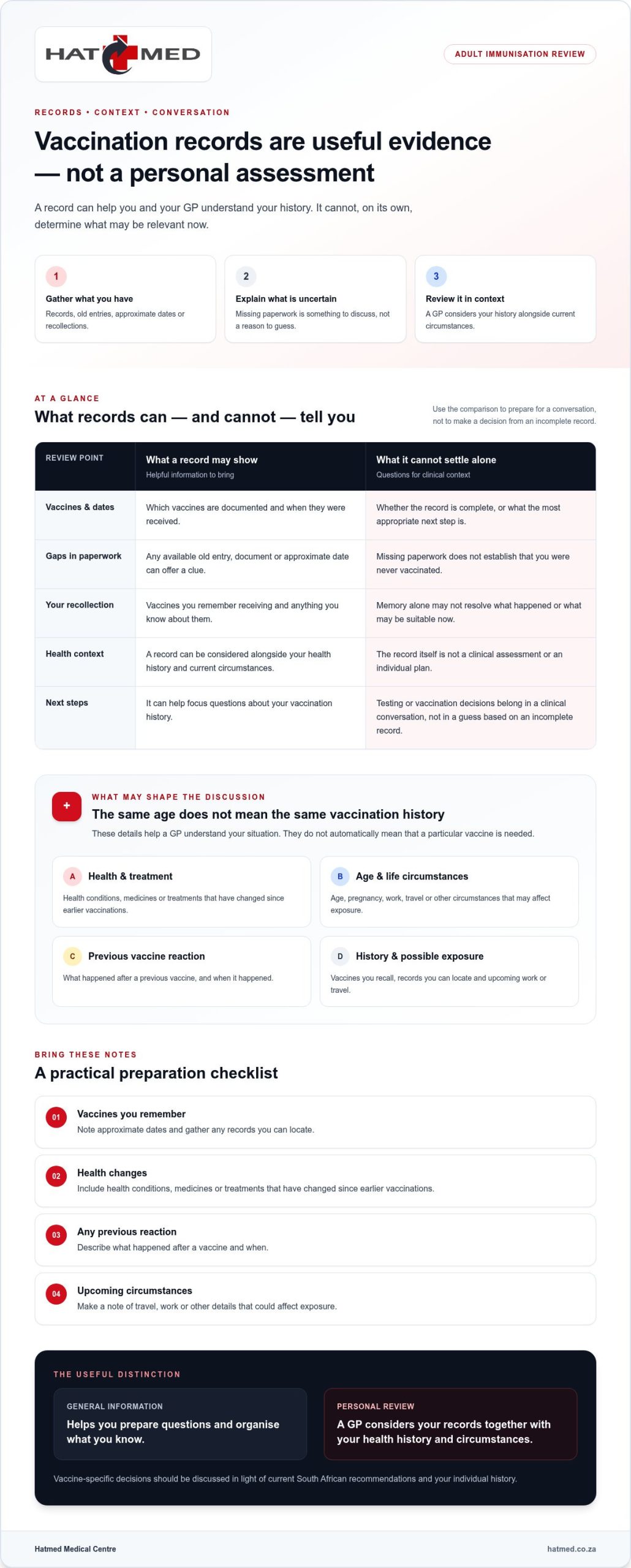
Age can affect which recommendations a clinician considers. A new diagnosis, treatment or change in daily activities may also be relevant. Work, travel or close contact with people at increased risk can shape a discussion about exposure. These factors don’t automatically mean that a particular vaccine is needed; they help a GP understand your situation.
Protection and recommendations vary by vaccine, and previous doses can affect what may be appropriate next. For a broad overview of how adult vaccination schedules are organised, see this general reference. It isn’t a substitute for current South African guidance or personal clinical advice. Vaccine-specific decisions should be considered in light of current South African recommendations and your history.
To make the conversation more useful, note what you know and what you’re unsure of. Consider writing down:
- Vaccines you recall receiving, approximate dates and any records you can locate.
- Health conditions, medicines or treatments that have changed since earlier vaccinations.
- Any previous reaction to a vaccine, including what happened and when.
- Upcoming travel, work or other circumstances that could affect exposure.
Bring your notes or available records to your GP consultation. Ask which details need clarification, whether a next step is relevant and how it fits with current guidance. Adult immunizations are best discussed as part of your wider health picture, with time to ask questions and consider a plan.
How adult immunisations work: protection, records and changing circumstances
Vaccines help your immune system recognise a particular infection and prepare to respond if it encounters it. They don’t promise that you’ll never become ill, and the level or duration of protection can vary. Some vaccines are intended for particular stages of life or health circumstances; others may be considered again over time. Their purpose and timing aren’t interchangeable, so one vaccine cannot simply stand in for another.
Population guidance describes what may be recommended for groups; a clinician’s assessment considers what makes sense for you. General schedules can explain how recommendations are organised, but they can’t interpret your medical history or determine your personal next step. For adults in South Africa, vaccine-specific decisions should be discussed in light of current local clinical guidance and your individual circumstances.
How vaccines help the immune system respond
A vaccine gives the immune system a way to practise recognising a target, so it may respond if it encounters that infection later. The approach differs between vaccines, as can the protection they offer and how long it lasts. Broad claims about how long vaccines work can therefore be misleading: the answer depends on the vaccine and the person’s history. A GP can discuss the relevant details without assuming one rule applies to every adult.
What vaccination records can and cannot tell you
A record can show which vaccines you received and when, but it isn’t a clinical assessment. It may be incomplete, difficult to interpret or missing details that matter when considering what to do next. If you can’t find paperwork, that doesn’t establish that you were never vaccinated; memory alone may not settle the question either. Treat gaps as something to discuss, not as a reason to guess.
Before an appointment, look through personal health files and documents from previous healthcare visits. Gather what you can, even if it’s only an old entry or an approximate date. A GP can consider those details alongside your health history, explain what remains uncertain and discuss whether further assessment is appropriate. Decisions about testing or vaccination belong in that clinical conversation, rather than being made from an incomplete record or an online checklist.
This is the practical distinction behind adult immunizations: general information can help you prepare, while your records need to be interpreted in context. If paperwork is missing, say so plainly and bring any clues you’ve found. At Hatmed Medical Centre, a GP consultation provides a setting to review your vaccination history and discuss your health circumstances as part of preventative care. You can arrange a Hatmed GP consultation to talk through your questions.
Which adult immunisations may be relevant to your health and circumstances?
Feeling well and having received childhood vaccinations are both reassuring, but neither settles whether a review would be useful. Your records may be incomplete, your health may have changed, or your circumstances may differ from those you had when you were younger. That doesn’t mean you need additional vaccinations; it means your history and current situation should be considered together.
Rather than treating adult immunizations as a fixed list, use these three areas to prepare for a conversation with your GP:
- Personal history: what you remember receiving, any written records and previous vaccine reactions.
- Health circumstances: ongoing conditions, recent diagnoses, medicines or treatments that may affect clinical advice.
- Exposure context: work, travel, close contact with others or other changes that may be relevant to your everyday life.
These are prompts for discussion, not recommendations or eligibility rules. Vaccine-specific advice should be considered against current South African clinical guidance and your history.
How health history may affect an immunisation conversation
Tell your GP about long-term conditions, recent changes in your health and any medicines or treatments you use. These details can help the clinician consider whether they affect the timing or suitability of vaccination. Having a chronic condition doesn’t by itself determine what you should receive; the details matter. Hatmed’s guide to chronic disease management offers further context on discussing ongoing health needs as part of care.
How age, work and exposure can shape questions
Age can be one factor in clinical guidance, but it shouldn’t be treated as an automatic rule for an individual. Your job or planned activities may also prompt useful questions, particularly if they involve specific exposure considerations. Share these details with your GP so they can distinguish general adult vaccination advice from requirements tied to a particular role or situation.
Travel deserves its own discussion. Advice can depend on your destination and individual plans, so don’t assume routine adult vaccination information covers every travel-related consideration. If you’re planning a trip, Hatmed’s South African travel clinic guide can help you consider travel health as a separate part of your preparation.
You don’t need to arrive with a conclusion. Bring your questions and whatever history you have, then discuss what matters in your case. A GP can put your health, records and current circumstances into context, and talk through whether any next steps are appropriate. This keeps the review individual rather than turning a broad checklist into a personal instruction.
How to prepare for an adult immunisation appointment
A little preparation can help you use your appointment well, even if your vaccination history is incomplete. You don’t need to arrive with every answer. Give your GP a useful picture of what you know, what has changed and what you’d like to clarify, so you can discuss practical next steps together.
What information should you bring?
Gather any immunisation records you can find, along with relevant details from previous healthcare visits. Note ongoing health conditions, medicines or treatments, and any reaction you’ve experienced after a vaccine. If you can’t locate records, don’t postpone advice solely for that reason. Tell your GP what you remember and where the gaps are.
Use this simple sequence to prepare:
- Gather records. Look through personal files and documents from earlier healthcare visits. Bring what you have, even if it’s incomplete.
- Note your history. Write down health conditions, medicines, treatments and any previous vaccine reactions, including what happened if you remember.
- List your questions. Jot down what you’re unsure about, such as whether a past dose is documented or which guidance applies to you.
- Discuss a plan. Review the information with your GP and agree on appropriate next steps or follow-up based on the consultation.
What questions can you ask your GP?
Ask which recommendations are relevant to your circumstances and why. You can also ask whether any vaccines need to be spaced apart or whether follow-up is appropriate for you. These decisions depend on your records and clinical assessment, so a question list can help you focus on what matters most.
If you have missing paperwork, mention that early in the conversation. Your GP can discuss what can be understood from the information available, what remains uncertain and whether further assessment is appropriate. You don’t have to decide in advance that a vaccine is necessary or unnecessary. Share useful details and raise concerns; the clinician can interpret them in context and explain the reasoning behind a recommendation.
For broader primary healthcare support, you can find a GP for ongoing care. Preparing in this way makes adult immunizations a focused discussion rather than a checklist exercise. A Hatmed GP consultation gives you an opportunity to review your history and personal circumstances with a GP.
Discuss adult immunisations with Hatmed as part of preventative care
Once you’ve gathered what you can, a GP can bring your vaccination history and current health circumstances into one conversation. Hatmed Medical Centre provides GP consultations and routine vaccinations as part of preventative care. Use the consultation to raise questions, explain what you’re unsure about and discuss what may be relevant to you, without assuming a particular vaccine or schedule suits everyone.
What to expect from a personalised discussion
Your discussion can cover your health history, concerns, available records and prepared questions. If you’re uncertain whether you received a vaccine, say so; gaps in your records are a reasonable topic to raise. The GP can consider your circumstances and current South African guidance when discussing clinical recommendations. The aim is to help you understand the options and appropriate next steps, not to apply a universal checklist.
It may help to take the conversation one question at a time. You could ask:
- Which immunisation guidance is relevant to my circumstances, and why?
- Does my health history or current treatment affect the discussion?
- What information would help clarify gaps in my vaccination records?
- Is there a follow-up step I should understand or record?
You don’t need to know the technical terms or arrive with a decision already made. Sharing what you remember, including concerns about a previous reaction, gives your GP a clearer starting point. Recommendations depend on your individual history and the guidance used in the clinical discussion, so an online list shouldn’t replace personalised advice.
Keep your preventative care connected
After discussing your history, keep any updated vaccination information with your other health records. Note what was discussed and any follow-up agreed with your GP; this can make future conversations easier, including if you see a clinician at another time. If you’re unsure how to record a detail, ask during the consultation so your notes remain useful.
Vaccination is one part of wider primary healthcare, alongside attention to your overall health and ongoing needs. A review can sit naturally within a broader conversation about preventative care, rather than being treated as a checklist or a guarantee against illness. Adult immunizations are best considered in light of your circumstances, with room to revisit questions if your health or situation changes.
Hatmed Medical Centre offers GP consultations and routine vaccinations to support preventative care. Explore Hatmed’s GP services to discuss your vaccination history and questions with a GP.
Make your next step a considered one
You don’t need to resolve every uncertainty before speaking with a GP. Set aside the records and questions you have, then make time for a conversation that puts them into your wider health picture. This can turn online reading about adult immunizations into a more relevant discussion, guided by your circumstances and current clinical advice.
Hatmed’s preventative care includes GP consultations and routine vaccinations. A consultation gives you space to discuss your health history and vaccination questions, and to consider appropriate next steps together. Keep any updated information with your health records to support future conversations.
Discuss your preventative healthcare with Hatmed and take a practical step towards a clearer plan. You can begin with the questions you have today.
Frequently Asked Questions
Can adults still need vaccines if they were vaccinated as children?
Yes. Childhood vaccination is useful history, but it doesn’t settle what may be relevant in adulthood. Advice can depend on the vaccine, your records, your health history and current South African guidance. For example, a change in treatment or a newly identified health concern may prompt fresh questions. Discuss uncertainties with a GP rather than assuming you need every vaccine or none.
How can I find out which immunisations I have already had?
Start by checking personal health files and documents from previous healthcare visits. Look for dates and vaccine names, but don’t worry if the picture is incomplete. Missing paperwork doesn’t prove a vaccine was never given. A GP can review what you find and discuss appropriate next steps using current guidance. Don’t decide to repeat or skip a dose without clinical advice.
Are adult immunisations different for people with chronic health conditions?
They can raise different questions, but the answer depends on the individual, the condition, any treatment and the vaccine being considered. Before your appointment, note your diagnosis, medicines and relevant care history, including recent treatment changes. Your clinician can assess how these details relate to current guidance. Avoid relying on a general online list to choose a vaccine, since advice for another person or condition may not apply to you.
Can I receive more than one vaccine at the same appointment?
Sometimes this may be appropriate, but it depends on the specific vaccines, your circumstances and current clinical guidance. There isn’t one rule that applies to every combination. Ask your GP whether the vaccines being discussed can be given together or whether timing, spacing or follow-up should be considered in your case. Share your relevant health information and vaccination history so the advice can be based on your circumstances.
What should I do if I cannot remember my vaccination history?
Uncertainty about past vaccinations doesn’t prevent a useful conversation with a GP. Bring any documents you can find and describe what you remember as accurately as possible, including approximate dates or any previous reactions. Explain which details are unclear. A clinician can consider the available information and talk through suitable options. Don’t select or repeat vaccines on your own simply because you can’t recall what you received.
Do adults need different immunisations before travelling?
Travel can bring up additional health questions, and advice may depend on your destination, itinerary, timing and personal health. This is separate from routine adult vaccination discussions, so share your plans with a clinician and seek advice early enough for an individual assessment. Hatmed’s travel health information can help you prepare for that conversation without relying on general destination lists alone.
Are adult immunisation recommendations the same for everyone in South Africa?
No general guide can determine what’s right for every person. Recommendations may depend on your vaccination history and health circumstances, and clinical guidance can change. Use reliable health information as background, then discuss how it applies to you with a GP. Guidance designed for another country or a population-level programme shouldn’t be treated as personal advice. A clinician can help you understand relevant South African guidance in context.