

Effective occupational health screening starts with the demands of the job, not a checklist applied to every employee. Employers need to understand which assessments are relevant, how to protect employee privacy and how to organise appointments around work. A focused process begins with the role and its known risks, while treating each employee with dignity.
This guide explains the purpose and limits of workplace screening, how to plan assessments around relevant duties and risks, and what employers and employees can expect when arranging an appointment. It covers how pre-employment and executive medical examinations can support workplace assessments, why screening doesn’t replace follow-up care when needed, and how practical preparation can make the process clearer for everyone.
Key Takeaways
- Occupational health screening is most useful when its purpose reflects the employee’s actual role and relevant workplace risks.
- Screening can inform safe work planning and support, but it isn’t a general diagnosis or a guarantee of fitness for every task.
- Set the assessment scope according to its purpose and the employee’s health context, rather than relying on a one-size-fits-all checklist.
- A clear preparation process helps employers organise assessments and employees understand why they’re being assessed and what information to bring.
- Hatmed’s pre-employment and executive medical examinations support workplace assessment needs. A clear description of the role helps frame the appointment.
What Is Occupational Health Screening, and Why Does It Matter at Work?
Occupational health screening is a health assessment considered in relation to a person’s work duties and relevant workplace risks. It can help an employer and clinician understand whether health information may be relevant to safe work planning or employee support. It isn’t a general diagnosis, a guarantee that someone is fit for every task, or a substitute for medical care when a health concern needs attention.
The purpose matters. A role involving frequent physical tasks may raise different questions from a largely office-based role, while specific workplace exposures may call for attention to other health considerations. The assessment should have a clear reason and enough information about the role to guide its scope. Applying the same broad checklist to every employee may gather irrelevant information while missing what matters for a particular job.
Used thoughtfully, screening can inform prevention and practical work planning. A clinician’s assessment, for example, may help clarify whether an employee’s health needs follow-up or whether further discussion about work arrangements is appropriate. It can also give employees an opportunity to raise relevant concerns. Screening provides information to consider; one appointment does not tell the whole story, and work decisions should not rely on that assumption.
Screening is one part of a wider approach to understanding health in relation to work. The distinction between medical screening and broader monitoring of workplace hazards is explored in What is Occupational Health Surveillance?. Employers can keep an assessment focused by stating its purpose, describing the job demands and sharing known risks, rather than arranging a routine check without a clear reason.
How is occupational health screening different from a routine check-up?
A routine check-up reviews a person’s health more generally, often to discuss wellbeing or an existing concern. A work-related assessment has a specific purpose and takes relevant job context into account. The clinician considers why the assessment was requested and what the duties involve. Screening may highlight an issue that needs further evaluation, but diagnosis and ongoing treatment require appropriate medical care.
Who may need workplace medical screening?
Employers may arrange an assessment when there is a relevant role-related or organisational reason. An employee might be asked to attend a pre-employment examination as part of a hiring process, or an executive examination in a workplace context. These examinations serve different purposes and don’t automatically involve identical assessments. The appropriate scope depends on the person’s duties, relevant risks and reason for the examination, not a one-size-fits-all schedule.
For employers, a useful first step is to describe the role accurately and explain why an assessment is being considered. Employees who understand the purpose can prepare relevant information and know what to expect. A respectful, focused process supports a clearer discussion without treating screening as a judgement about a person’s overall health or worth at work.
What Can an Occupational Health Screening Assess?
The assessment is shaped by its purpose, the role and the employee’s health context. There isn’t one standard panel of checks that suits every workplace. A clinician may consider relevant medical history and current health alongside the tasks and exposures described by the employer. Any examination, test or recommendation should follow from that context and clinical judgement, rather than from a job title alone.
Depending on the reason for the appointment, areas for discussion might include:
- Relevant past or current health concerns and any treatment the employee is receiving.
- Physical demands, such as regular lifting, prolonged standing or sustained concentration.
- Workplace exposures identified by the employer, which could include noise, dust, chemicals, heat or vibration.
- Whether the information gathered points to a need for further clinical assessment or follow-up.
These are examples, not a fixed checklist. An employee’s history may help the clinician understand how a particular health concern relates to the stated work demands. Screening can raise questions for further assessment, but it doesn’t by itself confirm a diagnosis or determine every aspect of a person’s ability to work.
How do job demands shape the assessment?
Consider the difference between primarily desk-based work and a role involving repeated physical tasks or a specific workplace exposure. The relevant questions may differ, but no occupation automatically calls for a particular test. Employers can help by describing actual duties, working conditions and known risks accurately. This gives the clinician useful context to decide what is relevant and helps avoid checks that don’t serve the assessment’s purpose.
To define the scope, describe the role in plain language: what the employee does, which demands are routine and what workplace risks are known. This information can guide a focused discussion and support relevant recommendations. If the purpose is unclear, it’s harder to judge whether a requested assessment is proportionate or what its findings are intended to inform.
What is the difference between screening and medical surveillance?
Screening generally refers to an assessment arranged for a stated employment or workplace purpose. Medical surveillance is commonly used to describe a more structured approach to monitoring health in relation to ongoing exposure risks. The terms can be used differently across settings, so a general explanation doesn’t establish what South African law requires for a particular workplace.
The US Occupational Safety and Health Administration explains medical surveillance in the context of workplace hazards in its OSHA Guidelines on Medical Surveillance. It’s a general reference, not South African regulatory guidance. Employers should base decisions about local requirements on applicable South African sources and the circumstances of the workplace.
For a focused assessment, share its purpose and the role context with the clinician. Hatmed Medical Centre provides pre-employment and executive medical examinations for workplace assessment needs. The reason for the assessment helps frame the discussion.
How Should Employers Choose the Right Occupational Screening Approach?
Start with a clear question: what should the assessment help the employer and clinician understand? Then define the role, relevant workplace risks and intended use of the findings. This keeps occupational health screening focused on a genuine need instead of defaulting to a generic package. It also helps employees understand why they’re attending and what the assessment can and cannot establish.
- Set the purpose: Clarify whether the assessment relates to a person starting a role or another workplace need.
- Describe the work: Share the role’s actual duties and demands, rather than relying on a job title alone.
- Identify relevant risks: Provide available information about workplace exposures or other factors that may matter to the assessment.
- Agree the scope: Give the clinician context to determine an appropriate assessment using clinical judgement.
- Plan for follow-up: Consider how relevant findings may inform further care or work-related discussion, without assuming a particular outcome.
Pre-employment and executive examinations differ chiefly in purpose. Neither name, by itself, tells you which checks will be included or what conclusion will be reached.
| Assessment option | Purpose to consider | Useful context to provide |
|---|---|---|
| Pre-employment medical examination | To assess health in relation to the stated requirements of a role before employment. | The duties, work demands and reason for the assessment. |
| Executive medical examination | A distinct medical examination option for an executive assessment purpose. | The reason the examination is being arranged and relevant background. |
When might pre-employment or executive medical examinations be appropriate?
A pre-employment examination may be considered when an employer wants a medical assessment in the context of a role’s stated requirements. An executive examination is a separate option offered by Hatmed Medical Centre. The appropriate scope depends on the purpose and clinical judgement, not an assumed list of tests. Neither assessment guarantees a particular outcome or determines an employer’s decision on its own.
A standard package may not suit every role. The relevant context for a mainly desk-based position, for example, may differ from that of a role involving physical demands or identified workplace exposures. A clear description helps the clinician focus the assessment and makes it easier to understand why particular questions or recommendations may be relevant. The CDC Guidelines for Workplace Medical Screening offer general programme-planning context, but are not South African legal guidance.
Which South African requirements should employers consider?
The Occupational Health and Safety Act is a relevant South African framework for workplace health and safety. Employers should consult current guidance from the Department of Employment and Labour and establish which duties apply to their circumstances. If a matter may involve the Compensation for Occupational Injuries and Diseases Act (COIDA), check the relevant requirements before drawing conclusions. A general screening recommendation does not establish a legal obligation, test panel or schedule.
Hatmed Medical Centre provides pre-employment and executive medical examinations. Sharing the assessment purpose and role context is a practical starting point for a focused discussion. Explore workplace medical examinations when planning an assessment for a specific need.
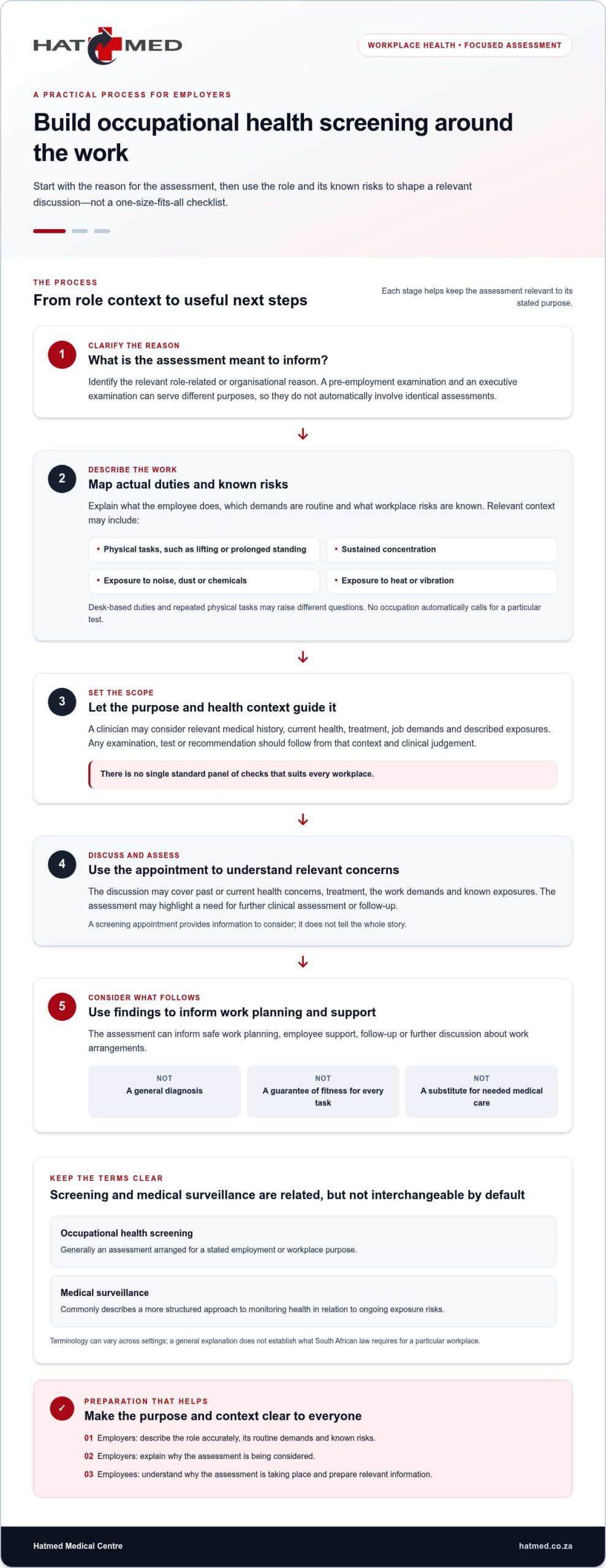
How Can Employers and Employees Prepare for Screening?
A clear process makes occupational health screening easier to understand for everyone involved. Before arranging appointments, employers should explain why the assessment is taking place, its general purpose and how relevant information will be handled. Employees should have an opportunity to understand the request and raise questions. This preparation can reduce uncertainty without promising a particular result.
Employers can use this workflow to organise the process:
- Define the reason. State whether the assessment relates to a role, a workplace concern or another employment purpose.
- Share relevant role context. Provide an accurate outline of the duties and any identified workplace risks that may matter to the assessment.
- Explain the appointment. Tell the employee what the assessment is intended to consider and what information they may need to bring.
- Arrange the assessment. Provide the clinician with the stated purpose and relevant context so the appointment can be approached appropriately.
- Plan communication and follow-up. Decide how relevant work-related recommendations will be communicated and how any need for further care will be handled.
What should an employee prepare before an appointment?
Employees can bring relevant medical history, details of current medication and any documents requested for the appointment. It’s also helpful to understand the role or assessment purpose being discussed. If something is unclear, or a health concern feels difficult to raise, discuss it with the medical professional during the appointment. Relevant context supports a more informed discussion, but employees don’t need to guess which checks will be performed.
How should employers handle results and follow-up?
Health information is sensitive. Employers should limit access to people who need information for a legitimate work-related purpose and handle it in line with applicable privacy obligations. Clinical details and work-related recommendations aren’t necessarily the same thing. Employers should communicate only appropriate work-related outcomes, rather than treating an assessment as permission to circulate an employee’s full health history. Explain the intended information flow clearly and allow employees to ask questions about what will be shared.
If an assessment identifies a health concern, screening may not be the end of the matter. The employee may need to discuss further evaluation or ongoing care with a medical professional. Hatmed provides primary healthcare and chronic disease management, which can support continued care for long-term health needs.
Preparation is a shared responsibility. Employers can provide a clear purpose and role information, while employees can bring relevant details and speak openly with the clinician. Find out about Hatmed’s medical examinations.
Arrange Occupational Health Screening with Hatmed Medical Centre
Arranging a workplace medical examination is more straightforward when its purpose is clear. Hatmed Medical Centre provides pre-employment and executive medical examinations to support employers and employees with workplace assessment needs. These are professional medical assessments, not a promise of a particular finding or employment decision. The stated purpose and role context help frame the appointment and inform the clinical discussion.
What workplace medical examinations does Hatmed provide?
Hatmed provides pre-employment medical examinations in relation to the stated requirements of a role, as well as executive medical examinations for a distinct assessment purpose. The name of an examination doesn’t determine a fixed set of tests or outcomes. Hatmed’s general practice also provides medical care, so if an assessment raises a health concern, further clinical attention may be appropriate.
Each appointment is considered on its own terms. Employers can explain the work context and reason for the assessment, while employees can share relevant health information with the clinician. The examination is a clinical assessment, not a substitute for ongoing care when a health condition needs continued attention. It also doesn’t guarantee that an employee will be suitable for every task or that an employer will make a particular decision.
What is the next step for an employer or employee?
Employers arranging an assessment can prepare a concise description of its purpose and the relevant job demands. Employees can bring useful medical information, current medication details and questions they would like to raise. A clear explanation of the appointment helps both parties understand what it is intended to address.
Before arranging an examination, bring together a few practical details:
- The reason for the assessment, such as a pre-employment or executive examination.
- A plain-language description of the role and its relevant duties.
- Any workplace risks or demands that may be important clinical context.
- Relevant health information the employee wants the clinician to consider.
These details set the context, but they don’t determine the clinical scope in advance. The clinician uses the stated purpose and professional judgement to guide the assessment. Employers shouldn’t assume that a particular test, report format or result will follow simply from the examination type. If further assessment or care is appropriate, it can be considered as a separate clinical next step.
When arranging an appointment, share the assessment purpose and role context. Employees can bring relevant health information and raise questions during the consultation. Arrange an occupational health assessment with Hatmed Medical Centre.
Take a Thoughtful Next Step for Workplace Health
A workplace assessment can start a more considered conversation about employee wellbeing. Its value lies not in gathering information for its own sake, but in using relevant clinical insight responsibly and considering whether further support is appropriate. This helps employers plan with care and gives employees room to discuss their health in a professional setting.
Hatmed Medical Centre provides pre-employment and executive medical examinations, alongside general practice and chronic disease management. This connection between assessment and ongoing care can be useful when an employee needs attention beyond the original workplace purpose. Each situation is individual, and the next step should be guided by the person’s needs and clinical advice.
If you’re planning occupational health screening, begin with a clear purpose and a description of the role. Hatmed provides professional medical assessments to support workplace screening needs. Arrange an occupational health assessment with Hatmed.
Frequently Asked Questions
What is occupational health screening?
Occupational health screening is a medical assessment connected to work and intended to provide relevant health information for a stated employment or workplace purpose. An assessment may, for example, consider whether a health concern is relevant to particular duties. The clinician determines its scope using the role context and individual circumstances. It isn’t a diagnosis or a substitute for treatment, and it doesn’t mean every worker needs the same assessment.
Is occupational health screening mandatory in South Africa?
Not every worker is automatically subject to the same screening requirement. Whether an assessment is required can depend on applicable South African law, the role and workplace hazards. The Occupational Health and Safety Act is a relevant framework, but it doesn’t make every assessment universal. Employers should consult current Department of Employment and Labour guidance and establish which requirements apply to their specific workplace.
What happens during an occupational health screening?
The clinician considers why the assessment has been requested, relevant health information and the work context. An employee may be asked about a health concern or medication that could matter to the appointment. The scope varies, so don’t assume a particular test in advance. Employees can ask what the assessment is intended to address and share relevant information directly with the clinician to support an appropriate discussion.
Can an employer see an employee’s full medical records?
Health information is sensitive and should be handled confidentially in line with applicable privacy requirements. Clinical details are distinct from work-related recommendations that may be relevant to an employer. What information may be shared depends on the circumstances and current South African rules, so a blanket answer isn’t appropriate. Employers should explain information handling clearly, restrict access appropriately and avoid circulating personal health details unnecessarily.
How should an employee prepare for an occupational health assessment?
Bring relevant medical history, current medication details and any documentation requested for the appointment. Before attending, make sure you understand why the assessment has been arranged and which role or work context it relates to. Share accurate information with the clinician, including details you think may be relevant, and raise questions or concerns during the appointment. Don’t stop medication or change treatment for screening unless your treating clinician advises you to.
Can occupational health screening identify every health condition?
No. Screening has a defined purpose and cannot rule out every condition or replace a full diagnostic consultation. If you have a symptom that isn’t addressed by the workplace assessment, raise it with a medical professional rather than assuming the screening has checked for it. If the appointment identifies a concern, appropriate clinical follow-up may be needed. The next step depends on the individual assessment and professional advice.
What is the difference between pre-employment screening and an executive medical examination?
They are both medical assessment options, but they may be arranged for different purposes. A pre-employment examination relates to a person’s prospective role, while an executive examination is a distinct assessment option. Neither label guarantees a standard test list; the context and clinical judgement guide the appointment. Hatmed Medical Centre provides both pre-employment and executive medical examinations, giving employers and individuals options suited to the reason for assessment.