

Maritime colour vision screening focuses on recognising colour-coded signals, not memorising plate answers. To understand how to pass the maritime Ishihara colour perception test, learn how the plates work and answer each one promptly: the recommended time is three seconds per plate. Accurate colour recognition matters at sea, where lights and signals can carry practical meaning.
It’s understandable to want to practise before a seafarer medical examination, especially if you’re unsure whether an online screening feels the same as using a printed Ishihara handbook. Screen settings can affect online results, so use practice tests to become familiar with the format, not as a substitute for a formal assessment.
This article explains how online Ishihara screening compares with the handbook, how long to view each plate, and why colour vision matters for maritime duties. You’ll also learn what to expect from a seafarers’ medical examination in South Africa and how to prepare without relying on memorised answers.
Key Takeaways
- Recognising coloured lights and signals can matter in maritime work, so consider how colour vision relates to the duties you’re pursuing.
- Use plate practice to build a calm, prompt response, rather than relying on memorised answers.
- For South African Merchant Navy candidates, normal colour vision is a stated medical standard; an online screening result alone doesn’t establish a full assessment.
- If you need a seafarer medical examination, Hatmed Medical Centre offers Seafarers / SAMSA Medical Examinations.
Maritime work that requires accurate colour vision
At sea, colours can convey operational information. Seafarers may need to recognise lights and signals, while maritime officers may interpret colour-coded symbols, signs, markers and maps. Recognising the right signal promptly can help workers understand their surroundings. Colour perception is therefore relevant to practical maritime duties, not just a medical form.
The Ishihara test is a colour-vision screening used in connection with maritime careers. Its plates use coloured dots to form numbers or patterns, screening primarily for red-green colour-vision deficiencies. The test does not recreate conditions aboard a vessel, where lighting, distance and surroundings can affect how a signal appears. It provides a structured screen, while maritime duties show why colour perception matters.
Think of the test in terms of visual decisions, rather than abstract answers. A worker may need to distinguish a light from its background, read a colour-coded marker or follow a map symbol. Maritime officers may also interpret signs and other signals. These examples illustrate how colour-coded information can matter in maritime settings.
- Lights and signals: notice the colour and interpret it in context.
- Signs and markers: distinguish colour cues that help identify information.
- Maps and symbols: read visual details where colour contributes to meaning.
For a candidate, the practical preparation is to understand what the Ishihara plates test, then respond based on what is actually visible. Memorising plate answers cannot establish that you can recognise colour cues in varied real-world settings. If a screening raises concern, further assessment can clarify the type and extent of any colour-vision deficiency. This matters because an online screening can indicate severity, but cannot classify a deficiency as protan or deutan. Accurate colour perception supports the recognition of maritime information; the assessment process helps establish how your vision performs.
Time allowed per plate
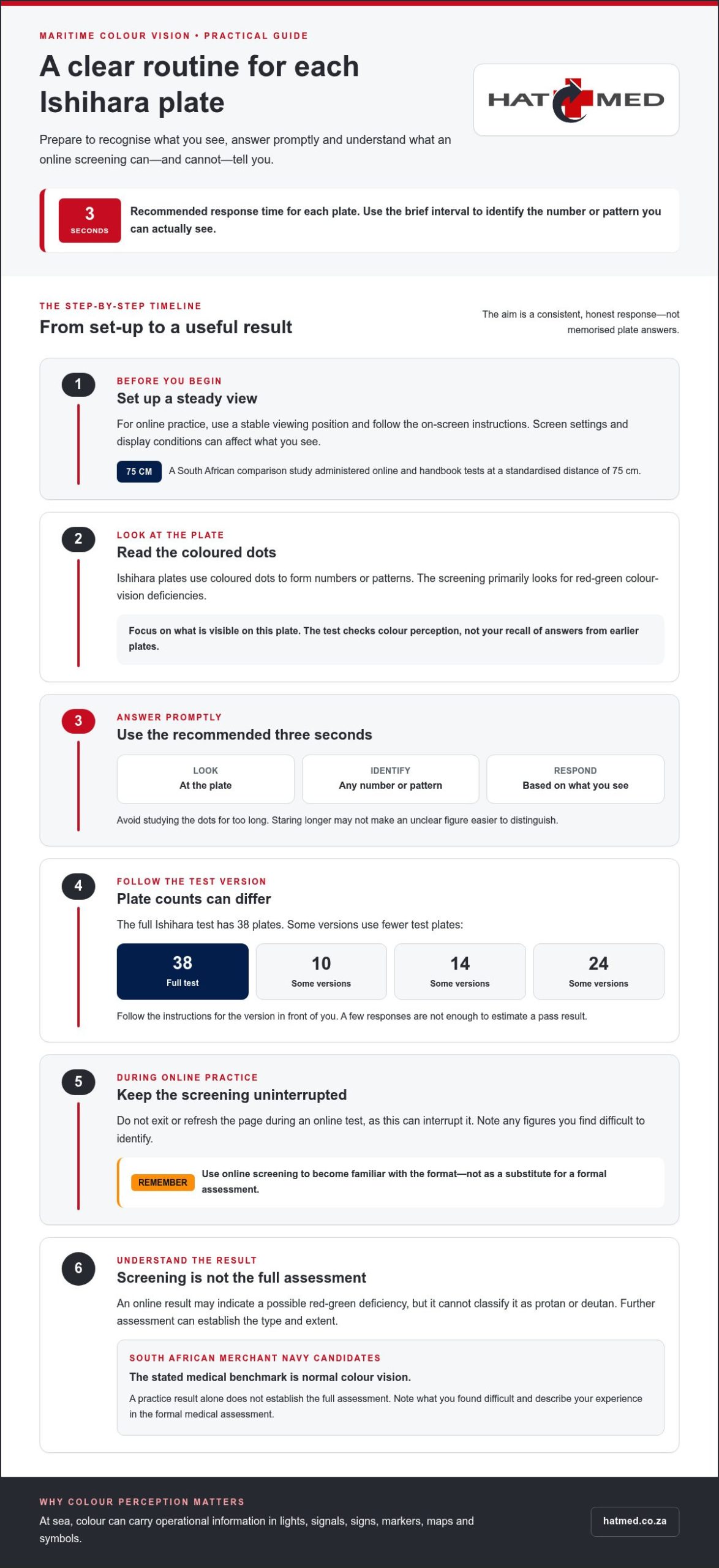
The recommended response time is three seconds per Ishihara plate. Use that brief interval to identify what you can see instead of studying the dots for too long. The plates screen colour perception using patterns that form numbers or shapes. Staring longer may not make an unclear figure easier to distinguish.
If you’re wondering how to pass the maritime Ishihara colour perception test, practise a consistent routine: look at the plate, identify any number or pattern, then answer promptly. Don’t rely on answers memorised from earlier plates. The test assesses colour perception, not recall. Red-green colour-vision deficiencies can affect how figures appear, so answer based on what you see.
Test versions vary in length. The full Ishihara test has 38 plates, while some versions use 10, 14 or 24 test plates. A shorter online quiz may feel different from a longer handbook assessment. Follow the instructions for the version in front of you, rather than estimating a pass result from a few responses.
For online screening, set up a stable viewing position and follow the on-screen instructions. In a South African comparison study, online and handbook tests were administered at a standardised distance of 75 cm. Don’t exit or refresh the page during an online test, as this can interrupt it. Screen colour and display conditions may also affect what you see, so treat online screening as practice, not a replacement for clinical assessment.
Learning how to pass the maritime Ishihara colour perception test means preparing to answer consistently, not memorising solutions. Practise responding within the recommended time and note any figures you find difficult to identify. If screening raises concerns, a seafarers’ medical examination is a relevant next step for discussing maritime fitness.
What colour vision standards apply to seafarers in South Africa?
For South African Merchant Navy candidates, the stated medical benchmark is normal colour vision. This relates to distinguishing colour information relevant to maritime duties, not simply reaching a target score on an online quiz. If you’re considering a seafaring role, understand the medical requirement before treating a practice result as conclusive.
Ishihara plates screen colour perception by asking you to identify figures formed by coloured dots. A screening result can indicate a possible red-green deficiency, but an online version cannot classify it as protan or deutan. Further assessment can establish its type and extent. A screening result is useful information, but does not by itself explain how colour perception may affect an individual.
- Role standard: normal colour vision is the stated benchmark for Merchant Navy candidates.
- Screening result: a possible deficiency can indicate a need for further assessment.
- Preparation: practise understanding the plates, not memorising their answers.
If you’re asking how to pass the maritime Ishihara colour perception test, focus on consistent, honest responses rather than recalled solutions. Note which figures are difficult to distinguish and describe your experience during the formal medical assessment. This gives the assessment a useful starting point without assuming a practice score determines your suitability for a role.
Preparing for the maritime Ishihara colour perception test also means understanding the difference between screening and assessment. If an online result concerns you, keep a record of it and explain the circumstances in which you took it. The screening method, the result and the assessment context all help frame the discussion. This can clarify the next medical step and the stated colour-vision standard for your intended maritime work.
Which alternative tests are accepted for seafarer colour vision assessment in South Africa?
For South African Merchant Navy candidates, the stated benchmark is normal colour vision. This describes the required outcome, not a list of alternative tests. Don’t assume another screening method is accepted as a substitute just because it also checks colour perception. The relevant question is whether that method forms part of the seafarer medical assessment.
The Ishihara test is the screening method discussed here, and it can be presented online or in a handbook. A South African comparison study at the University of KwaZulu-Natal optometry clinic examined both formats in 2014. Its comparison concerned online and handbook Ishihara screening, rather than establishing a wider list of accepted alternatives for seafarer assessments.
This distinction matters if you find a different colour-vision test online. A practice tool can help you understand how colour plates work, but it cannot establish whether another method meets the standard applied to your maritime role. Treat results as screening information, not proof that a formal medical assessment is complete.
Use these steps to interpret an alternative test sensibly:
- Identify the method: check whether it uses Ishihara plates or a different format.
- Separate practice from assessment: an online result alone does not establish maritime medical fitness.
- Discuss an existing result: describe the test format and any difficulty identifying its figures.
If screening suggests a colour-vision deficiency, further assessment can establish its type and extent. An online Ishihara screen may indicate severity, but cannot classify a deficiency as protan or deutan. If a result raises concerns, seek a professional assessment rather than relying on another online test for reassurance.
For a medical next step related to seafaring, arrange a seafarer medical assessment. It provides a setting to discuss your screening experience in the context of maritime medical requirements.
No alternative test is identified as accepted here; the discussion covers only online and handbook formats of the Ishihara test.
Hatmed Medical Centre: General Practitioner Consultations
Hatmed Medical Centre provides Seafarers / SAMSA Medical Examinations for people preparing for maritime work or completing a seafarer medical assessment. If an Ishihara screening result has raised questions, book this examination to discuss your results in the context of seafaring. A General Practitioner Consultation can also address general health concerns and questions you want to raise.
Bring details of any previous colour-vision screening and explain which plates or patterns were difficult to identify. This gives you a clear starting point for discussing your experience during the appointment. For a seafarer medical examination or a general health consultation, contact Hatmed Medical Centre.
Take your next step towards maritime work
Approach the maritime Ishihara assessment as a way to understand your colour perception, not as a puzzle to beat by memorising plates. If you’re wondering how to pass the maritime Ishihara colour perception test, focus on clear, honest responses and use any screening result to guide your next decision. The aim is to understand what the assessment indicates and how it relates to the maritime role you’re pursuing.
If you need a medical assessment or have questions about your next seafarer medical step, Hatmed Medical Centre provides Seafarers / SAMSA Medical Examinations and General Practitioner Consultations. It also provides Immigration Medical Examinations for immigration-related medical requirements. Choose the service that fits your reason for seeking care, and share relevant screening results during your consultation.
Contact Hatmed Medical Centre to discuss your next medical step. Prepare thoughtfully and move forward with confidence.
Frequently Asked Questions
What is the Ishihara test and how is it administered for maritime medical certification?
The Ishihara test screens colour perception with plates of coloured dots that form numbers or patterns. During an assessment, look at each plate and report what you see, following the examiner’s instructions. For example, someone with a red-green colour-vision deficiency may see a different figure. The test is a screening tool, not a full assessment of every aspect of vision.
How many Ishihara plates must be identified correctly to pass a maritime test?
There is no single South African maritime pass count established by the information available here. The stated Merchant Navy benchmark is normal colour vision, not a specified number of correct plates. Test versions also differ in length, so a score from one version cannot automatically be applied to another. Treat practice scores as an indication only, not confirmation of maritime medical fitness.
Can a failed Ishihara test be followed by an alternative maritime colour vision test?
A result indicating possible colour-vision deficiency should be followed by further assessment to establish its type and extent. An online Ishihara screen can indicate severity, but cannot classify the deficiency as protan or deutan. The available information does not establish which alternative tests are accepted for South African seafarer assessment, so don’t assume another online test replaces the relevant medical assessment.
Can glasses, contact lenses, or colour-correcting lenses be used during the test?
A customer testimonial reports passing a standard 14-plate Ishihara test using colour-correcting lenses at an occupational medicine facility. The material does not establish whether lenses are accepted for maritime assessments.
What happens to maritime certification or job eligibility after failing a colour vision test?
Normal colour vision is the stated medical standard for South African Merchant Navy candidates, and the eligibility guidance says students with colour blindness are not eligible. Further assessment can establish the type and extent of a suspected deficiency.