

Bring identification, assessment paperwork and relevant medical records to your seafarer fitness certificate assessment in South Africa. If you use glasses or take regular medication, bring those details too. This helps the examiner consider your health information alongside your answers and examination. Being prepared is useful, but the certificate may still include restrictions or require reassessment.
It’s understandable to want clear guidance before an appointment, particularly when a fitness decision can affect your work at sea. This guide explains what to prepare, how BMI may be considered, what certificate restrictions mean and when reassessment may be needed. It also outlines how the assessment fits into the process, so you can arrive informed and understand the next steps.
Key Takeaways
- Find out which certificate rules apply to your role and vessel, and keep track of its expiry when planning voyages.
- Learn how BMI can influence the assessment and why it should be considered alongside your overall health.
- Understand what a certificate restriction means for your duties and what may prompt a reassessment.
- Follow the application steps in order so you know what to expect before, during and after the medical examination.
- Explore how a GP consultation may support you in managing health concerns relevant to your assessment.
What will you need to bring to the medical assessment?
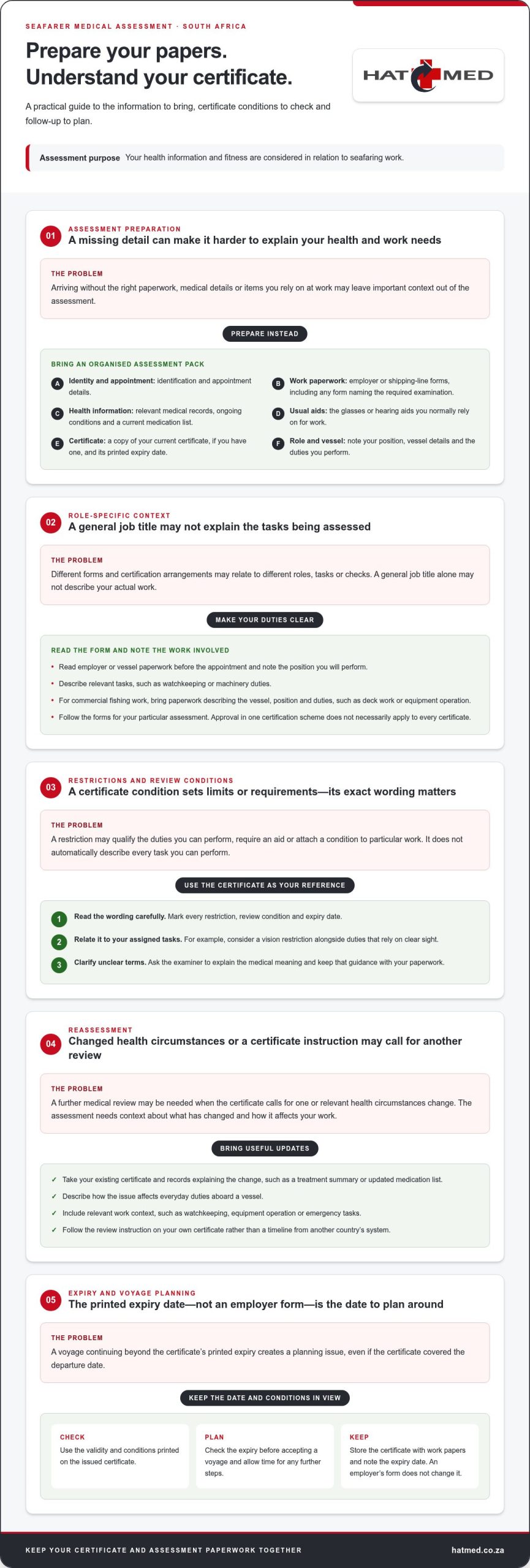
A medical assessment reviews your health information and fitness in relation to seafaring work. Before a South African appointment, organise your identification, appointment paperwork and relevant medical records. Bring any employer or shipping-line forms, as they may specify the examination required. Include a current medication list and details of ongoing conditions. If you use glasses or hearing aids, bring the ones you normally rely on. These items help you explain your health and usual work needs clearly.
A shipping-line-specific medical examination is requested by an employer or vessel operator. Its forms may identify the role, tasks or checks relevant to that employer’s process. Read the paperwork before your appointment and note the position you’ll perform. For example, the form may describe watchkeeping or machinery duties that differ from your general job title. Bring a copy of your current certificate, if you have one, and note its expiry date. If a voyage may continue beyond that date, factor the expiry into your planning.
A medical examiner is the practitioner who conducts the health assessment and records its outcome. The term “approved doctor” can refer to a practitioner recognised within a particular certification scheme, so approval in one system does not necessarily apply to every certificate. Bring the form naming the required examination and any previous certificate. Check the issued document for its validity and conditions. When planning a voyage, use the expiry date printed on that certificate rather than a general period from another scheme.
A fisher medical examination assesses health in the context of commercial fishing work. Bring paperwork describing your vessel, position and duties, such as deck work or equipment operation. These details help explain the tasks involved in your role. Requirements may differ between employers and certification arrangements, so follow the forms for your particular assessment. Keep the certificate and examination paperwork together, especially if your work documents request a specific medical record.
Use this practical checklist before leaving for the assessment:
- Bring identification, appointment details and employer or vessel forms.
- Pack your current certificate, relevant medical records and medication details.
- Bring glasses or hearing aids you normally use for work.
- Note your role, vessel details and certificate expiry date.
These steps help organise the information for a South African seafarer medical examination. Use the certificate’s wording and expiry date as your reference for its conditions and voyage planning.
Certificate restrictions and reassessments
A certificate restriction is a condition recorded on a medical fitness certificate that qualifies the duties a seafarer can perform. Read the wording carefully: it may describe a limitation, a required aid or a condition attached to particular work. For example, a vision restriction should be considered alongside duties that rely on clear sight. The certificate’s exact terms are the practical reference. Keep a copy accessible and relate each condition to your assigned tasks.
A reassessment is a further medical review after an earlier examination. It updates the assessment when the certificate calls for review or relevant health circumstances change. Bring the existing certificate and records explaining the change, such as a treatment summary or updated medication list. Describe how the issue affects your everyday duties aboard a vessel. Details about watchkeeping, equipment operation or emergency tasks provide useful context when considering fitness and any limits.
An expiry date marks the end of the certificate’s stated validity. Check it before accepting a voyage and plan the next assessment with enough time for any further steps. If a voyage continues beyond the printed expiry date, this creates a planning issue, even if the certificate covered the departure date. Keep the document with your work papers and record the date in your calendar. An employer’s medical form does not change the expiry date printed on the certificate.
A review condition is an instruction on a certificate specifying when further medical attention or assessment is required. Follow the wording on your own document rather than applying a timeline from another country’s system. For South African planning, the certificate’s stated expiry and conditions are the key references. If the document specifies a review, note the instruction and organise relevant records before attending. This connects the follow-up to the original assessment.
Use this sequence when a restriction or review condition appears:
- Read the certificate and mark every restriction, review condition and expiry date.
- Compare each condition with your actual duties, such as watchkeeping or equipment checks.
- Gather relevant medical records and note changes since the previous examination.
- Arrange the required follow-up in time to address the certificate’s instructions.
- Keep the updated certificate with your employment and voyage documents.
A restriction does not automatically describe every task you can perform; its wording sets the relevant limits. For example, a condition requiring corrective lenses should be read alongside the certificate’s stated duties or requirements. If the wording is unclear, ask the examiner to explain its medical meaning and record the guidance. Keep that explanation with your paperwork, particularly if your role or health changes.
What to bring to the assessment
An assessment pack is the set of documents and personal items that helps explain your identity, health and work duties. Before leaving, put your identification, appointment details and any employer forms together. Add your current certificate if this is a renewal. Keep originals secure and bring copies of medical records where available. An organised pack makes it easier to provide accurate details during the examination.
Identification confirms who is attending the appointment. Bring the document used for your booking and check that the name matches your employer’s paperwork. If your surname differs between documents, carry evidence explaining the difference, such as a marriage certificate. Keep your appointment confirmation accessible, whether printed or stored on your phone. This can prevent delays while you search through emails or travel documents at reception.
Medical records describe past or current health conditions and treatment. Bring recent letters, test results or discharge summaries relevant to your health. For example, a cardiologist’s report can clarify treatment and follow-up after a heart-related diagnosis. Include details of previous operations and significant injuries. If your records are electronic, save them somewhere you can open without relying on a weak connection.
A medication list is a current record of medicines, doses and how often you take them. Include prescription and non-prescription products, such as pain relief or supplements. Write down each medicine’s name and why you use it. If you have stopped a treatment, note when and why. Don’t rely on memory alone, especially if several medicines have similar names or are taken at different times.
Corrective aids support your vision or hearing during daily tasks. Bring your usual glasses, contact lenses or hearing aids, along with relevant prescription details. If you use more than one pair of glasses, take the pair you wear for work. For example, reading glasses may differ from those used for distance. Tell the examiner which aid you use and when you need it.
Role information briefly describes your actual work aboard a vessel. Note your job title, routine tasks and safety duties, such as keeping watch or responding to alarms. Bring shipping-line forms listing specific checks, and identify the vessel type if the form asks. Clear examples help explain how a health concern may relate to your work, rather than relying only on a general job title.
Use this final preparation sequence:
- Match your identification details against the appointment paperwork.
- Arrange health records by condition or treatment date.
- Write a complete medication list and pack your usual aids.
- Read employer forms and note any questions about a requested test.
For a South African seafarer medical assessment, these items help you describe your health and work clearly. The examiner can review them alongside the examination and any requested tests.
BMI requirements
Body mass index, or BMI, is a screening measure based on a person’s height and weight. For a SAMSA medical examination, a BMI from 30.1 to 34.9 may lead to delays, additional testing or limited fitness validity. This range does not, by itself, describe the full assessment outcome. It signals that further consideration may be needed before the examiner completes the fitness decision.
The practical effect depends on the examination findings and any follow-up information requested. For example, additional testing may mean the assessment takes more than one step. Limited fitness validity may mean a shorter period before another medical review. A delay can affect work or travel planning, so allow time for further appointments where possible. Don’t assume that a BMI in this range automatically means an unfit result.
BMI is one part of the health information considered during an examination. It should be viewed alongside your medical history, current health and the demands of your seafaring role. A measurement alone cannot show how you manage duties aboard a vessel. If the examiner requests further information, provide relevant records and attend the required follow-up. This allows the assessment to consider your circumstances rather than relying on one figure alone.
Before the appointment, prepare to discuss your health clearly. If you’ve had recent medical investigations or treatment, bring the related reports. Write down your current medication and any health concerns you want to raise. If a previous assessment resulted in a restriction or follow-up request, bring that certificate or paperwork. These details help explain the context of your current examination and any additional testing.
Use these steps to prepare:
- Check the appointment instructions for any requested documents or tests.
- Bring relevant medical reports and details of current medication.
- Tell the examiner about health changes since your last assessment.
- Ask what the next step involves if further testing is requested.
- Keep a record of any follow-up date or certificate condition provided.
If additional testing is needed, ask which result or information it is intended to clarify. For instance, a requested report may relate to a health issue raised during the examination. Keep the request and resulting paperwork together, so you can provide a consistent account at follow-up. The BMI range of 30.1 to 34.9 is relevant to SAMSA examinations, but it should not be treated as a universal rule for every employer or maritime medical system.
For seafarers, the practical approach is to prepare accurate health information and understand any follow-up instructions. A BMI figure may prompt further review, but the examiner’s overall assessment and the certificate’s stated conditions guide the next steps.
How do I apply for a seafarer fitness certificate in South Africa?
Applying means arranging the required medical assessment and completing the steps needed for a fitness decision. Start with paperwork supplied by your employer, vessel operator or training organisation. Identify the required certificate or examination before booking. A general medical check and a seafarer assessment may serve different purposes, so follow the wording on the form. If it names SAMSA, keep that instruction with your appointment details.
First, confirm the assessment type from your work documents. Note your position, vessel details and any employer-specific medical form. For example, a deck officer’s paperwork may identify duties that differ from those of an engine-room worker. Don’t rely only on your job title if the form describes particular tasks. Accurate details help relate the assessment to the work you’ll perform.
Next, arrange an appointment for the relevant seafarer medical examination. When booking, have the form and your current certificate nearby, if you already hold one. This makes it easier to explain whether you need an initial examination, renewal or review. Keep the appointment confirmation with your employer’s instructions. If the paperwork requires particular tests, note them so you can discuss them before attending.
Prepare your information before the appointment. Bring identification, relevant medical records, your medication list and any previous certificate. Include reports about ongoing conditions or treatment, such as a specialist letter following an operation. Write down questions about your duties or a previous restriction. Clear records help you give consistent answers and discuss your health history.
At the assessment, answer questions about your health and work accurately. Describe your actual duties, including watchkeeping, equipment operation or emergency tasks where relevant. The examination may include clinical checks or further tests, depending on the assessment process and information considered. Follow the examiner’s instructions and ask what any requested follow-up involves. The result may state fitness, include restrictions or require further review; read the issued document carefully.
After the examination, keep the certificate and related instructions with your employment records. Note its expiry date and any review conditions. If further information or testing is requested, organise the follow-up and retain the resulting reports. For example, a certificate with a review condition needs attention before the specified review. This helps you plan around work documents and voyage arrangements.
For a seafarer fitness certificate in South Africa, the key first move is matching the assessment to the requirement on your work paperwork. Bring the right documents, explain your duties clearly and keep the outcome accessible. To arrange a relevant seafarer medical examination, use the booking option on the practice website.
Hatmed Medical Centre: General Practitioner Consultations
Hatmed Medical Centre offers General Practitioner Consultations for seafarers who need to discuss a health concern affecting their wellbeing or medical assessment. A consultation can help you review an ongoing condition, understand treatment information or discuss a change in your health. Bring relevant medical records and current medication details so the discussion can focus on your circumstances.
If you manage a long-term condition, Chronic Disease Management can support ongoing care alongside your usual health routine. A GP consultation is not a substitute for a required seafarer medical assessment or certificate decision. It can, however, provide an opportunity to discuss general health questions and treatment concerns before or after an assessment.
For a GP consultation, contact Hatmed Medical Centre or visit hatmed.co.za.
Take your next step with confidence
Planning for a seafarer fitness certificate in South Africa is also an opportunity to take a considered approach to your ongoing health. If a health concern needs attention, a General Practitioner Consultation gives you space to discuss it and consider suitable next steps. Keeping your wellbeing in view can support you beyond the paperwork and help you prepare thoughtfully for future work at sea.
Hatmed Medical Centre offers Seafarers / SAMSA Medical Examinations, General Practitioner Consultations and Immigration Medical Examinations. Choose the service that matches your immediate need, whether you’re arranging a seafarer examination or seeking medical advice about a separate concern.
For guidance on the next step, contact Hatmed Medical Centre. A clear plan can help you move forward with greater confidence and care.
Frequently Asked Questions
What is a seafarer fitness certificate in South Africa, and who needs one?
A seafarer fitness certificate records the medical assessment of a person’s fitness for maritime work. Whether you need one depends on the requirements for your position, vessel and employer. For example, an operator may require a medical certificate before assigning you duties at sea. Check the wording in your employment or vessel paperwork, as requirements can differ between roles and operating arrangements.
Which South African authority issues or recognises seafarer medical fitness certificates?
SAMSA is the relevant South African maritime reference for seafarer medical examinations. The examining practitioner conducts the medical assessment, while certificate requirements and recognition relate to the applicable maritime and employment arrangements. Read the instructions accompanying your application or employment documents to identify the required certificate. This distinction matters if a form names a particular scheme or requests a specific medical document.
Where can I get a seafarer medical examination in South Africa?
You can arrange a seafarer medical examination through a medical centre offering Seafarers / SAMSA Medical Examinations. Hatmed Medical Centre provides this service. Before booking, have your employer’s paperwork available so you can identify the required assessment. If you also need to discuss a separate health concern, a General Practitioner Consultation can address it independently of the certificate assessment.
What documents and tests are required for a South African seafarer medical?
Requirements depend on the requested assessment and the instructions accompanying your paperwork. Useful documents often include identification, previous medical records and details of current treatment. Tests are selected as part of the examination process; there is no single test list to assume for every role or assessment. For example, an employer’s form may request particular checks, so bring it to your appointment.
How long is a South African seafarer fitness certificate valid?
Use the expiry date printed on your certificate as the operative date for that document. The validity period may relate to the applicable examination requirements and any conditions recorded on the certificate. Check the date before accepting work or planning a voyage, especially if the voyage may continue beyond expiry. Don’t apply a validity period from another country’s system, since foreign rules do not establish the dates for your South African certificate.
Can a South African seafarer use an ENG1 or foreign medical certificate?
An ENG1 or another foreign certificate should not be treated as automatically interchangeable with a South African seafarer medical certificate. Recognition depends on the applicable maritime scheme, vessel arrangements and employer requirements. Compare the certificate requested in your work documents with the document you hold. If the paperwork requires a specific examination or certificate, arrange that assessment rather than relying on a different country’s document alone.
What happens if a seafarer is found medically unfit, and how can the decision be appealed?
A decision of unfitness means the assessment has not cleared you for the relevant work in its current form; a restriction may instead limit particular duties. Read the written outcome for its reasons, conditions and review instructions. If you disagree, follow the appeal or review route stated in the decision and provide relevant medical evidence. Keep copies of the outcome, supporting reports and correspondence together.