

The right medical certificate depends on the requirements for your role and vessel, not simply on being a deck cadet. The ENG 1 is relevant to UK seafarer requirements, while South African seafarers may need a SAMSA medical examination. The deck cadet medical examination requirements and guidelines start with identifying which standard applies to your situation.
It’s understandable to want clarity before booking an examination, especially when different certificates and checks can be confusing. This guide explains which certificate may be required, what an ENG 1 examination checks, and how to prepare for the process.
You’ll also learn how hearing, vision, medical history and other parts of the assessment fit into the examination, so you can prepare with a clearer idea of what to expect.
Key Takeaways
- Match the certificate to your role, vessel and operating requirements; South African seafarers may need a SAMSA medical examination.
- Prepare for vision screening, as deck cadets who do not meet the required colour vision standard may be found unfit for the role.
- Understand how an ENG 1 result can affect fitness for duty, including possible restrictions and the route for an independent review.
- Arrive prepared for the examination by bringing official photo identification and being ready to discuss your medical history.
What is involved in an ENG 1 medical?
For South Africa, use the applicable SAMSA seafarers medical pathway; ENG 1 requirements describe the UK system. A deck cadet’s colour vision result can affect training and eligibility for deck duties.
-
Test Colour Vision for Deck Candidates
Complete the colour vision screening required for your intended deck-cadet pathway. First establish whether your assessment concerns South African SAMSA fitness or UK ENG 1 standards. The UK system includes specific colour vision requirements for deck candidates. A general sight test and colour vision screening assess different aspects of vision, so understand which test your examination includes.
-
Check Colour Vision for Deck Department
For UK deck-department seafarers, note whether Ishihara screening identifies a colour vision concern. A failed Ishihara screen leads to referral for a Colour Assessment and Diagnosis (CAD) test at an MCA-approved test centre. This further assessment helps determine whether the person meets the relevant colour vision standard. It is a separate step, not simply another name for Ishihara screening.
- Understand the UK CAD outcome before planning deck training. A new entrant deck candidate who fails the CAD test cannot obtain a UK certificate of competency as a deck officer. The result affects eligibility for that qualification, not merely the wording on a medical form. If your intended training or certificate is UK-based, treat the CAD assessment as a key part of the process.
- Take a failed required colour vision test seriously when considering deck-cadet fitness. Under the UK standard, a deck cadet who fails the required colour vision test is found permanently unfit because they cannot complete the required training. This outcome relates to the UK training requirement. Do not assume the UK result determines South African SAMSA fitness; the applicable national assessment pathway matters.
Seafarers and other crew members: which medical certificate do you need?
For a South African deck cadet, identify the applicable SAMSA medical examination for the intended seafaring role. UK ENG 1 standards are based on STCW and MLC guidance, but an ENG 1 is not automatically the South African certificate. Use the deck cadet medical examination requirements and guidelines as a checklist, and read the expiry date on the certificate issued for your pathway.
-
Identify the Required Medical Certificate
Confirm that your assessment is for South African seafarer fitness, rather than assuming you need a UK ENG 1. A South African deck cadet should follow the applicable SAMSA medical examination pathway. One practical part of the deck cadet medical examination requirements and guidelines is matching the certificate to your intended position and maritime requirements. Don’t treat an ENG 1 outcome as interchangeable with a SAMSA assessment.
-
Compare SAMSA, STCW and ENG1 Standards
Compare the purpose of each standard before relying on a certificate. STCW and MLC provide the international basis for UK ENG 1 medical fitness standards. SAMSA examinations address South African seafarer medical fitness, while ENG 1 applies within the UK system. These standards relate to maritime fitness, but that does not make their certificates automatically interchangeable.
-
Complete the Required Medical Examinations
Arrange the medical examination that applies to your South African deck-cadet role. The assessment establishes medical fitness for seafaring duties; an ENG 1 examination is relevant when the UK pathway applies. Review the certificate issued after your assessment and note its expiry date. Don’t assume one validity period applies to every certificate or pathway.
- Act promptly if a UK ENG 1 decision affects your duties. A failed colour vision test may lead to a restriction against night lookout duties; a failed CAD test may also affect eligibility for MCA certificate of competency or rating certification. To seek an independent review, contact UK MCA seafarer services within one month of the ENG3 being issued. An appeal cannot be made more than once when successive examinations concern the same restriction or reason for failure.
If found permanently unfit, provide clinical evidence that the condition has been reversed when seeking another ENG 1 within the next five years. This applies to the UK ENG 1 process, not as a stated SAMSA appeal rule.
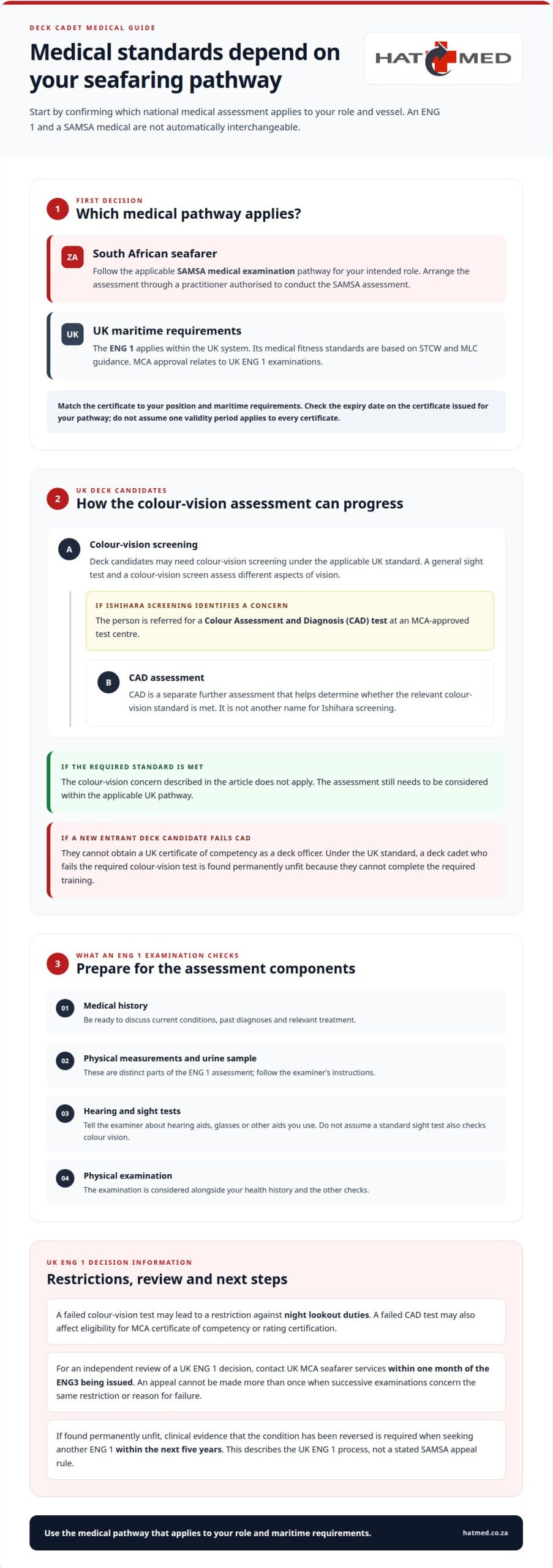
ENG 1 medical examination components
In South Africa, arrange a seafarers medical examination through a practitioner authorised to conduct the SAMSA assessment. MCA approval relates to UK ENG 1 examinations; it does not, by itself, establish authority to issue a South African seafarer medical certificate.
- Start by identifying which examination you need. The ENG 1 process applies to UK maritime requirements, whereas South African seafarers follow the relevant SAMSA process. Don’t treat the certificates as interchangeable. The examination route determines which medical standard and certificate apply to your role.
- Prepare a clear account of your medical history for the appointment. The ENG 1 examination includes a review of your history, so note current conditions, past diagnoses and relevant treatment. Be ready to explain the details accurately. This helps the examiner assess your health in relation to seafaring work.
- Expect physical measurements and a urine sample as part of an ENG 1 examination. Follow the examiner’s instructions for each check, and ask for clarification if you’re unsure what is required. These are distinct parts of the assessment, alongside the discussion of your health history.
- Complete the hearing and sight tests carefully. The ENG 1 examination checks both, and colour vision screening may be particularly relevant to deck duties. Tell the examiner about hearing aids, glasses or other aids you use. Don’t assume a standard sight test assesses colour vision as well.
- Allow time for the physical examination and any additional assessment indicated by your results. The ENG 1 process brings together the history, measurements, urine sample, hearing and sight checks, and physical examination. The examiner considers these elements as part of the overall fitness assessment, rather than treating one result as the entire examination.
- Before attending in South Africa, confirm that the appointment is for a SAMSA seafarers medical examination, not a UK ENG 1. A medical examiner’s MCA approval concerns the UK certificate; it should not be read as proof of SAMSA authority. Keep the correct certificate pathway clear when preparing your application and appointment.
A deck cadet must meet the medical standard applicable to the South African SAMSA examination for their role; UK ENG 1 standards and certificates are not interchangeable with the SAMSA pathway.
The examination must be conducted by a practitioner authorised to carry out the SAMSA assessment. MCA approval for UK ENG 1 examinations alone does not establish South African authority.
ENG1 medical examination process and checks
For a UK ENG 1, prepare for identification, clinical checks and any additional tests. This is distinct from the South African SAMSA medical pathway.
- Bring an official photo identification document to your ENG 1 appointment. You must present photo ID, although the doctor does not enter identification document details on the certificate. That change has applied since the end of May 2018. Keep your identification available for the appointment, even though its details are omitted from the certificate.
- Start the assessment by discussing your medical history with the doctor. Clearly describe relevant health conditions, diagnoses and treatment. This information helps put examination findings in context. Be accurate and mention current medication, rather than giving a brief summary that leaves out important details.
- Follow the doctor’s instructions for the examination checks. The ENG 1 assessment includes measurements, a urine sample, hearing and sight tests, and a physical examination. Each check contributes information to the medical assessment. Allow time to complete them in sequence and ask for clarification if an instruction is unclear.
- Ask before any additional ENG 1 test takes place if it may involve an extra charge. An approved doctor may charge for further tests, but the payer must agree to that charge before testing begins. This gives you a clear opportunity to understand and agree the cost before proceeding.
- Review the outcome and certificate details before leaving the appointment. An ENG 1 certificate is usually issued on the examination day if you pass. Read the result and any restrictions carefully, since the certificate records the assessment outcome relevant to your seafaring fitness.
- Keep the UK and South African processes separate when planning your next step. ENG 1 is the UK medical certificate, while South African seafarers follow the SAMSA medical route. A UK appointment or its result does not itself establish that you have completed the South African assessment.
Hatmed Medical Centre: General Practitioner Consultations
Hatmed Medical Centre offers Seafarers / SAMSA Medical Examinations for South African seafarers preparing for medical fitness assessment. If your requirement relates to a UK ENG 1, remember that it belongs to a separate certification pathway; a SAMSA examination addresses South African seafarer requirements. General Practitioner Consultations can also support you with general health concerns, whilst Chronic Disease Management provides care for ongoing conditions that may need attention as part of your health planning.
Choose the appointment that matches your need: a seafarer medical examination for the applicable SAMSA assessment, or a GP consultation for a general health discussion. For South African medical support, contact Hatmed Medical Centre or visit hatmed.co.za.
Take your next step with confidence
Use the deck cadet medical examination requirements and guidelines to plan for your appointment. Before booking, identify the certificate pathway relevant to your intended work and gather the health information you’ll need to discuss. Organising this information can help you focus on the assessment and understand any next steps.
For South African seafarer medical assessments, Hatmed Medical Centre offers Seafarers / SAMSA Medical Examinations. Its General Practitioner Consultations can also address general health concerns, while Immigration Medical Examinations support people completing immigration-related medical assessments. Choose the service that matches your needs.
Contact Hatmed Medical Centre to discuss your medical appointment. Taking the next step with the right information can make your preparation feel more manageable.
Frequently Asked Questions
Can a seafarer appeal more than once, following successive examinations?
No. Under the UK ENG 1 process, a seafarer cannot appeal more than once when successive examinations concern the same restriction or reason for failure. This limit relates to repeated examinations addressing the same issue, rather than every medical decision a seafarer might face. Keep the decision and examination records together so the reason for any review is clear.
What ID is required by seafarers when attending for a medical?
For a UK ENG 1 appointment, bring an official photo identification document. This requirement concerns the ENG 1 process; don’t assume it defines the document rules for a South African SAMSA examination. Keep your identification accessible when attending, and bring any examination paperwork provided for your appointment so the assessment can be completed against the correct pathway.
What does “Permanently unfit” mean?
In UK ENG 1 guidance, “permanently unfit” means the seafarer is considered unfit for at least five years. It is not the same as a temporary finding. If the seafarer seeks another ENG 1 within that period, clinical evidence that the condition has been reversed is required. The term describes a formal medical outcome, not simply a delayed appointment.
What vision and colour vision standards apply to deck cadets?
UK deck candidates must meet the required colour vision standard for their training and duties. Deck-department seafarers who fail Ishihara screening are referred for a Colour Assessment and Diagnosis test at an MCA-approved centre. A new entrant who fails the CAD test cannot obtain a UK certificate of competency as a deck officer because they cannot complete the required training.
What documents should a deck cadet bring to a medical examination?
For a UK ENG 1 appointment, take official photo identification. Also organise a concise account of your medical history, current medicines and any relevant clinical reports, as these details can help you answer questions accurately. Bring glasses or hearing aids you normally use for testing. These extra items are sensible preparation, but they are not a stated list of mandatory documents.
What happens if a deck cadet fails or is found temporarily unfit at the medical examination?
The outcome depends on the finding and the certificate pathway. Under UK ENG 1 rules, a colour vision result may lead to a restriction, while a new entrant who fails the required CAD test cannot obtain a deck officer certificate of competency. If told you’re temporarily unfit, ask for the reason and the specific follow-up or evidence needed for reassessment.