

Medical clearance is part of fishing safety, not just a formality. The commercial fishing crew medical clearance regulations in South Africa start with the maritime framework: the Minister of Transport issued the relevant regulations under section 356 of the Merchant Shipping Act, 1951 (Act No 57 of 1951). ILO Convention No. 188 requires fishers to hold a medical certificate.
If you’re responsible for crew or preparing to go to sea, it’s reasonable to want clear answers about who needs certification and whether vessel size changes the rules. Understanding commercial fishing crew medical clearance regulations in South Africa helps distinguish national requirements from rules that apply elsewhere.
This guide explains which commercial fishing crew need medical certificates, how vessel size and operating patterns relate to requirements, and when exemptions may apply. It also covers the role of medical fitness in protecting crew health and supporting safe vessel operation.
Key Takeaways
- Distinguish South African requirements from UK vessel-length and time-at-sea thresholds; UK rules don’t automatically apply to South African crews.
- For the small-vessel exemption described, eligibility depends on existing-fisher work history as well as vessel size.
- Medical examinations help assess fitness for work at sea and support crew health and safe vessel operation.
- Understand SAMSA’s role in issuing certificates under the Merchant Shipping (Training and Certification) Regulations, 1999.
Medical certificate thresholds by vessel length and operating pattern
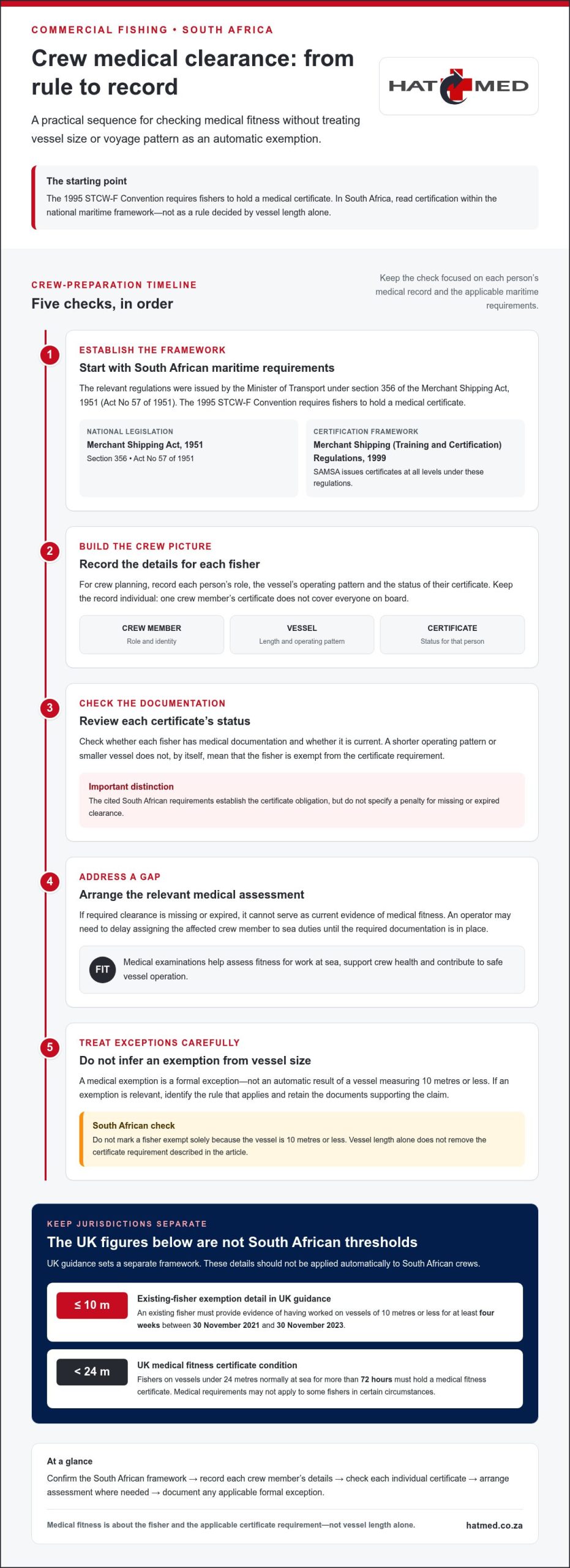
A medical certificate records whether a fisher meets the applicable medical fitness requirement. The commercial fishing crew medical clearance regulations in South Africa begin with the requirement for fishers to hold a certificate under the 1995 STCW-F Convention. Vessel length and time at sea should not be treated as automatic exemptions from that baseline.
SAMSA issues certificates at all levels under the Merchant Shipping (Training and Certification) Regulations, 1999. This identifies the South African certification framework. The commercial fishing crew medical clearance regulations in South Africa should therefore be read in that national context, rather than assuming that a vessel’s size alone determines whether a fisher needs medical clearance.
For crew planning, record each person’s role, the vessel’s operating pattern and the status of their certificate. These details help operators organise medical assessments and crew documentation around actual maritime work. A shorter operating pattern or smaller vessel does not, by itself, mean a fisher is exempt from the certificate requirement.
A vessel’s length and voyage pattern can be relevant when identifying applicable maritime requirements. Operators should distinguish these operational details from the general certificate requirement for fishers. For example, a crew list should show whether each fisher has current medical documentation, rather than assume that one person’s certificate covers everyone on board.
If required clearance is missing or expired, it cannot serve as current evidence of medical fitness. Operators may need to delay assigning the affected crew member to sea duties until the required documentation is in place. The cited South African requirements establish the certificate obligation but do not specify a penalty for missing or expired clearance.
Build a document check into crew preparation: identify the applicable South African maritime requirements, review each certificate’s status and arrange the relevant assessment where needed. This keeps vessel planning focused on individual crew records, rather than assumptions based only on vessel size or operating pattern.
Medical exemptions for some fishers on vessels of 10 metres or less
A medical exemption is a formal exception to a certificate requirement, not an automatic result of a vessel’s size. For South African commercial fishing, don’t treat 10 metres or less as a standalone exemption from the requirement for fishers to hold a medical certificate.
The 1995 STCW-F Convention requires fishers to hold a medical certificate. A vessel’s length alone doesn’t remove that requirement. The 10-metre figure in this heading should therefore not be used as proof that a South African fisher qualifies for an exemption. Operators need to distinguish a stated legal exception from an assumption based only on vessel dimensions.
For practical crew planning, record the vessel’s length and operating pattern alongside each crew member’s certificate details. This creates a clear record of the factors considered, without treating one measurement as decisive. For example, a fisher working on a vessel measuring 10 metres or less should not be marked exempt solely because the vessel falls within that size.
Where an exemption is relevant, its conditions determine who qualifies and what evidence is needed. Crew records should identify the applicable rule and retain documents supporting any claimed exception. This helps prevent an informal interpretation of vessel size from being mistaken for a valid clearance decision.
South African operators should use the applicable maritime certification framework when preparing crew for work at sea. Medical fitness concerns the fisher and the certificate requirement, not simply the vessel’s length. If a crew member needs an examination, arrange the appropriate medical assessment instead of relying on a size-based assumption.
For an examination connected with maritime work, a seafarer medical examination can support the medical assessment step.
UK guidance sets a separate framework: an existing fisher must provide evidence of having worked on vessels of 10 metres or less for at least four weeks between 30 November 2021 and 30 November 2023. Medical requirements may not apply to some fishers in certain circumstances. Fishers on vessels under 24 metres normally at sea for more than 72 hours must hold a medical fitness certificate.
National regulations for fishers’ medical examinations
South African requirements sit within maritime regulations and international standards. These rules support crew health and safe vessel operation.
Medical standards across crew roles
Medical fitness requirements concern a fisher’s health and ability to work safely at sea. The national framework identifies fishers generally, so skippers, deckhands and other crew should not assume their job title removes the certificate requirement. Medical examinations help reduce risks to fellow crew and support safe vessel operation. The cited requirements do not specify separate medical thresholds for each role.
Certificate issuers and authorisation
A certificate issuer is the authority responsible for issuing the relevant seafarer medical certificate. SAMSA issues certificates at all levels under the Merchant Shipping (Training and Certification) Regulations, 1999. The regulations were issued by the Minister of Transport under section 356 of the Merchant Shipping Act, 1951, identified as Act No 57 of 1951. For the official certificate route and forms, consult SAMSA.
Certificate validity and renewal timing
Certificate validity is the period during which a medical certificate remains current. The South African facts here establish the certificate requirement but do not specify a validity period. Check the expiry date on the individual certificate and arrange renewal before it lapses. A UK validity period cannot replace South African requirements. Renewal involves obtaining a current medical assessment and certificate through the applicable SAMSA route.
Fitness requirements for foreign crew
Medical fitness requirements concern whether a fisher can work safely and protect their health at sea. ILO Convention No. 188 requires fishers to hold a medical certificate. Its stated requirement concerns fishers, not a particular crew nationality. A diagnosis or medication alone cannot be identified here as an automatic bar; the relevant assessment concerns health and fitness for work. Foreign crew should hold the certificate applicable to their duties and vessel.
Who is authorised to conduct and issue a seafarer medical certificate in South Africa?
A certificate issuer is the authority that formally issues a seafarer medical certificate. SAMSA issues certificates at all levels under the Merchant Shipping (Training and Certification) Regulations, 1999.
The examination and certificate issuance are related but distinct steps. A medical examination assesses fitness, while the certificate is issued through the applicable maritime certification framework. The regulations were issued by the Minister of Transport under section 356 of the Merchant Shipping Act, 1951, identified as Act No 57 of 1951. This framework identifies SAMSA as the issuing authority.
For a South African seafarer certificate, use the SAMSA route rather than assuming that any general medical note serves the same purpose. ILO Convention No. 188 requires fishers to hold a medical certificate. The examination supports assessment of fitness, crew safety and safe vessel operation. It also helps address health risks that could affect colleagues at sea.
Before arranging an examination, establish which certificate the role requires and follow the relevant SAMSA process. The South African facts here identify SAMSA’s issuing role but do not specify a separate list of authorised examining practitioners or an official form. Do not treat foreign certificates or guidance as automatic substitutes for the South African process.
Hatmed Medical Centre provides Seafarers / SAMSA Medical Examinations for people preparing for maritime work or needing a seafarer medical assessment. This is a practical step towards the examination; certificate issuance remains part of the SAMSA framework. The assessment considers health and fitness in relation to seafaring duties, helping individuals understand the medical clearance process.
To arrange a relevant assessment, book a Seafarers / SAMSA Medical Examination. Keep the certificate’s stated details available for the vessel’s records, and follow its applicable renewal requirements before returning to sea.
Hatmed Medical Centre: General Practitioner Consultations
Hatmed Medical Centre provides General Practitioner Consultations for fishing crew seeking support with health concerns alongside work-related medical needs. A consultation gives you an opportunity to discuss a condition, medication or health change that may affect your wellbeing at sea. For a formal seafarer assessment, Hatmed also provides Seafarers / SAMSA Medical Examinations.
Bring relevant medical information to your appointment, including details of current treatment, so the clinician can consider your health in context. If you’re managing an ongoing condition, Chronic Disease Management can support continuity of care. These services complement the regulatory process; the applicable certificate is issued through the maritime framework.
For a seafarer medical assessment or support with a general health concern, contact Hatmed Medical Centre.
Make medical preparation part of crew planning
Build medical preparation into your crew management process instead of treating it as departure-day paperwork. Make responsibility clear for monitoring certificate records and arranging assessments, so a crew member’s health needs can be addressed before they affect work at sea. Planning ahead also gives individuals time to discuss relevant health concerns confidentially.
Understanding commercial fishing crew medical clearance regulations in South Africa is one part of responsible planning. When an assessment is required, arrange it and keep the resulting documentation organised for the relevant maritime process. Hatmed Medical Centre can support your next step with medical care suited to your needs.
If you’re ready to arrange an assessment or discuss a health concern, contact Hatmed Medical Centre. A clear plan can help you approach your next voyage with greater confidence.
Frequently Asked Questions
What medical fitness requirements apply to commercial fishing crew in South Africa?
Commercial fishers must hold a medical certificate under the 1995 STCW-F Convention. The assessment relates to fitness for work at sea, supporting the health and safety of the fisher and crew. In practice, crew planning should include checking each person’s certificate status against their intended duties and vessel operations, rather than assuming that a role or vessel size automatically removes the requirement.
Which South African laws and regulations govern medical clearance for fishing vessel crew?
The relevant framework includes the Merchant Shipping Act, 1951 (Act No 57 of 1951), and the Merchant Shipping (Training and Certification) Regulations, 1999. The Minister of Transport issued the referenced regulations under section 356 of the Act. ILO Convention No. 188 also requires fishers to hold a medical certificate. These instruments provide the legal context for crew clearance and certification.
What medical examinations and tests are required for commercial fishing crew clearance?
A medical examination assesses a fisher’s health and fitness for work at sea, but the applicable facts do not establish a universal list of tests for every crew member. The assessment supports safe vessel operation and helps reduce health risks to other crew. Bring relevant information about current health conditions and medication so these can be considered in relation to seafaring duties.