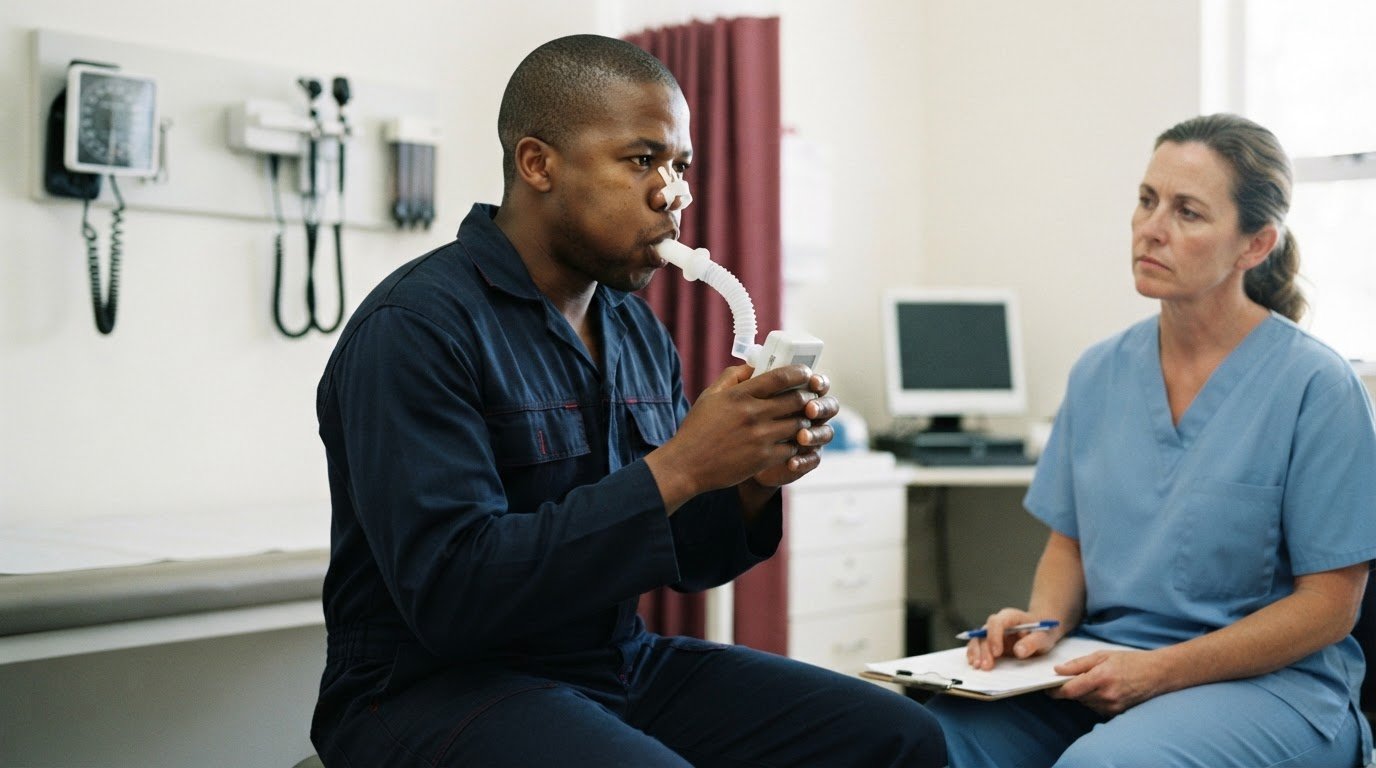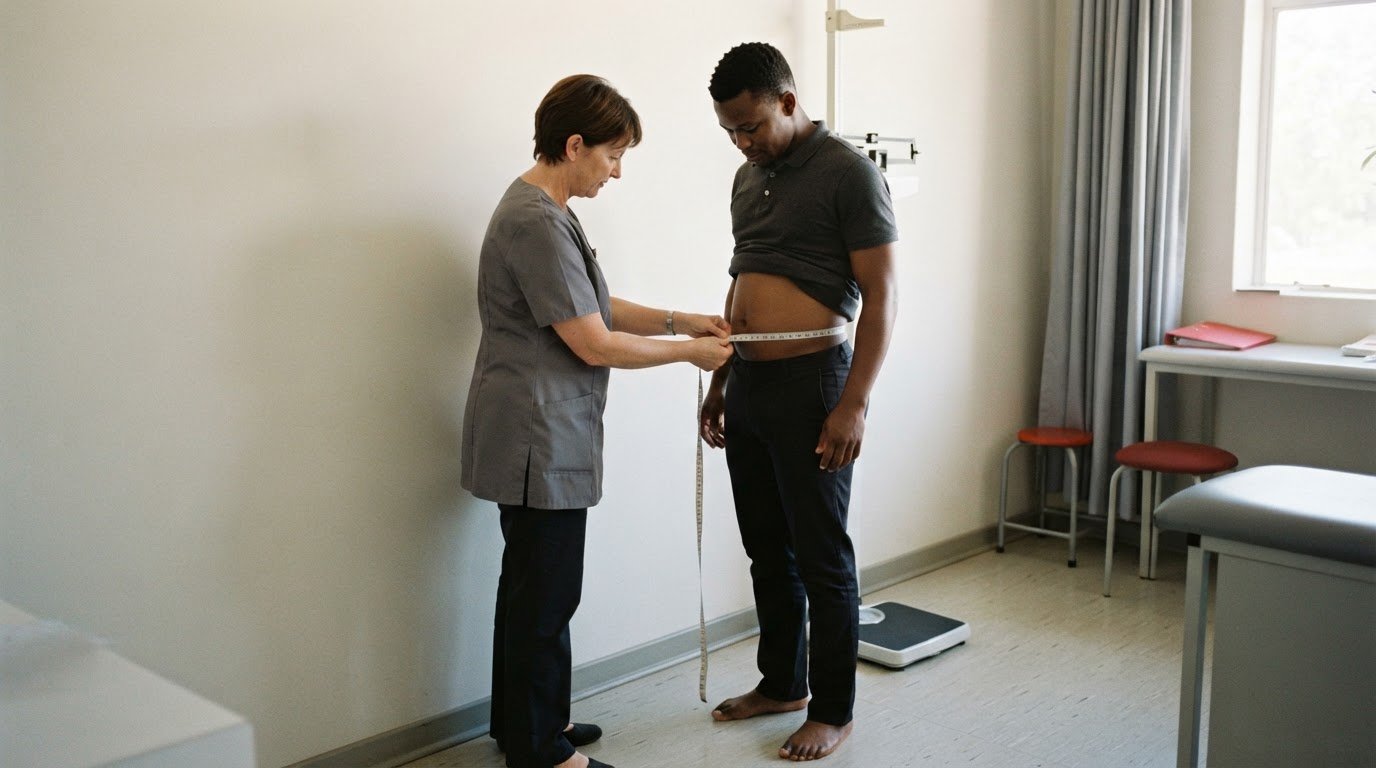

A medical fitness decision is more than a pass-or-fail label. For South African seafarers and marine pilots, the relevant assessment depends on the duties and certificate involved. If fitness is not established, a certificate may be withheld or issued with restrictions under the applicable process. Understanding the marine pilot annual medical fitness examination standards means distinguishing the assessment from its outcome.
It’s understandable to want a clear answer about what a refusal means for your work and what happens next. This guide explains how medical requirements apply to seafarers and licensed pilots, who can assess fitness, and how a denied certificate may affect duty status. It also explains why an annual examination should not be treated as the same checklist for every maritime role.
You’ll learn what the incorporated standards cover, how a fitness decision is reached, and what to consider if the outcome is not what you expected. The aim is to make the process easier to understand and help you approach an assessment with greater clarity.
Key Takeaways
- Understand why the medical requirements for seafarers and coastal pilots depend on the duties being assessed.
- Learn what a medical fitness assessment may consider, including health, physical and functional requirements.
- See why a denied or restricted certificate can affect whether you may perform your usual duties.
- Find out when a Seafarers / SAMSA Medical Examination can support your maritime fitness assessment.
Medical fitness certificates for seafarers and licensed pilots
A medical fitness certificate records whether a person meets the health requirements for maritime duties. The required standard depends on the jurisdiction and the certificate or licence being sought.
Certificate issuance requirements
For maritime certificates and licences, a medical fitness certificate can form part of the qualification requirements. In Oman, applicants for maritime competency certificates, professional certificates and marine pilot licences must hold a valid certificate issued by a doctor accredited by the General Directorate of Maritime Affairs. This is an Omani requirement, not a South African rule.
In Australia, Marine Order 76 governs medical fitness certificates for seafarers and licensed pilots. AMSA medical inspectors use form 232 as the clinical record and form 303 as the Certificate of Medical Fitness. These examples show why the country and certificate matter: an overseas form or approval process does not automatically establish fitness under South African requirements.
Fitness categories and restrictions
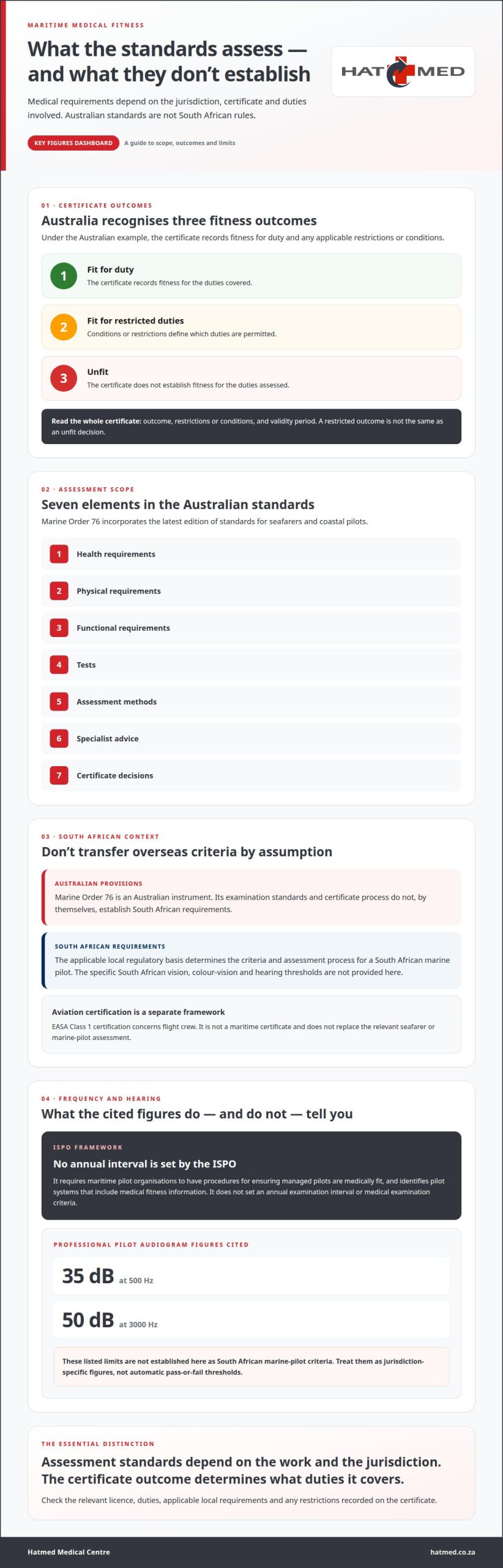
An Australian Certificate of Medical Fitness states whether an applicant is fit for duty, fit for restricted duties or unfit. It must also record any restrictions or conditions and its validity period. A restricted outcome is different from an unfit decision: it sets conditions on the duties covered by the certificate.
For a pilot, a restriction could affect which duties are permitted, depending on the condition recorded. Read the outcome alongside its restrictions and validity period, rather than treating the certificate as a simple pass or fail. Marine Order 76 also provides circumstances in which AMSA may revoke a certificate.
Medical fitness assessments apply to people working, or seeking to work, aboard ships and to licensed pilots. Australia’s incorporated medical standards cover health, physical and functional requirements, tests, assessment methods, specialist advice and certificate decisions. These are Australian standards, not South African criteria.
EASA Class 1 medical certification concerns flight crew, not maritime pilotage. An EASA Member State Class 1 certificate is accepted by other EASA Member States across their operational framework. That recognition does not make it a maritime certificate or replace the applicable assessment for a seafarer or marine pilot.
Incorporated medical examination standards for seafarers and coastal pilots
Medical standards set the health and functional areas assessed for maritime work. Requirements vary by jurisdiction, so Australian standards should not be treated as South African rules.
South African regulatory basis
The applicable regulatory basis determines which medical criteria and assessment process apply to a South African marine pilot. The available detail on incorporated standards concerns Australia’s Marine Order 76, not South African law.
Marine Order 76 incorporates the latest edition of standards for seafarers and coastal pilots, giving medical inspectors a structured basis for assessment. It covers health, physical and functional requirements, tests, assessment methods, specialist advice and certificate decisions. For South African pilots, the key distinction is that these Australian provisions cannot establish South African requirements by themselves.
Examination frequency
Examination frequency is the interval at which a pilot’s medical fitness is assessed. The marine pilot annual medical fitness examination standards should not be assumed to set one universal interval across jurisdictions.
The ISPO requires maritime pilot organisations to have procedures for ensuring that managed pilots are medically fit. It also identifies pilot administration or registration systems that include medical fitness information. However, the ISPO does not set an annual examination interval or medical examination criteria. Its management framework alone cannot determine how often a South African pilot must be examined.
Vision and colour vision standards
Vision standards concern the visual ability needed for maritime duties, while colour vision relates to distinguishing colours used in signals and navigation. Australian examination standards include required tests and assessment steps, but the South African visual-acuity and colour-vision thresholds are not provided here.
Consequently, an Australian threshold should not be presented as a South African rule. Consider the relevant South African assessment in its own regulatory context rather than inferring requirements from another country’s standards.
Hearing standards
Hearing assessment considers auditory function relevant to communication and safe work. Australian standards include examination requirements, but no South African marine-pilot hearing threshold is provided here.
A professional pilot audiogram’s listed limits, 35 dB at 500 Hz and 50 dB at 3000 Hz, are not established here as South African criteria. Treat them as jurisdiction-specific figures, not automatic pass-or-fail limits for South African pilots. A maritime medical assessment can form part of understanding the examination process.
Which South African laws or SAMSA regulations govern marine pilot medical examinations?
For a South African marine pilot, the governing medical requirements must be distinguished from overseas rules. Marine Order 76 (Health, medical fitness) 2017 is an Australian instrument, so its provisions should not be treated as South African law.
South African pilots need to understand their medical examination in the context of the local maritime certification requirements for their role. The licence, duties and assessment are connected: the examination outcome informs whether fitness for the relevant work has been established. Do not assume a foreign certificate or rule settles that question locally.
International standards can inform maritime frameworks, but they do not automatically set a South African examination schedule. The ISPO identifies the Standards of Training Certification and Watchkeeping Convention as an international foundation for its requirements. It also requires pilot organisations to maintain medical fitness procedures, but does not define annual examination intervals or medical criteria.
This distinction helps when reading medical guidance. A management system may require an organisation to maintain fitness information, while a national regulator sets the applicable certification rules. These responsibilities are related but not interchangeable. An organisation’s record of a pilot’s fitness should not be mistaken for a medical certificate or regulatory standard.
For comparison, Australia’s Marine Order 76 gives effect to sections A-I/9 and B-I/9 of the STCW Code and regulation 1.2 of the Maritime Labour Convention. Those legal references describe the Australian instrument’s basis. They do not establish that the same provisions govern a South African marine pilot.
In practice, separate three questions: which country’s rules apply, what medical assessment is relevant to the pilot’s duties, and what certificate or restrictions result. This helps prevent Australian forms, ISPO procedures or international references from being presented as South African law without a clear local connection.
The applicable framework is the South African maritime certification requirements for the pilot’s role, set by the national regulator. This section does not name a specific South African law or SAMSA regulation.
How often must a marine pilot undergo an annual medical fitness examination?
The word “annual” in this heading does not establish a universal yearly legal interval for South African marine pilots. The ISPO requirements do not specify an annual examination interval or medical criteria, so they cannot, by themselves, determine how often a South African pilot must be examined.
Frequency depends on the applicable certification requirements and the validity period recorded for the relevant medical certificate. For comparison, an Australian Certificate of Medical Fitness must state its validity period. This shows why the certificate’s own terms matter, but it does not create a South African renewal schedule.
Marine Order 76 applies in Australia, where medical inspectors use the standards for seafarers and coastal pilots. Those standards set out examination and assessment requirements, but the facts available here do not establish their intervals as South African rules. Applying an Australian schedule to a South African pilot could therefore give a misleading answer.
To interpret an examination date, separate three matters: the country’s rules, the certificate’s validity period, and any relevant duty restrictions. A certificate may state fitness for duty, restricted duties or unfitness, along with its conditions and validity. These details explain how the result applies; they do not establish one examination frequency for every pilot.
For example, an Australian certificate’s stated validity period informs the holder’s Australian certification status. It does not determine the next examination date for a South African licence. The applicable South African maritime certification requirements remain central, while an organisation’s fitness procedures provide a separate management context.
If you’re planning an assessment, establish which certificate or licence it relates to, then review its stated validity and restrictions. This helps distinguish an annual workplace or organisational expectation from a formal examination interval required by the relevant certification framework.
Follow the validity period and conditions on the relevant certificate, subject to the applicable South African certification requirements. An organisation’s annual expectation is not, by itself, a formal examination interval.
Hatmed Medical Centre
Hatmed Medical Centre provides Seafarers / SAMSA Medical Examinations for people preparing for maritime medical assessments. A consultation gives you an opportunity to discuss your health and understand how the assessment relates to your seafaring role, while distinguishing South African requirements from overseas standards.
If you have an existing condition, General Practitioner Consultations or Chronic Disease Management can support your ongoing care alongside a maritime assessment. These services address health needs; they do not replace licensing rules or determine a certificate outcome.
For guidance on your medical assessment and next steps, contact Hatmed Medical Centre.
Plan your next medical step with clarity
Use your next assessment as an opportunity to discuss how your health, treatment and day-to-day duties relate to medical fitness. Understanding the marine pilot annual medical fitness examination standards can help you prepare relevant information for the consultation and clarify what the assessment is intended to address.
Hatmed Medical Centre provides Seafarers / SAMSA Medical Examinations, General Practitioner Consultations and Immigration Medical Examinations. These services address different medical needs, while the relevant maritime authority remains responsible for certification requirements and decisions. If you’re arranging a medical assessment, contact Hatmed Medical Centre to take the next step.
Contact Hatmed Medical Centre to discuss your medical examination needs and move forward with confidence.
Frequently Asked Questions
What happens if the medical certificate is denied?
If a certificate is denied, it does not establish that you are medically fit for the duties concerned. You cannot rely on that certificate to demonstrate fitness for those duties. Read the decision and its reasons carefully, then clarify whether further medical information or reassessment is part of the issuing authority’s process. A denial is an assessment outcome, so understanding its stated basis is essential.
What medical fitness standards apply to marine pilots in South Africa?
South African marine pilots must be assessed against the medical requirements that apply to their licence and duties. The standards should be distinguished from Australia’s Marine Order 76 and the ISPO framework, which do not themselves establish South African criteria. For a practical example, an Australian audiogram threshold cannot automatically be treated as a South African pass mark. The relevant local certification framework determines the applicable requirements.
Which physical and psychological health criteria are assessed for marine pilots?
The assessment considers whether your health and functional capacity are compatible with your maritime duties. Physical health and functional ability are relevant areas in medical examination standards, but Australian standards do not establish a specific South African list of conditions or thresholds. Do not assume a particular psychological test or pass threshold applies without a relevant South African requirement. Medical history and supporting clinical information can help explain an individual health concern.
Who is authorised to conduct and certify marine pilot medical examinations in South Africa?
The authorised examiner depends on the South African process applicable to the pilot’s certificate or licence. Hatmed Medical Centre provides Seafarers / SAMSA Medical Examinations, but that service description alone does not establish authority to certify every marine pilot licence outcome. A medical examination and a licensing decision are distinct: the clinician assesses health, while the applicable maritime certification process governs how that assessment is used.
What happens if a marine pilot fails or is temporarily unfit at the annual examination?
A failed or temporarily unfit outcome means the assessment has not established fitness for the relevant duties at that time. The certificate’s restrictions or conditions indicate whether any duties remain permitted. A restricted outcome, for example, differs from an unfit outcome and should be interpreted according to its written terms. Further assessment or updated clinical evidence may inform a later decision through the applicable certification process.
Can a marine pilot appeal a medical decision or obtain a waiver, and what is the process?
An appeal or waiver route depends on the rules governing the South African licence and the body that issued or considered the decision. Start by reviewing the written outcome and any review instructions. If a review is available, follow the stated submission process and provide relevant medical evidence. Do not assume a waiver exists or will be granted; its availability and conditions depend on the applicable framework.