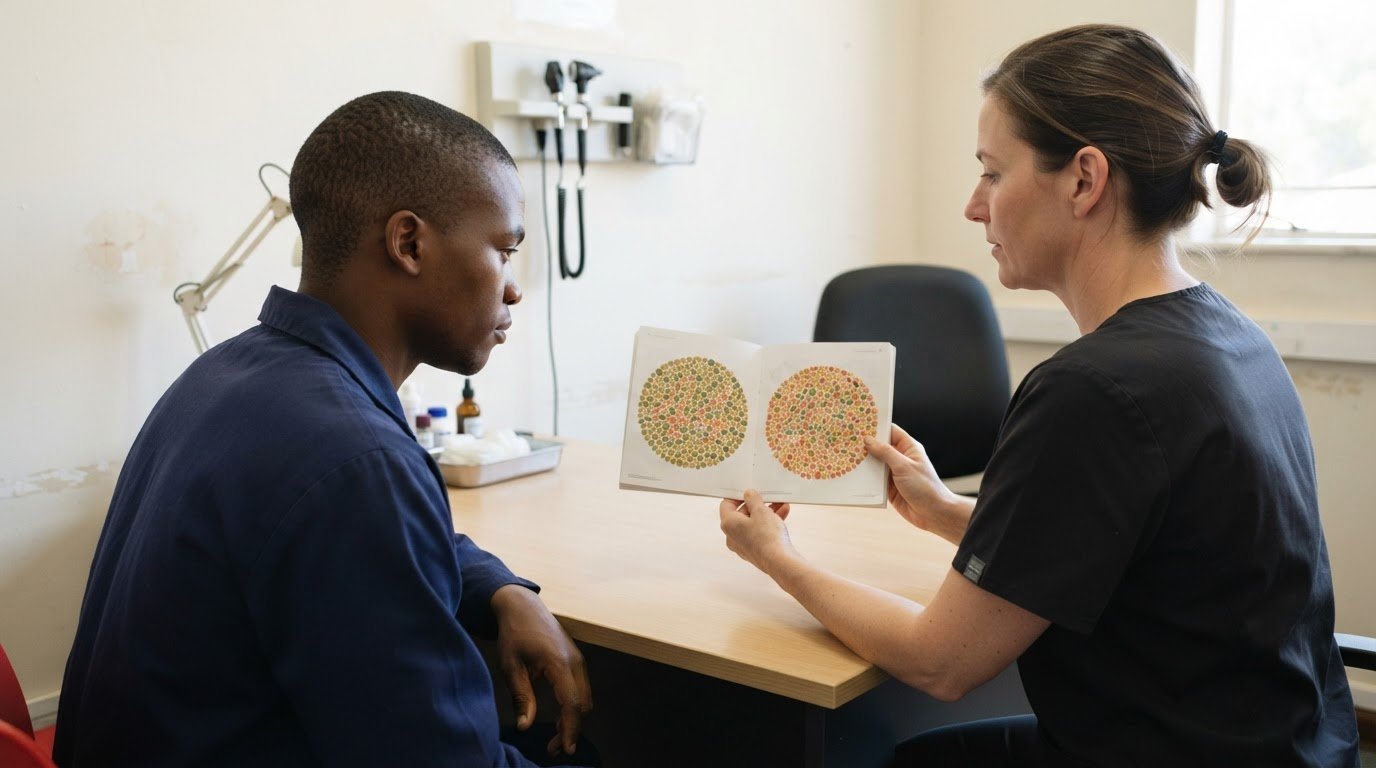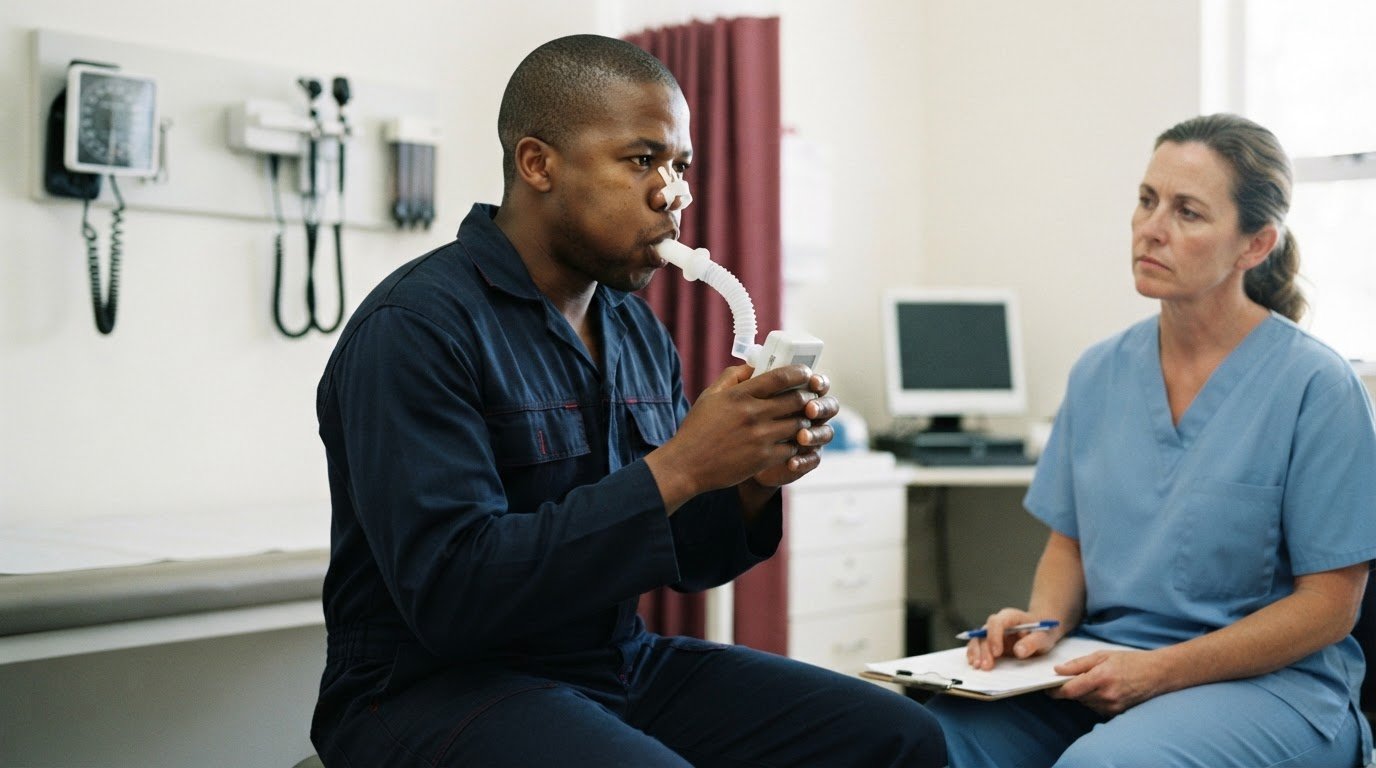
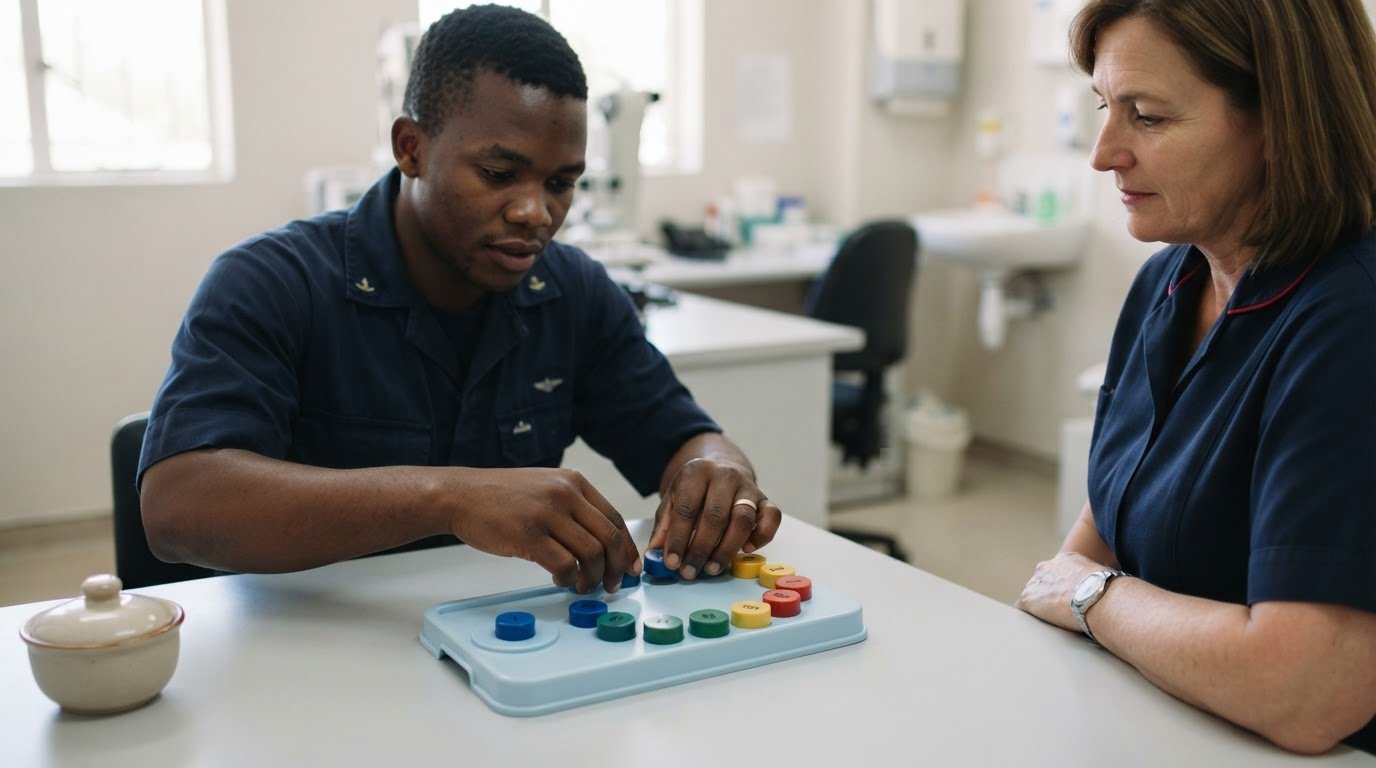
Yes. A mariner can pass a lantern test and fail Ishihara plates because the tests assess colour vision in different ways. Colour blindness lantern test alternatives for mariners include plate and colour-arrangement tests, but a result on one test does not automatically predict a result on another.
The Farnsworth Lantern Test presents vertical pairs of red, green or white lights for identification. Each target is shown for two seconds, and the test uses nine pairs. Ishihara plates, by contrast, check for red-green colour vision deficiencies using patterns of coloured dots. That difference can matter if you’re preparing for a medical assessment or trying to understand a previous result.
This guide explains how the lantern test works, how alternatives such as the Farnsworth-Munsell 100 Hue and Farnsworth D-15 tests assess colour discrimination, and how colour-vision results relate to mariner duties. It also clarifies why passing a particular test is not, by itself, the same as meeting every role’s vision requirements. Knowing what each assessment measures can help you discuss your results with greater confidence.
Key Takeaways
- Understand how proctored colour-vision alternatives assess colour discrimination differently, and why results can vary between tests.
- Learn why colour-vision criteria may differ between deck and engineering duties, and what a test result can mean for each role.
- See how mild red-green deficiency may affect recognition without making someone completely unable to distinguish colours.
- Find out what to consider when preparing for a South African seafarer medical assessment and interpreting its colour-vision results.
Proctored colour-vision testing alternatives
The colour blindness lantern test alternatives for mariners include Ishihara plates, the Farnsworth D-15 and the Farnsworth-Munsell 100 Hue test. They assess colour vision through different tasks, so results may not match. This matters if you pass one assessment but fail another, or need to understand what a result says about your ability to distinguish colours.
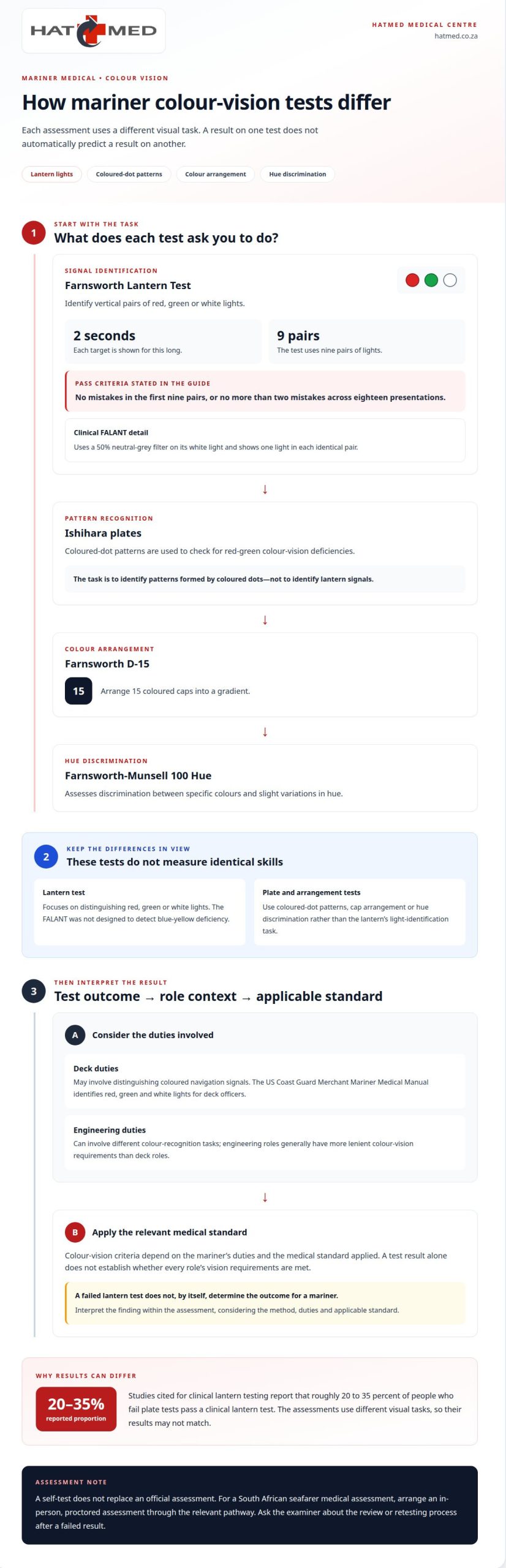
The Farnsworth Lantern Test presents vertical pairs of red, green or white lights. Each target appears for two seconds, and the test uses nine pairs. A pass means no mistakes in the first nine pairs, or no more than two mistakes across eighteen presentations. The clinical FALANT uses a fifty per cent neutral-grey filter on its white light and shows one light in each identical pair.
Ishihara plates check for red-green deficiencies using coloured-dot patterns. The Farnsworth D-15 asks you to arrange 15 coloured caps into a gradient, whilst the Farnsworth-Munsell 100 Hue test assesses discrimination between specific colours and slight hue variations. These methods don’t test identical skills. The FALANT also wasn’t designed to detect blue-yellow deficiency.
For deck officers, colour testing can relate to distinguishing red, green and white signals. STCW-related assessments should be considered in the context of the relevant role and medical standard. A test result alone does not establish whether all duties’ vision requirements are met.
Can a mariner appeal a failed colour-vision assessment or request a retest? A failed result does not establish an automatic appeal route. Ask the examiner who conducted the assessment about the review or retesting process.
How much do maritime colour-vision tests cost in South Africa? The price depends on the case and is provided after a quote request. Factors include the test method and whether it forms part of a wider medical examination.
Where can mariners in South Africa take an approved colour-vision test? Arrange an in-person, proctored assessment through the relevant seafarer medical assessment pathway. Comparing colour blindness lantern test alternatives for mariners can help explain the methods, but a self-test does not replace an official assessment.
Colour vision requirements for deck and engineering roles
Colour-vision criteria depend on a mariner’s duties and the medical standard applied. Deck work and engineering work can place different demands on colour recognition.
Colour-vision requirements by role
Deck duties may involve distinguishing coloured navigation signals, while engineering work can involve different colour-recognition tasks. The US Coast Guard Merchant Mariner Medical Manual identifies red, green and white lights for deck officers. Engineering roles generally have more lenient colour-vision requirements than deck roles. This distinction helps explain why the same test result may have different implications for different duties.
SAMSA requirements for mariners
SAMSA requirements should be considered in the context of South African seafarer medical assessment and the role involved. According to the Electronic Code of Federal Regulations, the Coast Guard will accept Farnsworth D-15 Hue Test as a color vision test to meet the requirements of this paragraph. This is a specific provision from that regulation; it does not establish a SAMSA test option. A Seafarers / SAMSA Medical Examination provides a relevant setting for a South African medical assessment.
Outcomes after a failed test
Failing a lantern test does not, by itself, determine the outcome for a mariner. The meaning of the result depends on the applicable medical standard, assessment method and duties involved. The distinction between deck work requiring recognition of coloured signals and engineering duties may be relevant when interpreting the finding. Consider the result within the medical assessment, rather than as a complete decision on fitness for every maritime role.
For deck officers and lookouts, accurately distinguishing coloured signals is a practical vision consideration. An aviation test result does not automatically establish whether a mariner meets maritime requirements. The relevant role and the standard applied to its assessment shape how a colour-vision result is interpreted.
How mild red-green deficiency may affect results
Mild red-green deficiency usually reduces colour recognition or discrimination; it does not mean someone sees no colours. For example, a mariner may notice a red light but confuse it with a green light in a particular test. This matters when a role relies on identifying coloured signals accurately, rather than simply seeing that a light is present.
Ishihara plates and the Farnsworth Lantern Test use different visual tasks. Ishihara asks the examinee to identify patterns formed by coloured dots, whilst the lantern test asks them to distinguish red, green or white lights. A person’s result can therefore differ between these assessments without either test measuring exactly the same ability. Studies cited for clinical lantern testing report that roughly 20 to 35 percent of people who fail plate tests pass a clinical lantern test.
That contrast can help explain a result, but it doesn’t make either assessment irrelevant. The lantern test focuses on red-green signals, while a plate test screens for red-green deficiency through patterns. The Farnsworth-Munsell 100 Hue test examines a different task: distinguishing specific colours and slight variations in hue. For personnel, the useful question is what colour task the intended role requires and what the relevant assessment measures.
Consider a deck duty involving red and green navigation lights. Recognising each light in a controlled test can differ from distinguishing colours in another format. Read a report alongside the test name and result, not as a general statement that someone is either wholly colour blind or has normal colour vision. The exact assessment matters.
For mariners, a failed Ishihara result does not alone show how another proctored test will turn out. Likewise, passing a lantern assessment does not establish every aspect of colour discrimination. Comparing the methods helps explain differing results and keeps the focus on the specific colour-vision ability being assessed.
What are the South African Maritime Safety Authority (SAMSA) colour vision requirements for mariners?
For a South African mariner, colour-vision findings need to be understood within the SAMSA seafarer medical assessment and the duties of the intended role. The test name and recorded result provide context, but a result from one assessment should not be treated as a complete answer about fitness for every maritime duty.
There isn’t one interchangeable result across all colour-vision methods. Ishihara plates assess colour recognition through dot patterns, while the Farnsworth D-15 involves arranging coloured caps. If reports from these methods differ, the difference may reflect the task each test measures. The name of the test is therefore important when interpreting a medical record.
Role is another useful point of context. A deck assignment may involve interpreting coloured navigation signals, whereas engineering duties can involve different visual tasks. Understand the reported finding alongside the position being assessed, rather than assuming that the same colour-vision result has identical implications across roles.
When reviewing a medical record, note these details:
- The name of the colour-vision test and whether the document records screening or a fuller assessment.
- The specific finding, such as difficulty distinguishing colours or a recorded test outcome.
- The maritime role under consideration and any duties involving coloured signals.
These details make the result easier to discuss in its proper South African maritime context and help distinguish a test result from a broader medical assessment. For example, difficulty with an Ishihara plate records performance on that task; it does not, by itself, describe performance on every colour-recognition task.
For South African certification, keep the assessment’s jurisdiction clear and do not treat a test method as universal approval. The relevant context is the SAMSA medical assessment, the test performed and the role being considered. A clear record of these elements helps a mariner understand what the finding relates to and what it does not measure.
Hatmed Medical Centre
Hatmed Medical Centre offers Seafarers / SAMSA Medical Examinations for mariners completing a South African seafarer medical assessment. If you are unsure how a colour-vision result relates to your duties, the examination provides a clinical setting to discuss the assessment and its findings. The test name, result and intended role are useful context, particularly if an Ishihara screening and another colour-vision test produced different outcomes.
Bring any relevant previous results so they can be considered during the consultation. This helps clarify what the recorded findings mean within the medical assessment, without treating a result from another maritime authority as a SAMSA decision. For guidance about a seafarer medical assessment and your colour-vision results, contact Hatmed Medical Centre.
Take your next step with a clear record of your results
Your next step is to keep the test result connected to the assessment it came from. The test name, findings and role being assessed help frame a useful conversation about what the result means for your maritime medical assessment. If you have questions about colour blindness lantern test alternatives for mariners, focus on understanding the evidence rather than treating one test as a complete answer about your vision.
Hatmed Medical Centre offers General Practitioner Consultations, Immigration Medical Examinations and Seafarers / SAMSA Medical Examinations. For support with your medical assessment, contact Hatmed Medical Centre. A clear, informed conversation can help you approach your next step with greater confidence.
Frequently Asked Questions
Can I pass this test but fail Ishihara plates?
Yes. Different test formats can produce different results for the same person. For example, someone may identify coloured lights during a lantern assessment but have difficulty reading a particular Ishihara plate. Tell the clinician which assessments you have taken and share the recorded results. This provides useful context for understanding differences without treating one result as a complete measure of every colour-vision task.
Does the test check blue-yellow (tritan) deficiency?
No. The Farnsworth Lantern Test was not designed to test blue-yellow deficiency, also called tritan deficiency. It focuses on identifying red, green and white lights. A result from this test therefore cannot show how well someone distinguishes blue-yellow colours. The assessment method matters: a lantern result addresses its intended colour task, not every possible type of colour-vision difference.
What is the lantern test for colour vision in mariners?
The Farnsworth Lantern Test is a controlled assessment in which an examinee identifies coloured lights shown in vertical pairs. It is primarily used to screen defence and aviation personnel, rather than being designed specifically for South African mariners. Its result describes performance on this light-identification task; it does not automatically settle whether someone meets a maritime medical standard.
Which alternative colour vision tests are accepted for seafarers?
Options discussed for mariners include Ishihara plates, the Farnsworth D-15 and the Farnsworth-Munsell 100 Hue test. Acceptance depends on the maritime authority and the applicable assessment, so an option used in one country isn’t automatically accepted in another. For instance, the US Coast Guard acceptance of the D-15 is not proof of SAMSA acceptance for South African certification.
Does SAMSA accept Ishihara, Farnsworth D-15, or anomaloscope tests for maritime medical certification?
The available South African information here doesn’t establish that SAMSA accepts all three tests, or any one of them as a universal option. The US Coast Guard’s acceptance of the Farnsworth D-15 applies to its own requirements. For a South African medical assessment, distinguish an individual test result from the authority’s certification decision.
What are the pass criteria for colour vision tests for deck officers and lookouts?
For the Farnsworth Lantern Test, a pass means no mistakes in the first nine pairs or no more than two mistakes across eighteen presentations. That criterion applies to the lantern test, not automatically to Ishihara plates or other assessments. Deck duties and lookout work can involve recognising coloured signals, so both the test method and relevant maritime authority matter.