
To understand the marine notice medical examination guidelines in South Africa, start by separating seafarer fitness from stevedore medical surveillance. The seafarer guidelines help maritime administrations set criteria for serving seafarers and candidates, with decisions focused on whether they can safely perform routine and emergency duties. Marine Notice No. 34 of 2018, by contrast, covers recommended medical surveillance protocols for stevedores.
It’s easy to confuse these requirements because both concern medical assessments in the maritime sector. A seafarer fitness examination considers a person’s health in relation to the work and safety responsibilities they may face at sea.
This article explains who the seafarer guidelines are intended for and how they differ from South Africa’s stevedore protocols. It also clarifies what national medical standards mean for seafarer examinations, helping you understand which assessment applies to your role.
Key Takeaways
- Understand who the medical fitness guidelines are intended to cover, from serving seafarers to candidates preparing for sea service.
- Learn how fitness assessments relate to a seafarer’s ability to carry out routine and emergency duties safely.
- See why stevedore medical surveillance protocols should not be confused with seafarer medical examinations.
- Find out how a Seafarers / SAMSA Medical Examination can support your next step towards meeting medical assessment requirements.
Medical fitness examinations for serving seafarers and seafarer candidates
Medical fitness guidelines help assess serving seafarers and candidates for work at sea. They support fair decisions about whether a person can safely and effectively perform routine and emergency duties.
Fitness-for-Duty Examinations
A fitness-for-duty examination assesses whether a seafarer’s health is compatible with their duties at sea. Rather than treating one diagnosis as the only measure of fitness, the practitioner considers medical findings in light of the work’s demands, including routine tasks and emergency responsibilities. Equitable decisions take account of a person’s health-related capabilities alongside those demands. To arrange an examination, book with a medical examination provider and attend the assessment. The practitioner reviews the relevant findings before determining fitness and issuing a certificate where appropriate.
Expired or Invalid Certificates
An expired or invalid certificate no longer provides current evidence of medical fitness. In South Africa, sailing without valid evidence may leave a seafarer unable to demonstrate fitness for assigned duties. The specific consequences depend on the applicable requirements and circumstances; the information here does not establish a South African penalty or extension period. Certificate validity matters because fitness decisions relate to safe performance at sea. Resolve any expiry or validity concern through the relevant examination process before accepting a voyage or assignment.
Unfitness, Restrictions and Appeals
An unfitness decision means the assessment has not established that the seafarer can safely perform the duties considered. A restriction limits the duties or conditions covered by the fitness decision. If declared unfit or given restrictions, review the decision and its stated basis, then seek clarification or reassessment through the applicable process. The guidelines support equitable decisions, but the available South African facts do not establish a specific appeal deadline or route. Keep the decision and restrictions clear when pursuing a review, so the next assessment can address the duties in question.
National medical examination standards
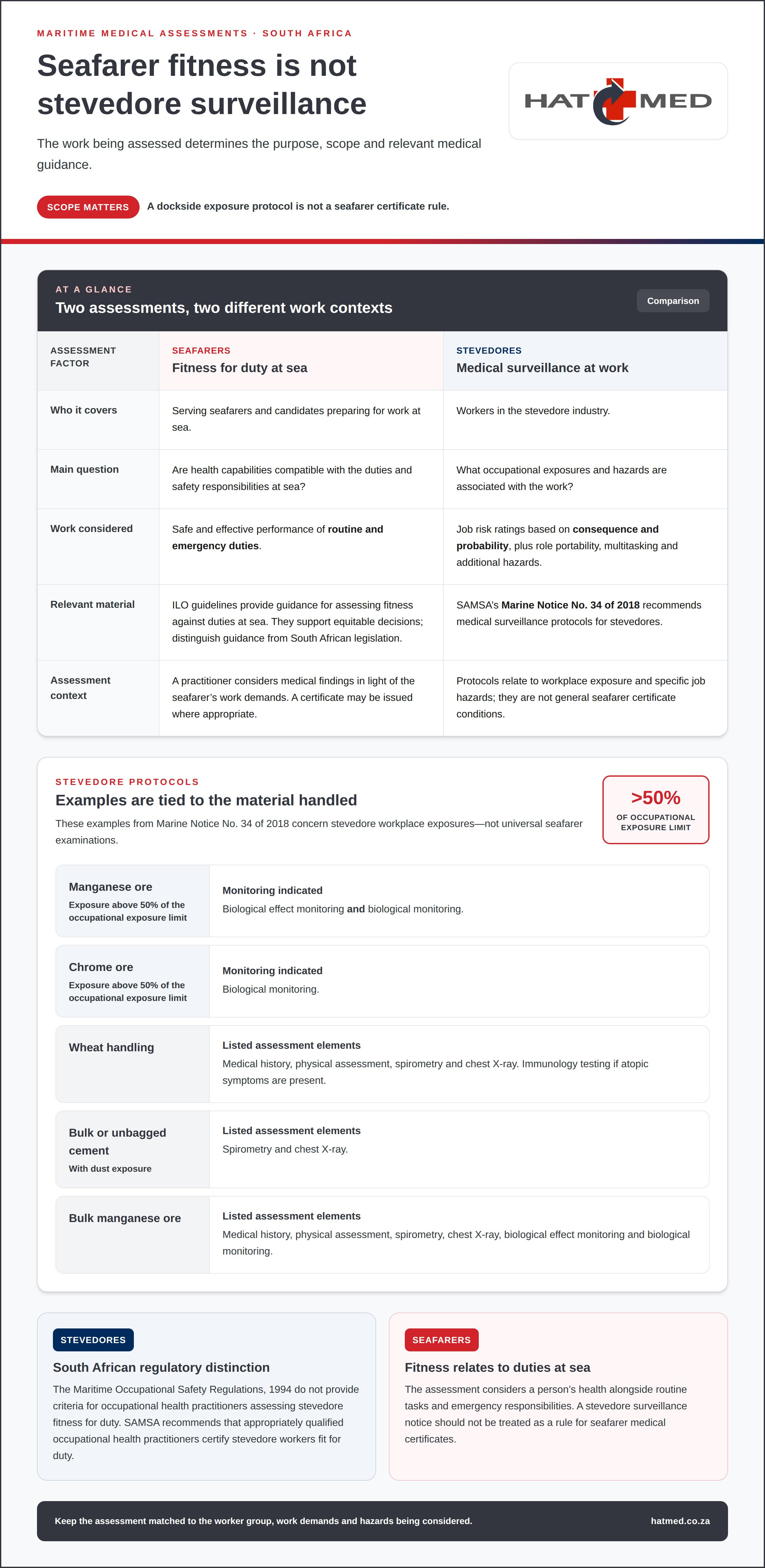
A governing rule sets requirements for a specific worker group or maritime activity. In South Africa, the available legal details distinguish stevedore fitness assessments from seafarer examinations. This distinction matters: a notice addressing dockside occupational hazards should not automatically be treated as a rule for seafarer certificates.
The Maritime Occupational Safety Regulations, 1994 do not provide criteria for occupational health practitioners assessing stevedore fitness for duty. SAMSA recommends that appropriately qualified occupational health practitioners certify stevedore workers fit for duty. These points concern stevedores, not seafarer certificate requirements. The marine notice medical examination guidelines in South Africa should therefore be read according to the worker group and subject they cover.
SAMSA’s Marine Notice No. 34 of 2018 recommends medical surveillance protocols for the stevedore industry. Its approach considers job risk ratings, calculated from consequence and probability, and the portability of roles. Workers may multitask and face additional hazards. These protocols link assessment to workplace exposure rather than setting general certificate conditions for serving seafarers or candidates.
The ILO guidelines on medical examinations of seafarers provide guidance for assessing fitness in relation to duties at sea. They support equitable decisions about safely and effectively performing routine and emergency work by relating medical capabilities to job demands. When interpreting South Africa’s marine notice medical examination guidelines alongside international material, distinguish guidance from South African legislation.
SAMSA’s stevedore protocols and the ILO seafarer guidelines address different assessment contexts. A practitioner assessing stevedore fitness considers occupational exposure and job hazards, while seafarer fitness decisions relate to duties at sea. Keeping these scopes separate helps prevent a workplace surveillance protocol from being mistaken for seafarer certificate conditions.
What is the latest South African Marine Notice on seafarer medical examinations?
A Marine Notice is a maritime communication addressing a defined operational or safety subject. South Africa’s Marine Notice No. 34 of 2018 concerns recommended medical surveillance protocols for stevedores, not medical examinations for seafarers. It therefore should not be presented as a seafarer medical examination notice. The distinction matters: a dock worker’s exposure-based surveillance and a seafarer’s fitness assessment address different work and health considerations.
Marine Notice No. 34 of 2018 describes stevedore job risk ratings as the product of consequence and probability. It also recommends considering job portability, including multitasking and exposure to additional hazards. For manganese ore exposure above 50% of the occupational exposure limit, the protocols require biological effect monitoring and biological monitoring. For chrome ore, biological monitoring is indicated above 50% of that limit. These examples show the notice’s focus on workplace exposures, rather than general seafarer certificate criteria.
For wheat handling, the notice lists medical history, physical assessment, spirometry and chest X-ray. Immunology testing is included if atopic symptoms are present. For bulk or unbagged cement with dust exposure, it indicates spirometry and chest X-ray. Bulk manganese ore protocols include medical history, physical assessment, spirometry, chest X-ray, biological effect monitoring and biological monitoring. Each protocol addresses a particular stevedore hazard, so these tests are not a universal seafarer examination checklist.
Seafarer examination guidance is addressed separately by the ILO guidelines on medical examinations of seafarers. The print edition carries ISBN 978-92-2-127462-9, while the Web PDF carries ISBN 978-92-2-127463-6. The Joint ILO/IMO Working Group on Medical Fitness Examinations of Seafarers and Ships’ Medicine Chest met from 26 to 30 September 2011. Its final report is dated 30 September 2011. These references concern seafarers, unlike South Africa’s 2018 stevedore notice.
The Bahamas notice requires the company and master to ensure seafarers are medically fit before employment or onboard task assignment, citing STCW Regulation I/14. Bahamas Marine Notice 28 says certificates cannot be extended after expiry.
Which South African laws and SAMSA rules govern medical fitness examinations for seafarers?
A governing rule sets requirements for a particular maritime activity or worker group. South African information about stevedore fitness and seafarer medical examinations concerns different assessment contexts. Keep these scopes distinct: a workplace surveillance protocol for stevedores is not a seafarer certificate rule.
The Maritime Occupational Safety Regulations, 1994 do not provide criteria for occupational health practitioners assessing stevedore fitness for duty. SAMSA recommends that appropriately qualified occupational health practitioners certify stevedore workers fit for duty. These points apply to stevedores. They do not set out the criteria for assessing a seafarer’s fitness for sea service.
SAMSA’s Marine Notice No. 34 of 2018 recommends medical surveillance protocols for South Africa’s stevedore industry. The notice describes job risk ratings as the product of consequence and probability. It also recommends accounting for role portability, including multitasking and exposure to additional hazards. These details help explain the notice’s occupational focus, rather than establishing general seafarer certificate conditions.
For seafarers, the ILO guidelines on medical examinations address fitness in relation to duties at sea. They support equitable decisions about whether a person can safely and effectively perform routine and emergency duties, in keeping with their health-related capabilities. This framework helps explain fitness assessments while distinguishing the guidelines from South African legislation and SAMSA’s stevedore notice.
For practical purposes, identify the examination’s purpose first: seafarer fitness for sea duties or stevedore surveillance tied to workplace hazards. That distinction helps keep the relevant assessment criteria in view without transferring requirements between roles. If you need a seafarer medical assessment, arrange a medical examination.
The ILO guidelines are intended to help maritime administrations establish criteria for medical fitness examinations of serving seafarers and seafarer candidates. Their Web PDF ISBN is 978-92-2-127463-6. Separately, SAMSA strongly recommends that occupational health practitioners use the notice’s protocols when conducting stevedore medical examinations; that recommendation remains specific to stevedores.
In the Bahamas notice, certificates satisfying STCW requirements are accepted as documentary evidence of medical fitness to serve on a Bahamian ship, and a certificate must be in English or include an English translation. If a certificate expires during a voyage, the seafarer may continue working until the next port where an examination is possible or for up to three months from expiry, whichever is earlier. These Bahamas provisions are comparative, not South African rules.
Hatmed Medical Centre
Hatmed Medical Centre provides Seafarers / SAMSA Medical Examinations for serving seafarers and candidates who need a medical assessment. This is a practical next step when preparing for sea service or addressing a seafarer medical requirement. A General Practitioner Consultation can also help you discuss a health concern relevant to your fitness assessment. For ongoing conditions, Chronic Disease Management supports care alongside your wider health needs.
Bring any relevant medical information to your appointment so it can inform the assessment. The practitioner considers your health in relation to the examination and its purpose. If you’re ready to arrange an assessment, contact Hatmed Medical Centre.
Take the next step towards medical readiness
Understanding the marine notice medical examination guidelines in South Africa is a starting point. The next step is arranging an assessment relevant to your seafaring role. Clear information about your health and intended duties helps focus the examination on questions related to fitness for sea service. If your health changes, discuss it during a medical assessment rather than relying on an earlier certificate to reflect your current circumstances.
Hatmed Medical Centre provides Seafarers / SAMSA Medical Examinations, General Practitioner Consultations and Immigration Medical Examinations. These services address different health and assessment needs, whether you’re preparing for sea duties or require another medical examination. Choose an appointment that matches your immediate purpose, and bring relevant health information to inform the consultation.
For a professional next step, contact Hatmed Medical Centre. Taking time to address your medical assessment needs can help you move forward with greater clarity.
Frequently Asked Questions
Who must undergo a seafarer medical examination in South Africa, and how often?
Serving seafarers and people preparing to enter seafaring work are within the intended scope of medical fitness examinations. Assessment frequency depends on the certificate and maritime requirements that apply to the person’s service. Don’t use another country’s age-based validity periods to plan South African examinations. If moving between roles or flag states, establish which certificate regime applies before relying on an existing certificate.
What medical standards and fitness criteria apply to South African seafarers?
The assessment considers whether a seafarer’s health-related capabilities are compatible with safely performing routine and emergency duties at sea. For example, fitness is judged against the work the person may need to carry out, rather than a diagnosis alone. This supports equitable decisions by relating medical findings to job demands. Both candidates and serving seafarers fall within this fitness-for-duty framework.