

Does operating an inland commercial vessel automatically mean you need the same SAMSA medical certificate as a seagoing crew member? It’s important not to assume the requirements are identical. For SAMSA medical certification for inland commercial vessel operators, start by identifying your role and vessel context, then establish which current requirements apply to that operation.
It’s understandable to feel unsure about which certificate, form or examination is relevant, particularly if you have a health condition and are concerned about the outcome. A medical assessment considers your individual health and fitness. Its purpose is to assess your circumstances, not to make assumptions before an examination.
This guide explains how to identify the applicable certification pathway, what a medical assessment may involve and how to prepare relevant health information. Hatmed Medical Centre provides Seafarers / SAMSA Medical Examinations and general practitioner consultations, with supportive clinical care throughout the process. As requirements can vary by role and operation, check the current applicable guidance before proceeding.
Key Takeaways
- For SAMSA medical certification for inland commercial vessel operators, identify your role and vessel context first, then verify which requirements apply.
- A medical fitness assessment is separate from competency training, an operating licence and vessel paperwork. Each serves a different purpose.
- Your health history and the applicable examination requirements inform an individual clinical assessment. No certificate outcome can be assumed in advance.
- Prepare by gathering identification and relevant health records, attending the examination and following up on any next steps.
- Hatmed Medical Centre provides Seafarers / SAMSA Medical Examinations to support the medical-assessment process. Certification decisions depend on applicable requirements and clinical findings.
Purpose of SAMSA Medicals for Inland Vessel Operators
A SAMSA medical is a clinical assessment of whether a person’s health is compatible with the duties of a particular maritime role. It is separate from permission to operate a vessel: the medical assessment considers fitness, while licensing and vessel documents address other requirements. If you’re researching SAMSA medical certification for inland commercial vessel operators, first establish which rules apply to your role and operation.
Fitness requirements relate to the work being performed. An operator may need to make decisions, communicate clearly, respond to changing conditions or carry out practical tasks where a sudden health difficulty could affect personal or crew safety. The assessment considers your health in relation to the applicable examination requirements, rather than treating every vessel role as identical. The South African Maritime Safety Authority (SAMSA) reference provides background on the authority’s wider maritime safety remit.
Medical certification assesses health and fitness in relation to the relevant duties. It does not, by itself, guarantee certification or authorise someone to operate a vessel.
Which inland vessel roles may need medical certification?
Commercial operators, skippers and crew members are possible role groups to consider, but a job title alone doesn’t establish that the same medical requirement applies to everyone. The relevant pathway may depend on your actual duties, vessel type and whether it operates on inland, coastal or seagoing waters. For example, the requirements for a person responsible for operating a vessel may differ from those for another onboard role.
Don’t assume inland operations follow the same rules as coastal or seagoing work, or that every inland role is covered in the same way. Check current SAMSA guidance for your specific role and operation before arranging an examination. This helps you identify the appropriate assessment instead of relying on a certificate or form intended for a different context.
Medical fitness is not the same as a licence
Different requirements answer different questions. A medical assessment considers health and fitness against the applicable standard. Competency training and qualifications relate to knowledge and skills. A licence or certificate of competence addresses authority or qualification to perform a defined role, while vessel paperwork relates to the vessel and its compliance obligations.
These documents may form part of an operator’s broader compliance pathway, but they are not interchangeable. A medical certificate alone doesn’t demonstrate that competency, licensing or vessel-documentation requirements have been met. Equally, completing training doesn’t replace any medical assessment required for the role.
Identify each requirement separately and verify its current source in SAMSA guidance. Hatmed Medical Centre provides Seafarers / SAMSA Medical Examinations to support the clinical assessment process. The examination findings and applicable requirements inform the outcome; certification isn’t automatic.
How inland vessel duties and health considerations shape the assessment
A medical assessment is an individual clinical process, not a checklist that produces the same answer for every operator. The clinician considers your relevant health history alongside the requirements that apply to the examination. Identifying the correct pathway first is important: criteria for one seafarer role or vessel context shouldn’t automatically be applied to a different inland operation.
Assessment criteria need to match the relevant role because health is considered in the context of the duties and requirements that apply to that operator. The practical responsibilities of a role may inform what the clinician needs to understand, but verify the applicable standard and any specific tests against current SAMSA guidance. Don’t assume that vision, hearing or mobility checks apply in the same way to every inland operator unless the relevant requirements support that.
What health information should an operator be ready to discuss?
Prepare an accurate account of your current health conditions, medicines and relevant medical history. Include information about ongoing treatment, past events that may be relevant to your health, and changes since a previous assessment. Bring supporting records where available. Clear, complete information helps the clinician make an informed assessment. It doesn’t mean a particular diagnosis automatically determines fitness or the certificate outcome.
Why the operating context matters
Before interpreting a requirement, note your vessel category, actual duties and operating waters. Commercial inland operations may follow a different pathway from recreational boating or seagoing work, but check that distinction against current guidance rather than assuming it. Verify any named medical standard, examination form or role-specific threshold before relying on it.
For SAMSA medical certification for inland commercial vessel operators, role and operating context are practical starting points for a focused clinical discussion. Describe what you do aboard the vessel and where it operates, rather than relying only on a job title. These details can help frame which requirements need consideration, while SAMSA guidance remains the reference for the applicable certification pathway.
Where a seafarer medical examination applies, SAMSA’s Audits and Accreditation information explains the accreditation context for practitioners conducting those examinations. It should not be taken as proof that every inland role follows the same process. First establish which requirements apply to your operation. Hatmed Medical Centre provides Seafarers / SAMSA Medical Examinations to support the clinical assessment process. A certificate outcome is not guaranteed.
Medical certificate, licence or training: compare the requirements before proceeding
Several documents may be relevant to vessel work, but they don’t serve the same purpose. Separating them helps prevent a common mistake: assuming that a training certificate or general health check automatically meets a medical-certification requirement. The pathway for SAMSA medical certification for inland commercial vessel operators depends on the role and operation, so use the comparison below to identify what to verify, not as a universal checklist.
| Requirement | Purpose | What to verify |
|---|---|---|
| Medical assessment | Considers health and fitness for the relevant duties under the applicable examination requirements. | Check current SAMSA guidance for the medical certificate type, role and inland operation that apply. Verify the practitioner and examination requirements against the relevant official guidance. |
| Competency training | Develops or assesses the knowledge and skills associated with a role. | Check the relevant SAMSA guidance, course or qualification documents, and the requirements attached to the specific role. |
| Operating licence or competency document | Addresses whether a person holds the qualification or authority required for the relevant operation. | Verify the document type, issuer and conditions in the current official requirements for that vessel and role. |
| Vessel paperwork | Relates to the vessel’s own identification, safety or compliance documentation. | Check the vessel’s documents and applicable official requirements for its category and operating waters. |
These categories can overlap in an operator’s broader compliance process, but one doesn’t automatically replace another. Completing training doesn’t establish medical fitness, and a medical certificate alone shouldn’t be treated as permission to operate a vessel. The relevant documents and issuing sources may differ according to the vessel and role.
How does a SAMSA medical examination differ from a routine check-up?
A routine GP consultation focuses on general healthcare needs, such as discussing a symptom or managing an ongoing condition. A medical examination for certification has a defined purpose: it considers relevant health information in light of the applicable certification requirements. The specific examination process depends on those requirements, so don’t assume that every routine check-up, test or certificate is an accepted substitute.
What should an operator verify before relying on a certificate?
Read the document carefully and compare it with current official guidance. Check that the certificate type relates to your role and operation, and review any validity conditions stated on the document or in the applicable requirements. If the guidance and paperwork appear inconsistent, or you can’t tell whether the document applies to your inland operation, seek clarification from SAMSA before relying on it.
Hatmed Medical Centre provides Seafarers / SAMSA Medical Examinations for the clinical-assessment step. A general health consultation and a certification examination have different purposes. Arranging the relevant examination helps direct the assessment towards the applicable requirements, without assuming a particular certificate outcome.
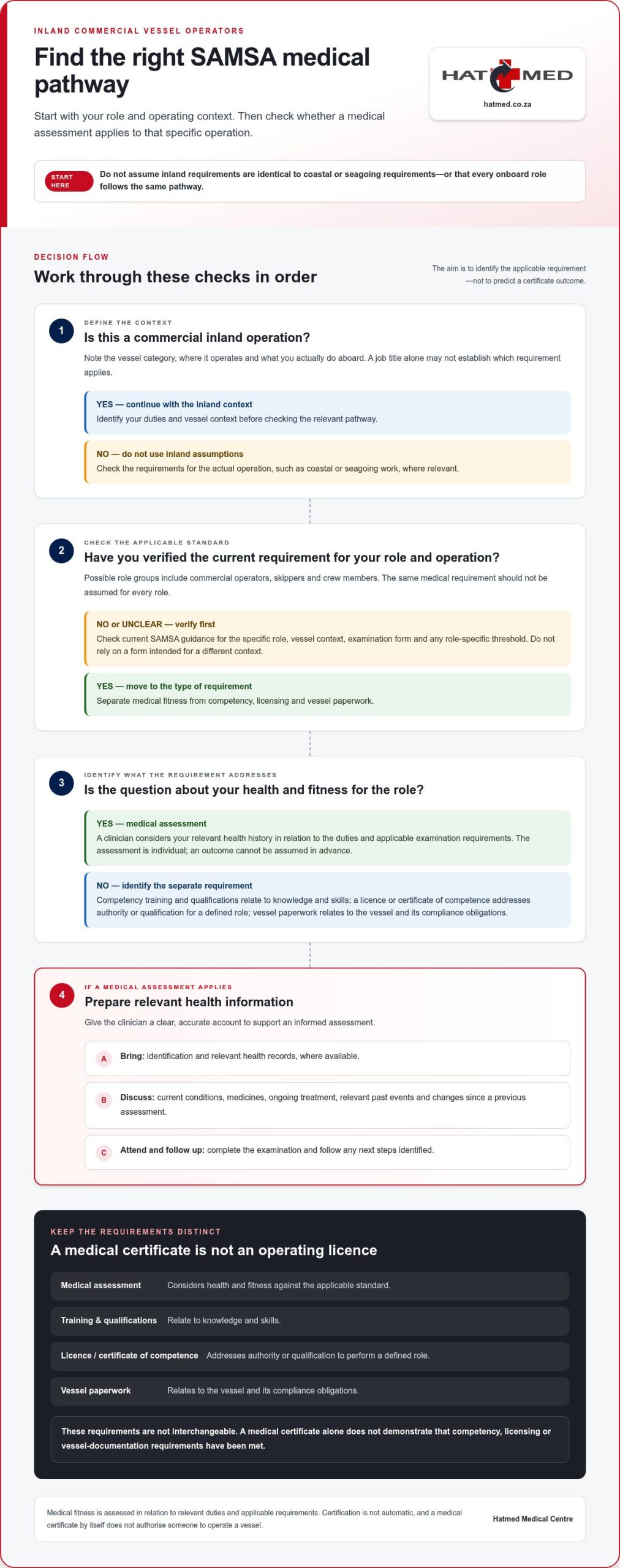
How to prepare for an inland commercial vessel medical examination
Preparation can make it easier to give a clear account of your health and complete the relevant assessment. Before your appointment, establish which examination applies to your role and operation, then follow the clinic’s current instructions about documents and preparation. The aim is to arrive ready to discuss your health accurately, not to anticipate or influence the outcome.
Good preparation means accurate disclosure and the correct role-specific requirements. Use this sequence to organise your next steps:
- Identify the requirement. Check current SAMSA guidance for the certificate or examination relevant to your duties, vessel category and operating context. Keep the applicable instructions or form to hand.
- Gather health records. Collect relevant reports, prescriptions and previous certification documents, if available. Prepare a current list of medicines and relevant diagnoses.
- Attend the assessment. Bring identification and relevant health records, following the clinic’s current appointment instructions. Explain your duties and any health changes or concerns clearly.
- Follow up. Note any next steps provided after the assessment, including whether further information or a follow-up discussion is needed. Keep copies of documents provided to you.
What to bring and disclose at the appointment
Bring relevant medical reports, prescriptions and previous certification paperwork where available, along with identification if requested in the clinic’s instructions. Be ready to describe changes in your health or treatment, and any concerns you feel could affect your work duties. Share your current medicines accurately, including their names and how you take them if you know. Don’t stop or change medication for the examination unless the clinician responsible for your care advises you to do so.
Follow any clinic instructions about additional documents or examination preparation rather than relying on general advice. If you’re unsure whether a record or health detail is relevant, bring it or make a note to discuss it. An open conversation helps the clinician understand your circumstances.
What may happen after the assessment?
The clinician will communicate the assessment outcome through the applicable process. Depending on the findings and requirements, further information or follow-up may be needed. This doesn’t predict the result. Keep your contact details and relevant records accessible, and ask for clarification about any next step you’re given.
If you manage an ongoing condition, continued primary care may also help you keep treatment information organised. Hatmed Medical Centre provides Chronic Disease Management alongside Seafarers / SAMSA Medical Examinations. To take the medical-assessment next step, arrange a Seafarers / SAMSA Medical Examination with Hatmed Medical Centre.
Arrange a SAMSA medical examination with Hatmed Medical Centre
Once you’ve identified the medical requirement that applies to your role, Hatmed Medical Centre’s Seafarers / SAMSA Medical Examination is a practical next step for the clinical assessment. The examination considers your health in relation to the applicable requirements, but it can’t guarantee a certificate outcome. Decisions depend on the relevant requirements and clinical findings.
Make the discussion more useful by having your role and operating context to hand. For SAMSA medical certification for inland commercial vessel operators, the specific vessel, duties and operating waters may help distinguish which guidance is relevant. If your employer has provided a form or written instructions, keep these available so the assessment can be considered in context.
What to have ready when arranging the examination
Before arranging the examination, note your vessel role and operating context, and gather identification and relevant health records for the appointment. These might include medical reports, a current medicine list or previous certification documents, where available. Follow Hatmed Medical Centre’s appointment instructions for any additional documents or preparation. If you’re unsure whether a record is relevant, having it available can help you discuss your circumstances clearly.
A clear next step for operators and employers
Medical assessment is one part of a broader compliance process. If current SAMSA guidance doesn’t clearly explain whether a particular certificate applies to your inland role, resolve that regulatory uncertainty with SAMSA before relying on an assumption. Employers can also clarify which role-specific documents they require, helping the operator understand which examination and paperwork to prepare for.
Keep these questions separate: what medical assessment is required, what competency or operating documents apply, and what paperwork relates to the vessel? Clear answers can help you proceed without treating one document as a substitute for another. Bring relevant role details and health records to the examination so the clinician can consider your circumstances through the applicable assessment process.
When you’re ready to take the medical-assessment step, arrange a Seafarers / SAMSA Medical Examination with Hatmed Medical Centre. The practice provides a supportive clinical assessment, with any certification outcome determined by the applicable requirements and clinical findings.
Take the next step with confidence
Once you’ve clarified which medical pathway applies to your inland role, you can move forward with a clearer purpose. Keep role-specific instructions and relevant health information together so you’re ready to discuss your circumstances during the assessment. If any aspect of the requirement remains unclear, resolve it against current SAMSA guidance rather than relying on assumptions.
Understanding SAMSA medical certification for inland commercial vessel operators is not about predicting an outcome before an examination. It’s about approaching the process with the right information and allowing the clinical assessment to consider your individual health alongside the applicable requirements. Hatmed Medical Centre provides Seafarers / SAMSA Medical Examinations, general practitioner consultations and patient-centred primary healthcare.
When you’re ready to take the medical-assessment step, arrange a SAMSA medical examination with Hatmed Medical Centre. Bring your role details and relevant records, and take the process one clear step at a time.
Frequently Asked Questions
Do inland commercial vessel operators need a SAMSA medical certificate?
Some may need one, but the requirement depends on the operator’s role, vessel category and operating context. Don’t assume every inland commercial role follows the same pathway, or that seagoing requirements automatically apply. For SAMSA medical certification for inland commercial vessel operators, use current SAMSA guidance to establish whether your specific duties require an examination and which certificate or process applies before arranging an assessment.
Is a SAMSA medical certificate the same as a boat licence?
No. A medical certificate relates to health assessment for the applicable role, while a licence or competency document addresses a different operating or qualification requirement. Evidence that you’ve completed training, for example, doesn’t demonstrate that a medical assessment has taken place. Treat each document separately and check the current requirements for your vessel and duties rather than relying on one certificate to cover every compliance need.
What does a SAMSA medical examination include for inland operators?
The examination is guided by its purpose and the requirements that apply to the relevant role. A clinician may review your medical history and assess your health; don’t assume particular tests or examination elements apply to every inland operator. Before your appointment, check the applicable SAMSA instructions and any relevant form. This helps you understand what the assessment is intended to address without treating a general check-up as a substitute.
Can I operate an inland commercial vessel with a medical condition?
A diagnosis alone doesn’t establish whether you’re fit for a particular role or determine a certificate outcome. The clinician needs to consider relevant health information in relation to the applicable requirements and your duties. Be open about your condition, treatment and medicines, and bring relevant records if you have them. Don’t stop or change prescribed treatment to prepare for an examination unless your treating clinician advises you to.
How do I prepare for a SAMSA medical examination?
First, identify which examination applies to your role and operation. Then organise identification, relevant medical reports, prescriptions and previous certification documents where available. Prepare a current medicine list and be ready to explain any changes in your health or treatment. Follow the practice’s appointment instructions for additional documents or preparation. If you’ve been given role-specific paperwork, bring it so the assessment can be considered in the right context.
Does maritime training replace a SAMSA medical certificate?
No. Training addresses knowledge or skills, while a medical certificate relates to an assessment of health under the applicable requirements. Completing a course, receiving a training certificate or holding a competency document shouldn’t be treated as proof that a medical examination has been completed. Check the current requirements for your role to understand which documents apply; one step in the process may not replace another.
What happens if further assessment is needed after my medical examination?
The clinician will explain the next step through the applicable process. Additional information or a follow-up assessment may be needed before the process can be completed, but this alone doesn’t predict the final outcome. Ask what information is needed, how to provide it and whether you should bring supporting records. Keeping relevant reports and treatment details organised can make follow-up clearer and help you understand what happens next.