

Comprehensive executive medicals combine a doctor’s consultation with physical checks and selected tests to build a broader picture of your health. The assessment may also include a discussion of cancer screening suited to your age, health history and individual risk. Its purpose is to help business leaders understand their health needs and discuss practical next steps.
A demanding role can leave little time to focus on your wellbeing, and a single test rarely answers every health question. An executive assessment gives you a structured opportunity to discuss concerns, review relevant results and consider how different aspects of your health fit together.
This article explains what an executive health assessment may involve, from the consultation and physical checks to medical tests and appropriate cancer screening. You’ll also learn how the assessment can be tailored to individual health needs, what to expect and when a GP-led executive medical examination may be a useful next step.
Key Takeaways
- Understand how an executive health assessment can bring a medical consultation, relevant tests and physical checks into one structured review.
- Learn how fitness and body composition findings can help identify areas to discuss as part of your wider health picture.
- See why cancer screening should be considered in light of individual health factors rather than treated as a one-size-fits-all checklist.
- Find out how lung function, vision and hearing checks may contribute to an assessment, depending on your health needs.
- Use a GP consultation to discuss concerns, understand test results and consider appropriate follow-up, including ongoing chronic disease management where relevant.
What is Executive Health?
Executive health is a structured medical assessment for business leaders, combining a consultation with checks selected around personal health needs. Comprehensive executive medicals can help organise relevant findings, but they don’t replace ongoing care or guarantee changes in health or work performance.
Executive health for business leaders
An executive health assessment brings medical review and relevant checks together, rather than treating each result in isolation. Because the checks can vary, consider your health history, current concerns and the questions you want answered.
In South Africa, you can book an executive medical examination with a provider that offers this service. When arranging your appointment, explain whether you want a general health review or an assessment for a specific work-related purpose.
Personalised reports, referrals and results
A useful report clearly sets out the assessments completed, the findings and any recommended next steps. It can help you prepare questions for a follow-up consultation and keep relevant results together for future care.
If a finding needs further assessment, a referral can guide you to the appropriate next step. Screening results describe what was found during the assessment; they don’t, by themselves, show that an executive health programme has improved work performance.
Screening can identify issues that deserve attention, but it has limits: a normal result doesn’t rule out every health problem. Discuss symptoms and concerns during the consultation, even if a test result appears reassuring.
Medical duration and preparation
There’s no fixed appointment length for every executive medical. The time depends on the consultation and checks included, so allow enough time for discussion, examination and any planned tests.
Before your appointment, prepare a concise health history, a list of current medicines and any questions you want to raise. Bring relevant previous results if available, and follow any preparation instructions for specific tests.
Medical-aid or health-insurance cover depends on your scheme’s benefits, rules and the type of assessment. Review your plan documents for the applicable benefit and any payment conditions before booking.
Suitability and assessment frequency
Business leaders may consider an executive assessment when they want a structured health review, have concerns or wish to discuss personal risk factors. It can also help organise questions about existing conditions for a medical consultation.
There’s no universal schedule that suits everyone. The interval depends on your health, previous findings, symptoms and any follow-up plan. A new concern should prompt a medical discussion rather than waiting for a routine assessment.
Physical fitness and body composition assessment
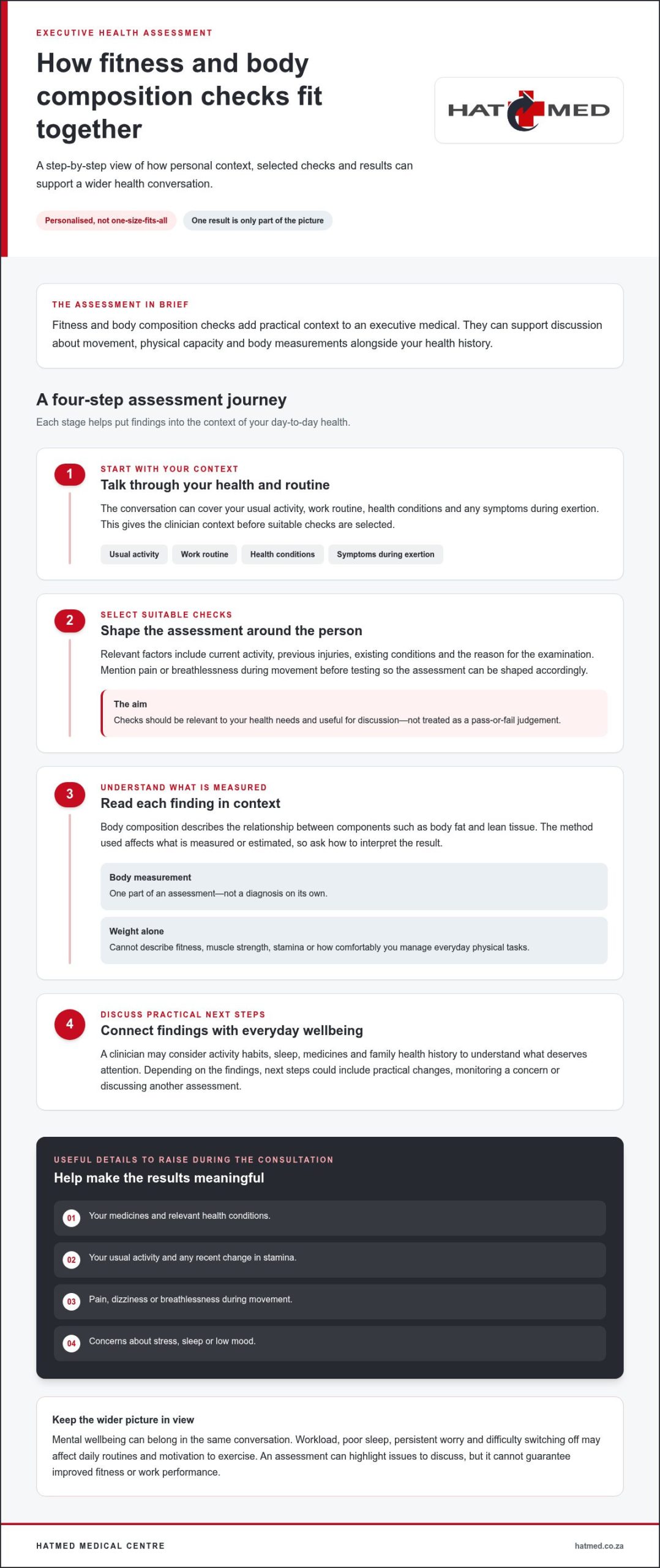
Fitness and body composition checks can add practical context to an executive health assessment. They support discussion about movement, physical capacity and body measurements alongside your health history, rather than treating one result as the whole picture.
A typical assessment starts with a conversation about your usual activity, work routine, health conditions and any symptoms during exertion. The clinician can then select suitable checks and explain what each result can and cannot show. For example, a body measurement is one part of an assessment, not a diagnosis on its own.
Body composition describes the relationship between components such as body fat and lean tissue. The method used affects what is measured or estimated, so ask how to interpret the result in context. Weight alone can’t describe fitness, muscle strength, stamina or how comfortably you manage everyday physical tasks.
Fitness checks should reflect the person being assessed. Relevant factors include current activity, previous injuries, existing conditions and the reason for the examination. If a movement causes pain or breathlessness, mention it before testing. This helps shape a safer, more useful assessment and keeps a performance measure in perspective.
Personalised preventive health assessments also consider the context behind a measurement. A clinician may discuss your activity habits, sleep, medicines and family health history to understand what deserves attention. Depending on the findings, next steps could include practical changes, monitoring a concern or discussing another assessment.
Mental wellbeing belongs in this conversation too. Workload, poor sleep, persistent worry and difficulty switching off can affect daily routines and motivation to exercise. You can raise these concerns during the consultation, alongside physical symptoms. A private, direct discussion gives the clinician clearer context than a fitness result alone.
- Bring a list of medicines and relevant health conditions.
- Describe your usual activity and any recent change in stamina.
- Mention pain, dizziness or breathlessness during movement.
- Share concerns about stress, sleep or low mood.
These details help connect test findings with your day-to-day experience. If stress or emotional wellbeing is affecting your health, mental health management can form part of a broader conversation about appropriate support. An assessment can highlight issues to discuss, but it cannot guarantee improved fitness or work performance. Use the results as a starting point for informed decisions, not as a pass-or-fail judgement of your health.
Cancer screening where appropriate
Cancer screening looks for signs of disease before symptoms prompt an investigation. In an executive assessment, it should be discussed as part of your personal health needs, not treated as an automatic panel of tests. The relevant next step depends on factors such as age, family history, previous results, symptoms and personal preferences. A clinician can discuss which screening options suit your circumstances.
Different cancers call for different approaches. Breast, cervical, bowel and prostate screening, for example, involve distinct tests and considerations. A single blood test cannot screen for every cancer, and tests without a clear reason can produce confusing findings. Discuss which cancer is being considered, what the test looks for and how the results would guide follow-up.
Screening is not the same as investigating a symptom. A new lump, unexplained bleeding or persistent change needs medical assessment, even if previous screening was reassuring. An abnormal screening result can require further investigation and does not itself confirm cancer. A normal result cannot rule out every cancer or explain new symptoms.
- Share relevant family history, including which relatives were affected.
- Describe previous screening tests and any follow-up results.
- Raise new symptoms before discussing routine screening.
- Ask what an abnormal result would mean and what happens next.
For example, a family history of a particular cancer can shape the questions discussed during a consultation. A previous abnormal result can also affect the next step, as follow-up may differ from routine screening. Keep copies of relevant reports where possible, and note the date and type of previous test. These details make the discussion more specific than a general checklist.
Before agreeing to a test, understand its purpose, possible outcomes and follow-up pathway. Ask whether it is intended for screening or to investigate a symptom. Consider how you’ll receive and discuss the result, and whether further assessment may be needed. This helps you weigh the potential value of screening against uncertainty or additional procedures.
Executive screening should support informed decisions, not promise prevention or early detection. The most useful discussion connects a proposed test to your health history and a clear plan for interpreting results. If you have symptoms, explain them directly: symptom-led assessment and routine screening answer different questions.
Lung function, vision and hearing checks
Lung function, vision and hearing checks can add focused information to an executive medical. They’re selected according to symptoms, health history and relevant exposures, rather than assumed to suit everyone. A clinician can explain what each check measures and how its result relates to your concerns or daily activities.
A lung function test such as spirometry measures how air moves in and out of your lungs. You breathe into a mouthpiece as instructed, and the result helps assess airflow. A history of wheezing, persistent cough, breathlessness, asthma or exposure to dust and fumes gives useful context. Tell the clinician about symptoms during exercise or at work to help interpret the test. Spirometry is a measurement, not a complete explanation of every breathing problem.
Vision checks can assess how clearly you see and whether you’ve noticed changes. A visual acuity chart, for example, tests your ability to read letters or symbols at a set distance. Mention headaches when reading, blurred vision, difficulty driving at night or prolonged screen use. Bring your glasses or contact lenses and explain when you use them. A basic check doesn’t replace a full eye examination if a concern needs further assessment.
Hearing checks can identify whether sounds are difficult to detect or distinguish. An audiometry test presents tones through headphones, and you indicate when you hear them. Share any history of loud workplace noise, machinery, music or persistent ringing in your ears. Also mention whether you struggle to follow conversation in a busy room. These details help put a test result in the context of everyday communication.
- Describe symptoms and when they occur, such as breathlessness on stairs.
- List relevant exposures, including workplace dust or loud machinery.
- Bring prescribed glasses or contact lenses for a vision check.
- Ask what a result means and whether follow-up is recommended.
Before the appointment, note your symptoms, medicines and work exposures. If a result is outside the expected range, the next step depends on the finding and your history. The clinician can explain whether it calls for repeat testing, a closer examination or a referral. This makes lung, vision and hearing checks useful parts of a broader assessment, without treating any single measurement as a diagnosis.
Medical exams, tests and consultations
A medical assessment works best as a connected process: consultation, examination, selected tests and discussion of findings. The consultation gives context to each result. A medicine, symptom or previous diagnosis, for example, may affect which checks are relevant and how the clinician interprets them. Tests should address a health question, not simply lengthen a checklist.
The first step is a focused conversation about your health history, current symptoms, medicines, family history and daily routine. The clinician can then perform a physical examination based on your concerns. This may include checking blood pressure, listening to your heart and lungs, or examining an area linked to a symptom. Ask what each check is intended to assess.
Further tests depend on the questions raised during the consultation. Blood or urine tests may help assess specific aspects of health, while an electrocardiogram records the heart’s electrical activity. Neither provides a complete picture on its own. The clinician considers results alongside your history, examination and symptoms, then explains whether further assessment is appropriate.
What risks, false positives or follow-up tests can result? A screening or test result can be abnormal without confirming a disease, leading to repeat testing or further investigation. Testing can also create uncertainty or identify findings that need monitoring. Discuss each test’s purpose, possible outcomes and follow-up plan beforehand.
Results are most useful when you understand what they mean for you. Ask which findings are within the expected range, which need attention and what action follows. For instance, a result that needs repeating may call for a new sample, while a finding linked to symptoms may require a more focused examination. Keep the report and follow-up advice together.
- Share an up-to-date list of medicines and relevant previous results.
- Describe symptoms clearly, including when they started and what affects them.
- Ask why a test is recommended and how its result will be used.
- Before leaving, clarify who will explain results and any next steps.
A comprehensive assessment is not a guarantee that every condition will be detected. Some conditions may not be covered by the chosen tests, and results must be interpreted in context. A clear consultation helps you distinguish routine findings from issues that need action. To discuss an executive medical assessment, arrange a consultation and bring your health questions and relevant records.
Hatmed Medical Centre: General Practitioner Consultations
Hatmed Medical Centre offers General Practitioner Consultations to help you discuss assessment findings, health concerns and possible next steps. Bring your report, relevant test results and a list of medicines so the consultation can focus on questions that matter to your ongoing care.
A GP consultation can help you understand which findings need attention and whether further assessment or follow-up is appropriate. If you’re managing a long-term condition, Hatmed’s Chronic Disease Management service can support ongoing care alongside discussions about your broader health needs.
Hatmed Medical Centre also conducts Immigration Medical Examinations and Seafarers / SAMSA Medical Examinations for people who need these specific assessments. For a personal health discussion after an executive assessment, arrange a General Practitioner Consultation with Hatmed Medical Centre.
Make your next health decision with confidence
Use comprehensive executive medicals as a starting point for a practical conversation about your health priorities. Before your next appointment, write down your questions, the findings you want explained and any changes you’re considering. A focused discussion can help you decide which concern deserves attention first and what follow-up would be useful for your circumstances.
Hatmed Medical Centre offers General Practitioner Consultations for personal health discussions, as well as Immigration Medical Examinations and Seafarers / SAMSA Medical Examinations for people with those assessment needs. Start by identifying your purpose: ongoing health questions call for a different conversation from a specific medical examination.
If you’re ready to discuss your next step, contact Hatmed Medical Centre. Take your questions at your own pace and make space for informed decisions about your health.
Frequently Asked Questions
What is included in a comprehensive executive medical in South Africa?
A comprehensive executive medical in South Africa typically combines a doctor’s consultation with assessments selected for the individual. These may cover physical health, body composition, lung function, vision, hearing and appropriate screening. The exact scope depends on your health needs and the appointment’s purpose. Before booking, identify whether you need a general health review or a work-related medical examination, as these serve different purposes.
Which tests and screenings are included in executive health assessments?
Tests and screening vary according to the assessment and your health history. A clinician may consider physical checks, selected laboratory tests, lung function, vision or hearing checks, and cancer screening where appropriate. For example, a specific symptom may call for an investigation focused on that concern rather than routine screening alone. Ask what each proposed test is intended to assess and how its result will be discussed.
Which South African hospitals and clinics offer executive medicals?
Executive medical examinations are available from providers that offer this type of assessment. Hatmed Medical Centre provides Executive Medical Examinations alongside General Practitioner Consultations. The right appointment depends on whether you want a broad health review or documentation for a defined purpose. Immigration and seafarer medical examinations, for instance, are distinct services, not substitutes for an executive health assessment.
How do executive medical packages differ between South African providers?
Packages can differ in the consultation, examinations, tests, screening options and reporting included. Compare the stated scope and follow-up process, rather than judging a package by its name. One assessment may focus on a medical examination, while another may include additional checks selected for individual health concerns. A useful comparison asks what is assessed, how results are explained and what happens if a finding needs further attention.