

What if the biggest leadership risk isn’t a demanding quarter, but a health concern that’s gone unnoticed? An executive health assessment can help bring that risk into view, offering more than a routine GP visit by bringing relevant checks and professional guidance together in a coordinated assessment.
It’s understandable to put health appointments off when work is relentless. Stress, long hours and limited time can make it difficult to keep track of your wellbeing, while the possibility of an undiagnosed condition can weigh on your confidence and career plans. A structured assessment offers a practical way to take stock, with advice shaped around your individual health and the pressures of leadership.
In this article, we’ll explore whether an executive health assessment is worth considering compared with a standard GP visit, and how it can support long-term leadership wellbeing. Through a detailed case study approach, we’ll look at how screening may identify hidden risks, what happens when results call for follow-up, and how a clear, personalised plan can help you decide what to do next.
Key Takeaways
- See why leadership habits such as ignoring symptoms can leave important health concerns unaddressed.
- Follow a case study that explores how preventative screening may bring less obvious health risks to light.
- Compare the scope and time considerations of an executive health assessment with a standard medical consultation.
- Prepare for an assessment by gathering medication details and family health history, and planning time for a thorough review.
- Learn how Hatmed’s patient-centred executive medical examinations and chronic disease management can support a practical next-step plan.
The Leadership Health Gap: Why Standard Check-ups Often Fail Executives
Leaders are often expected to keep performing through pressure, fatigue and competing demands. That “hero culture” can make it easy to dismiss persistent headaches, poor sleep or changes in energy as part of the job. Whether overseeing day-to-day operations or launching new commercial ventures with corporate support providers like Goodhand, heavy professional commitments can easily overshadow self-care. Yet symptoms aren’t a reliable early-warning system: conditions such as hypertension may develop without obvious signs. If a health concern is only addressed once it disrupts work, the individual may face a more complex path back to wellbeing, whilst colleagues and the organisation must manage the uncertainty and disruption.
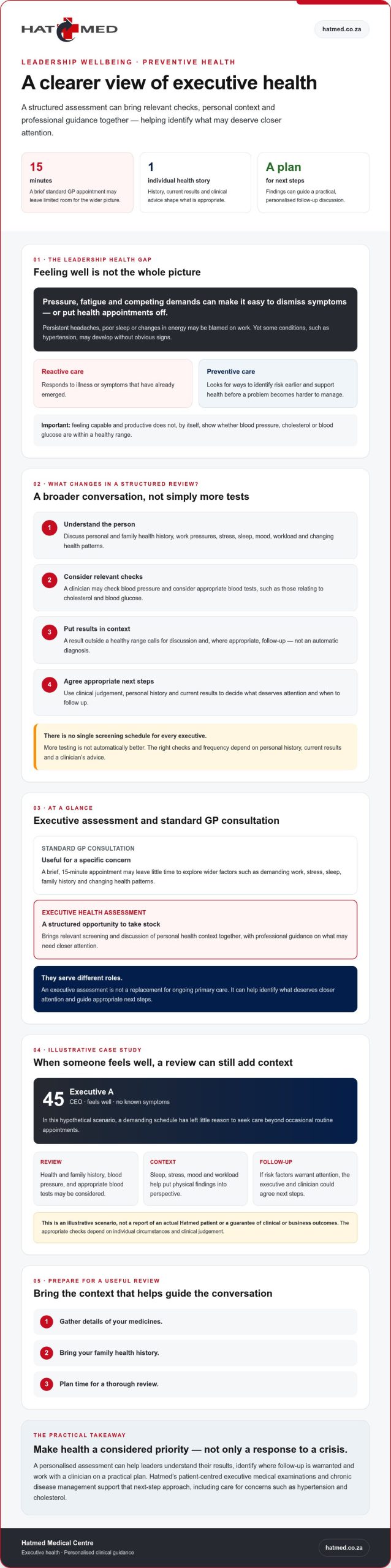
A routine GP consultation remains valuable, particularly when you have a specific concern. But a brief, 15-minute appointment may leave little room to explore the wider context of demanding work, stress, sleep, family history and changing health patterns. An executive health assessment creates a more structured opportunity to discuss these factors alongside relevant screening. It isn’t a replacement for ongoing primary care; it can help identify what deserves closer attention and guide appropriate next steps.
The Limitations of Reactive Medicine
Reactive care responds to illness or symptoms that have already emerged. Preventive care looks for ways to identify risk earlier and support health before a problem becomes harder to manage. The principles of preventive healthcare help explain why a review may consider risk factors even when someone feels well.
There isn’t one screening schedule that suits every executive. The right frequency depends on personal history, current results and a clinician’s advice. Rather than assuming that more testing is always better, use a comprehensive review to agree which checks are appropriate and when to follow up. This turns health from a crisis response into a considered priority for leadership longevity in 2026 and beyond.
Identifying the “Silent Killers” in the C-suite
High-pressure work can affect sleep, activity, eating habits and stress levels, all of which matter when discussing cardiovascular and metabolic health. This doesn’t mean every executive will develop a stress-related condition. It does mean that feeling capable and productive isn’t, on its own, proof that blood pressure, cholesterol or blood glucose are within a healthy range. A clinician can assess these findings in context, rather than treating a single result as a diagnosis.
Metabolic risks can also go unnoticed when someone appears energetic and performs well. A discussion of personal and family history, combined with appropriate clinical checks, may help identify where follow-up is warranted. Hatmed’s chronic disease management includes support for conditions such as hypertension and cholesterol concerns. Early, ongoing care can help leaders understand their results and work with a clinician on a practical plan.
For organisations, the strategic value lies in making appropriate care easier to prioritise, not treating a person’s health as a productivity metric. A steady, personalised approach can support both leadership wellbeing and more informed planning.
Case Study: Early Intervention and the ROI of Preventative Screening
This is an illustrative scenario, not a report of an actual Hatmed patient or a guarantee of clinical or business outcomes. Executive A is a 45-year-old CEO who feels well and has no known symptoms. With a demanding schedule, he has little reason to seek care beyond occasional routine appointments. An executive health assessment gives him time to review his health more broadly, including factors that may not be apparent from how energetic or capable he feels at work.
The Diagnostic Breakthrough
In this hypothetical example, a clinician reviews Executive A’s health and family history, checks his blood pressure and considers appropriate blood tests, such as those relating to cholesterol and blood glucose. The precise checks would depend on his circumstances and clinical judgement; no particular panel is right for everyone. Results outside a healthy range would prompt discussion and, where appropriate, follow-up rather than an automatic diagnosis.
The assessment also makes room to discuss sleep, stress, mood and workload. These details help put physical findings in context and may reveal concerns a brief appointment didn’t have time to explore. A clinician familiar with your health history can help connect earlier results with current concerns. For guidance on choosing one, see this guide to finding a general practitioner.
Suppose the review identifies risk factors that warrant attention. Executive A and his clinician could then agree on appropriate next steps, which might include ongoing monitoring, changes to daily habits or further medical review. That is a more responsible conclusion than claiming screening alone would have prevented a cardiac event. Early identification can inform care, but it can’t guarantee a particular outcome.
Measuring the Corporate Impact
The business case is best assessed without assuming a fixed return. Consider the potential consequences if a senior leader needed three months away from work: responsibilities may need to be reassigned, decisions could be delayed, and colleagues may take on extra pressure. The actual impact would vary by organisation, role and circumstances. A screening programme can’t promise to prevent absence, but it may help people address health concerns earlier and plan follow-up more thoughtfully.
There can also be a cultural effect. When leaders make space for appropriate healthcare, they can signal that wellbeing matters and that seeking support isn’t a failure of commitment. That may encourage more open conversations across a team, though morale and stability depend on many factors beyond one person’s health.
For Executive A, the useful outcome isn’t an unsupported promise of greater energy or a longer career. It’s a clearer understanding of his health, a personalised plan if follow-up is needed, and a better-informed basis for future decisions. Hatmed provides executive medical examinations with a patient-centred approach; organisations can learn more about its executive medical examinations as one option to consider.
Executive Health Assessment vs. Standard Medical: A Comparison
A standard GP consultation and an executive health assessment serve related but different purposes. A GP visit is valuable for a specific symptom, ongoing care or a general health concern. An executive examination takes a broader, more planned view, creating space to review relevant risks, health history and wellbeing together. The distinction isn’t simply “basic” versus “advanced”; the appropriate scope depends on the person and clinical judgement.
For example, both appointments may include discussion of health history and basic measurements such as blood pressure. A more comprehensive assessment may also consider cardiovascular and metabolic risks, including cholesterol and blood glucose, where appropriate. Additional investigations aren’t automatically needed for every person. Ask the provider which checks are clinically relevant, what they involve and how results will be explained.
Time and coordination matter, too. A brief consultation can be suitable for a focused concern, but may leave less room for a wider review. A longer appointment or coordinated visit can allow more opportunity to discuss results, work pressures and follow-up. Don’t assume every centre uses a half-day format; check the expected duration and whether any tests require separate appointments.
Advanced Diagnostic Tools
Some assessments may consider tests beyond routine measurements, but the choice should be individualised rather than a fixed checklist. A resting ECG records the heart’s electrical activity at rest. A stress ECG assesses it during exercise and may be considered when clinically appropriate. Neither test alone provides a complete picture of heart health.
Blood tests can assess more than glucose, with cholesterol among the factors a clinician may review. Lung function testing measures aspects of breathing and may be relevant depending on symptoms, history and exposure risks. Ask which tests are included, why they’re recommended and what further review might be needed. This helps distinguish useful screening from testing without a clear purpose.
The Mental Health Component
Leadership pressure can affect mood, sleep, concentration and energy, but these experiences shouldn’t be self-diagnosed or dismissed as simply part of the role. A thoughtful review can create space to discuss stress, anxiety, low mood or cognitive fatigue and decide whether further support is appropriate. Screening can guide a conversation; it isn’t, by itself, a diagnosis.
Physical and mental wellbeing are connected parts of overall health. Hatmed’s patient-centred approach includes mental health support alongside physical assessments, helping make the discussion more rounded. Ask how results are shared: a useful review should leave you understanding the findings, recommended next steps and when to seek follow-up, rather than with unexplained figures or a vague verbal summary. A personalised plan is more valuable than a longer test list.
How to Prepare for Your Executive Health Assessment
A little preparation can make an executive health assessment more useful and help you use appointment time well. Before your visit, ask the centre what to expect, including whether any tests require fasting and how long to allow. Fasting isn’t necessary for every assessment, so follow the instructions you’re given. Don’t stop or change prescribed medication unless a healthcare professional advises you to.
Gather the information that helps your clinician understand your health over time:
- A current list of medicines and supplements, including doses if known.
- Previous medical reports or test results that may be relevant.
- Family health history, especially known long-term conditions.
- Your current concerns, including changes in sleep, stress, mood or energy.
Protect the appointment in your diary as you would an important business commitment. Confirm the expected duration and whether any parts of the assessment take place separately. Leave space afterwards to discuss results or make notes, rather than scheduling a demanding meeting immediately afterwards. Be open about work patterns, lifestyle and symptoms, even if they seem minor. Honest context helps the clinician give advice that fits your circumstances.
Maximising the Value of Your Consultation
Decide what you’d like help understanding. You might want to discuss a family history of hypertension, persistent fatigue or how stress is affecting sleep. Sharing specific concerns helps focus the conversation without assuming they point to a particular diagnosis.
Ask what each result means for you, whether it needs follow-up and what steps are realistic. A general practitioner who understands your health history can help put findings in context and support ongoing care. If fatigue or hormonal fluctuations are highlighted as ongoing concerns, you might also learn more about Summit Health to explore how personalised wellness services address energy levels. You should leave knowing which actions to take, who to contact with questions and when results will be reviewed.
Follow-up and Implementation
A report is most useful when it leads to a practical plan. Work with your clinician to identify any recommended changes, monitoring or further review. If the plan feels difficult to fit around work, discuss manageable steps and agree what progress will look like. Follow-up timing should reflect your results and individual needs, rather than a one-size-fits-all schedule.
Preventive care is an ongoing cycle: review your health, act on relevant advice, then check in as appropriate. Hatmed provides patient-centred executive medical examinations. Explore Hatmed’s executive medical examinations as you plan your assessment.
Partnering with Hatmed for National Executive Wellness
Supporting leadership health calls for clinical care that considers the person as well as the demands of the role. Hatmed Medical Centre takes a patient-centred approach to executive medical examinations, combining professional assessment with a welcoming, supportive environment. The aim is to help people understand their health and identify sensible next steps, not to treat a demanding job as a diagnosis.
For businesses with leaders working across South Africa, a dependable medical partner can make it easier to prioritise health alongside business responsibilities. Hatmed provides specialised executive medical examinations alongside primary healthcare, including General Practitioner Consultations, chronic disease management, mental health management and vaccinations. Having these services within one professional centre can support continuity of care, while the checks and follow-up recommended for each person should reflect their individual needs.
A Holistic Approach to Corporate Health
A useful executive health assessment should make space to discuss relevant physical health concerns and the pressures that may affect wellbeing. Hatmed’s approach brings professional medical assessment together with attention to comprehensive wellness. Where appropriate, practitioners can help patients consider concerns such as hypertension or cholesterol as part of chronic disease management, and mental wellbeing can be included in the broader conversation.
This joined-up perspective matters because a leader may need more than a set of results. They may also need help understanding what those results mean, what requires follow-up and how to navigate care over time. A respectful, inclusive environment can make it easier to raise concerns, including those that are difficult to discuss during a busy working week.
Next Steps for Your Leadership Team
If you’re arranging assessments for yourself or colleagues, begin by outlining your goals and asking what the examination includes. Share any relevant industry or role-specific requirements, then confirm with Hatmed which elements can be accommodated and whether any further arrangements are needed. Screening isn’t one-size-fits-all, so the scope should be guided by individual health information and clinical advice.
Before booking, ask about preparation, the time to set aside, how results are reviewed and what follow-up may be available if a concern is identified. These practical details help executives plan around work without treating health as an afterthought. They also give organisations a clearer view of how to support participation responsibly, while keeping each person’s medical needs central.
Hatmed aims to be a reliable medical partner for corporate clients, offering professional assessments with patient-centred care. To discuss executive medical examinations for yourself or your team, contact Hatmed about leadership health assessments.
Make Leadership Wellbeing Part of the Plan
Leadership health deserves attention before concerns become harder to manage. A structured review can help identify areas that may need follow-up, while a clear conversation about results gives you a practical basis for next steps. As the case study illustrates, screening isn’t a guarantee of a particular outcome, but it can support more informed decisions about your health.
An executive health assessment can also offer time to consider physical wellbeing, stress and personal health history together, rather than treating each concern in isolation. The right checks depend on your individual circumstances, and ongoing care matters if results point to a need for monitoring or support.
Hatmed Medical Centre provides specialised professional medical assessments with a patient-centred approach, alongside expertise in chronic disease management. You don’t have to work out what your results mean alone. Take a proactive step and book your comprehensive executive health assessment with Hatmed today.
With supportive clinical guidance and a plan shaped around your needs, you can move forward with greater clarity and confidence in your wellbeing.
Frequently Asked Questions
What is the difference between a regular check-up and an executive health assessment?
A regular check-up often focuses on routine care or a specific concern, whilst an executive health assessment offers a broader, structured review of health and wellbeing. Its scope may include a discussion of personal and family history, relevant physical checks and consideration of stress or mental wellbeing. The exact assessment should be guided by your circumstances and a clinician’s judgement, rather than assuming every executive needs the same tests.
How long does a full executive health assessment typically take?
There isn’t one standard appointment length, as the time required depends on the assessment’s scope, your health history and any tests arranged. Ask Hatmed how much time to set aside, whether preparation is required and if any parts take place separately. Allowing time for a careful discussion of your results and questions can be as important as completing the tests, so avoid scheduling another commitment too closely afterwards.
Do I need a referral from my regular doctor to book an executive medical?
Referral requirements can depend on the provider and the type of examination, so confirm directly with Hatmed before making arrangements. Have your medical history, current medicines and any previous test results available, as these can help inform the consultation. If you already see a GP, you may also wish to ask for relevant records to be shared or brought along, supporting continuity between your existing care and the assessment.
Are executive health assessments covered by South African medical aids?
Cover can vary between medical aid schemes, benefit options and the services included in an assessment. Don’t assume an executive examination is covered in full or that every test will be funded. Before booking, ask your scheme whether the consultation and any proposed tests are covered, whether you need authorisation, and what costs may be your responsibility. Hatmed can clarify its service details, but your scheme confirms your benefits.
What specific tests are included in the executive screening at Hatmed?
The tests included can vary according to a person’s health needs, and a fixed Hatmed test panel hasn’t been confirmed here. A clinician may consider relevant checks such as blood pressure, cholesterol or blood glucose, based on individual circumstances. Ask Hatmed which assessments are available, what each is intended to assess, and whether preparation such as fasting is needed. The aim is an appropriate review, not unnecessary testing.
How often should a corporate leader undergo a comprehensive health assessment?
There isn’t a single recommended interval for every corporate leader. How often to have a comprehensive review depends on your age, health history, current results, risk factors and any ongoing condition. Discuss timing with a GP or the clinician conducting your assessment, and follow advice about monitoring specific findings. If you develop new or concerning symptoms between planned reviews, seek medical advice rather than waiting for the next assessment.
Can the assessment help with mental health and stress management?
Yes, an assessment can provide an opportunity to discuss stress, sleep, mood and the effects of work pressure, alongside physical health. This conversation can help a clinician understand your concerns and consider whether further support is appropriate; screening alone isn’t a diagnosis. Hatmed offers Mental Health Management as well as executive medical examinations, supporting a patient-centred approach to discussing mental wellbeing and possible next steps.
What happens if the assessment identifies a chronic health condition?
If results suggest a possible chronic condition, the clinician can explain what they mean and advise on appropriate follow-up. This may involve further assessment, monitoring or a discussion of ongoing care, depending on the findings. Hatmed provides chronic disease management, including support for conditions such as hypertension and cholesterol concerns. Ask what your results mean, what action is recommended and when you should arrange a review, so you have a clear plan.