

A seafarer’s medical certificate is more than a pass-or-fail check: medical certification for seafarers assesses medical history, vision, hearing and physical fitness against the demands of duties at sea. ENG1 is the United Kingdom’s official version of the seafarer medical certificate standard, not a universal certificate name. For South African seafarers, this article explains how ENG1 relates to seafarer and SAMSA medical examinations.
It’s understandable to focus on whether you’ll pass, how long your certificate is valid and what a vision test involves. But medical certification for seafarers serves a broader purpose: it assesses your fitness for specific work at sea. Any restrictions can affect which duties you’re considered fit to perform.
Here, you’ll learn what the examination covers, how vision and colour vision can affect fitness, and how certificate restrictions, expiry and changes in health fit into the picture. The guidance also distinguishes the UK’s ENG1 from South African seafarer/SAMSA medical examinations, so you can better understand what applies to your circumstances.
Key Takeaways
- A seafarer’s medical examination considers whether your health and abilities fit the duties you may perform at sea.
- ENG1 is the United Kingdom’s certificate format, so understanding which certificate applies depends on where you work and the relevant maritime requirements.
- Medication, health changes and certificate restrictions can affect your assessed fitness and the duties you’re cleared to undertake.
- Certificate expiry matters when planning work at sea; learn how validity periods and a voyage’s timing can affect your next examination.
- Vision testing can assess both clarity and colour perception, while glasses or contact lenses may be compatible with certification if corrected vision meets the required standard.
What Is a Seafarer’s Medical Certificate, and How Does the ENG1 Fit In?
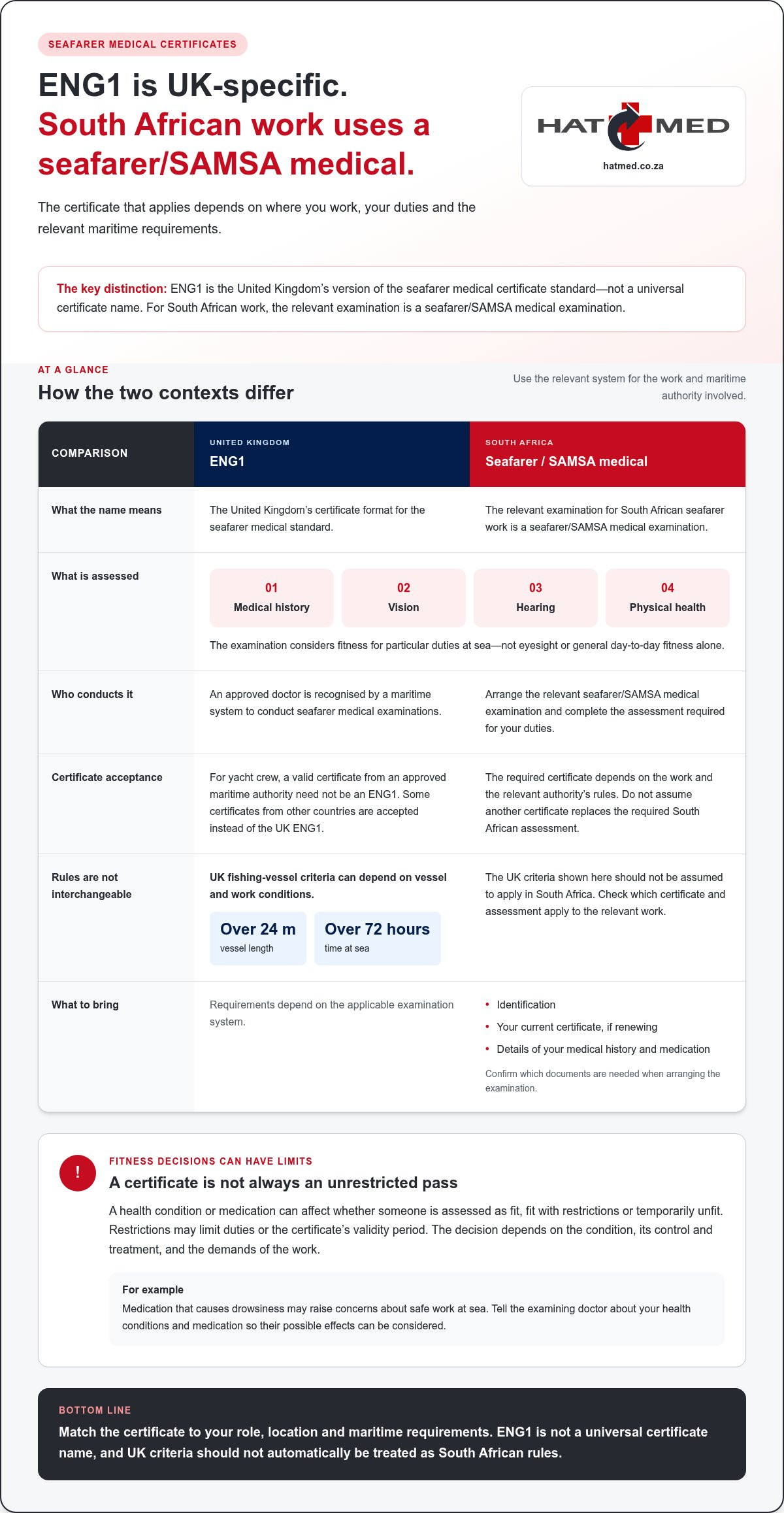
A seafarer’s medical certificate records whether your health supports particular duties at sea. The examination considers medical history, vision, hearing and physical health, rather than eyesight alone. ENG1 is the United Kingdom’s version of the seafarer medical certificate standard, not a universal certificate name.
Approved doctors and examinations
An approved doctor is recognised by a maritime system to conduct seafarer medical examinations. This matters because the examination assesses fitness for work at sea, not simply general fitness for everyday activities. Tell the doctor about your health conditions and medication so their possible effects can be considered.
Medical examination schemes differ between countries and worker groups. In Denmark, seafarers and fishermen aged 16 to 18 serving on Danish ships must have examinations at intervals of no more than 12 months. For those aged 18 or older, an examination every second year will normally be sufficient.
Certificate requirements and fitness standards
For South African work, the relevant examination is a seafarer/SAMSA medical examination; ENG1 is the United Kingdom’s certificate format. The certificate assesses fitness for specific duties at sea, including medical history, vision, hearing and physical health. STCW and MLC are maritime frameworks, but the applicable certificate and assessment depend on the seafarer’s role and requirements.
For yacht crew, the key point is holding a valid certificate issued by an approved maritime authority; it need not be an ENG1. Some certificates from other countries are accepted instead of the UK ENG1. For Denmark, a foreign authority’s certificate may be treated as equivalent when the authority has implemented STCW and the certificate complies with the Maritime Labour Convention.
Food-handler and non-food-handler examinations address different work contexts. A food-handling assessment concerns duties involving food, while a seafarer’s medical examination assesses fitness for maritime duties. Don’t assume one certificate replaces the other. The required certificate depends on the work and the relevant authority’s rules.
Applications, renewals and required documents
To apply for or renew a South African seafarer’s certificate, arrange the relevant seafarer/SAMSA medical examination and complete the assessment required for your duties. Bring identification, your current certificate if you’re renewing, and details of your medical history and medication. This information helps the doctor assess your circumstances. Confirm which documents you need when arranging the examination.
Medical systems also set procedures for challenges and further examinations. In Denmark, a complaint about an examination by an approved maritime medical practitioner must be filed no later than eight weeks after the examination. That Danish deadline is not a South African appeals rule.
If you work in Greenland, Denmark or another country, the certificate’s acceptance depends on the applicable maritime system and the issuing authority. For UK fishing vessel workers, ENG 1 requirements can depend on vessel and work conditions. For example, the stated UK criteria include a vessel over 24 m or time at sea exceeding 72 hours. These UK rules should not be assumed to apply in South Africa.
Certificate restrictions and changes in medical fitness
Medical conditions and medication can affect whether you’re assessed as fit, fit with restrictions or temporarily unfit. The effect depends on the condition, how well it is controlled, its treatment and the demands of your duties. For example, medication that causes drowsiness may raise concerns about safe work at sea.
Fitness decisions and limitations
A fitness decision considers how a health issue affects your ability to perform the duties safely. A certificate may limit your duties or validity period, rather than simply record an unrestricted pass.
A newly diagnosed case of diabetes may result in a restricted certificate lasting six months while the condition is monitored. This is an example of a time-limited decision, not a universal rule for every seafarer with diabetes.
Irish standards offer further examples of condition-specific assessment. A seafarer with inflammatory bowel disease needs a three-month remission period before being considered suitable to resume duties. For a balance disorder, symptoms must have resolved or been controlled for at least three months before the person can be considered fit for seafaring.
These examples describe Irish standards, not South African requirements. The practical point is that fitness depends on how a condition affects the person and the work involved. A restriction may therefore affect permitted duties, while monitoring or further assessment can inform a later decision.
BMI and physical fitness
BMI can prompt closer assessment of whether a person can manage physical duties, including emergencies. In ENG1 guidance for yacht crew, a BMI over 35 requires an exercise test to demonstrate fitness for physical duties in an emergency.
For yacht crew with a BMI between 30 and 35, whether an exercise test is needed is at the medical examiner’s discretion. These thresholds belong to the described ENG1 guidance; they should not be treated as South African rules.
The exercise test focuses on functional ability, not BMI alone. If your examination follows this guidance, the result helps assess whether you can meet the role’s physical demands. Be ready to discuss your usual activity and any symptoms that affect exertion.
Conditions and medications affecting fitness
Disclose diagnosed conditions, symptoms and prescription medicines during the examination. Some medicines may affect an ENG1 outcome, particularly those that cause drowsiness or require special storage. Include non-prescription treatments in your medication history, so the doctor can consider their effects alongside your condition.
Irish standards illustrate how specific the assessment can be. Seafarers with blood pressure readings greater than 150 mmHg systolic or 90 mmHg diastolic should be referred to their GP and declared unfit pending confirmation of adequate control.
For a single unexplained seizure, Irish standards say a seafarer may be suitable after 12 months seizure-free, subject to a consultant neurological opinion confirming the risk of another seizure is equivalent to that of the general population. A person with epilepsy may be considered suitable after 10 years seizure-free, without anti-epileptic medication during that period and with no continuing liability to epilepsy, subject to specialist clearance. These are Irish criteria, not South African rules.
Medical certificate validity and expiry during a voyage
A certificate’s validity period tells you how long its fitness assessment remains current under the issuing system. For South African seafarers, use the expiry date and conditions shown on the certificate issued for your examination; don’t assume a United Kingdom ENG1 period automatically applies locally.
How validity periods work
The example in ENG1 guidance describes a full seafarer’s medical certificate as lasting two years. That is an ENG1 example, not a universal validity period for every certificate or a South African rule. The certificate’s issuing authority, recorded expiry date and any individual restrictions are central to understanding its validity.
Read your certificate carefully when it is issued. Note its expiry date, any duty restrictions and whether it has a shorter validity period. For example, follow the specific end date recorded on your certificate, even if your health feels unchanged.
Planning around a voyage
An expiry date can affect work planning if it falls during a voyage or before your next assignment. Compare the certificate date with the expected departure, voyage schedule and return date. If the dates overlap, arrange the required renewal examination in advance, rather than waiting until you’re already at sea.
Keep a copy of your current certificate with your personal records, and make sure the relevant employer or maritime administrator has the documents they require. A clear record helps you track the next examination date and any restrictions to consider when duties are assigned.
Changes in medical fitness matter even before a certificate expires. A future expiry date does not reflect a health change that occurs after the assessment. If you develop a condition or begin treatment during a voyage, record the details and follow the reporting process for your role and certificate.
What to do before expiry
Before accepting a new assignment, compare your certificate’s expiry date with the planned voyage. Allow time for the examination and its outcome. Bring your existing certificate and relevant medical information to the appointment so the doctor can review the previous assessment alongside your current health.
For example, if you schedule a renewal close to the printed expiry date, delays could leave less time to complete further assessment requirements before departure. Planning ahead gives you time to organise records, discuss ongoing treatment and address restrictions that may affect your duties.
For South African work, distinguish the locally relevant seafarer/SAMSA examination from ENG1. The United Kingdom’s two-year example can help explain how a validity period may be presented, but it does not replace the date or conditions on your own certificate. Use those details to plan each renewal and voyage responsibly.
Visual acuity and colour vision testing
A vision assessment considers more than whether you can read a chart. It may include visual acuity, or how clearly you see, and colour perception. These abilities matter for tasks aboard vessels, where crew may need to recognise visual information in different working conditions. The standards depend on the certificate and duties being assessed.
Visual acuity and corrective lenses
You may still obtain a medical certificate if you wear glasses or contact lenses, provided your corrected vision meets the required standard. Bring your usual lenses to the examination and explain when you rely on them. This helps the assessment reflect the vision you use in practice, rather than relying on unaided eyesight alone.
For example, a crew member whose distance vision is blurred without glasses should complete the assessment wearing their usual correction. Tell the examiner if your prescription has changed or your lenses cause difficulty. These details help describe your day-to-day vision accurately.
Colour vision and duties at sea
Colour vision testing checks whether you can distinguish colours relevant to your work. The result may affect particular duties without automatically ruling out all work at sea. Guidance for crew members says a person who is colour blind can work on deck but cannot stand night watch.
This example shows why certificate restrictions matter alongside test results. A limitation on night watch is different from a decision that someone cannot work on deck. The requirements for your certificate and role determine how the result affects your permitted duties.
Role-specific eyesight standards
Some maritime systems set specific eyesight thresholds for particular tasks. In Denmark, seafarers and fishermen undertaking lookout duty need unaided eyesight of at least 0.1 (6/60) in each eye. Corrected eyesight must reach at least 0.5 (6/12). These are Danish standards, not South African thresholds.
For Danish lookout duties, the distinction between unaided and corrected vision shows why both measures can matter. Glasses may improve acuity, but the stated standard also considers vision without them. Don’t apply these figures automatically to a different certificate or country.
During your examination, share your usual vision correction and any relevant changes in your eyesight. If a colour vision result affects a duty, ask for the certificate restriction to be explained. For instance, a night-watch limitation affects watch planning, even if deck work remains permitted under the guidance described.
Vision standards relate to safe performance of the assessed work, not simply to wearing or avoiding glasses. A seafarer whose corrected vision meets the applicable standard may qualify, while colour perception may affect specific duties. Check the conditions recorded on your certificate before taking an assignment involving lookout or night-watch responsibilities.
Purpose of the seafarer’s medical certificate
Medical certification for seafarers links a health assessment to the practical demands of work at sea. It helps establish whether your health supports your duties and whether restrictions should be recorded. Its purpose is not simply to label someone healthy or unhealthy.
The examination considers medical history, vision, hearing, physical health and fitness for specific duties. These areas can affect different tasks in different ways. For example, eyesight may matter particularly for lookout work, while physical capacity may be relevant during an emergency response.
Fitness for duties, not a general health label
A certificate describes fitness for the work being assessed, rather than guaranteeing overall health. A crew member may be fit for some duties but restricted from others. Its practical value is in connecting the assessment outcome with the demands of the role.
For instance, guidance for yacht crew says a colour-blind crew member can work on deck but cannot stand night watch. This shows how an assessment can inform task allocation without automatically ruling out all maritime work. The restrictions recorded on the certificate clarify that distinction.
Why maritime work makes the assessment relevant
Work at sea can involve duties where vision, hearing, mobility or ongoing treatment affects performance. A medical examination considers these factors together. Disclose your medication so the examining doctor can assess its possible effects, such as drowsiness or special storage needs.
The certificate also records the outcome for the seafarer and relevant maritime administration. In Denmark, seafarers must have a valid medical certificate during employment. This example illustrates how a certificate can be tied to a working relationship, but it is not a South African rule.
A certificate does not replace the training or qualifications required for a job. Instead, it addresses a separate question: whether your health supports the relevant duties. For example, you may have the skills for a role but still need an assessment that considers a health condition or vision limitation.
What the result helps you understand
Check the certificate’s validity date, restrictions and covered duties. If it records a limitation, use that information when discussing assignments and watch responsibilities. If your health or medication changes, share the new information at your next medical assessment rather than relying on an earlier record.
For a South African seafarer, a seafarer/SAMSA medical examination connects the assessment to maritime work. In practice, medical certification for seafarers helps relate health to duties, so restrictions and recorded conditions matter as much as the fitness decision.
Hatmed Medical Centre: General Practitioner Consultations
Hatmed Medical Centre conducts Seafarers / SAMSA Medical Examinations for seafarers who need an examination related to maritime work. A General Practitioner Consultation can also help you discuss a health concern or medication that may affect your fitness assessment. Sharing relevant medical information helps the doctor understand your health history and current treatment.
If you’re managing an ongoing condition, Chronic Disease Management provides care focused on that health need. Choose the service that matches your needs, whether that’s a seafarer examination, general medical care or ongoing condition management.
For a seafarer medical examination or help with a related health concern, contact Hatmed Medical Centre.
Plan your next maritime medical step
Before arranging your next assessment, identify the certificate or examination your role requires and gather the health information you want to discuss. This gives your appointment a clear purpose, whether you’re preparing for maritime work or managing a related health concern.
Medical certification for seafarers forms part of a wider picture of personal health and work readiness. Hatmed Medical Centre offers Seafarers / SAMSA Medical Examinations, General Practitioner Consultations and Immigration Medical Examinations to address different medical needs through relevant assessments and care.
If you’re ready to discuss an examination or a health concern, contact Hatmed Medical Centre. Taking the next step with your needs clearly in mind can help you approach your medical appointment with confidence.
Frequently Asked Questions
Which doctors or clinics are approved to conduct seafarer medical examinations in South Africa?
Hatmed Medical Centre offers Seafarers / SAMSA Medical Examinations conducted by SAMSA-accredited practitioner Dr Johan Momberg. For your examination, what matters is whether the practitioner is recognised for the maritime assessment you need, rather than simply providing general medical care. Bring your current certificate and health information to the appointment. This helps the practitioner understand the examination’s purpose and the role being assessed.
What tests and examinations are included in a seafarer medical assessment?
A seafarer assessment can cover your medical history, vision, hearing, physical health and fitness for your duties. The exact assessment may vary with the certificate and work involved. For example, an ENG1 hearing assessment may use a formal audiogram or a WHO-standard test. Tell the doctor about medication and relevant health changes, and bring your usual glasses or contact lenses if you use them.
How long is a seafarer medical certificate valid, and what are the age-related rules?
Validity and age conditions vary between maritime systems, so use the expiry and conditions on the certificate applicable to your South African role. The ENG1 guidance example describes a full certificate lasting two years, but that is not a universal South African period. Foreign age rules also differ: Danish seafarers aged 16 to 18 have examinations at intervals of no more than 12 months. Don’t treat that as a South African rule.
What happens if I fail a seafarer medical examination, and can I appeal or request a review?
If the examination finds you unfit or records a restriction, ask for the outcome and its effect on your duties to be explained. Any further examination or review depends on the rules that apply to your certificate. For comparison, Denmark requires complaints about an approved maritime practitioner’s examination within eight weeks. Ireland has a separate appeal process. Neither country’s timeframe should be assumed to apply to a South African examination.
Are medical certificates from other countries accepted for South African seafarers?
A certificate accepted in another country isn’t automatically established as acceptable for South African work. Acceptance depends on the applicable maritime requirements for your role and the authority responsible for the certificate. Some foreign certificates may be accepted instead of a UK ENG1, but that relates to UK requirements. Danish rules also describe conditions for treating a foreign certificate as equivalent. These examples don’t determine acceptance in South Africa.