

For mine employees, the cost rule is clear: under section 18 of South Africa’s Mine Health and Safety Act 29 of 1996, employers pay for clinical examinations and medical tests performed under the Act unless it expressly provides otherwise. The legal requirements for employee medical screening in South Africa also include medical surveillance under the Occupational Health and Safety Act 85 of 1993. The rules depend on the work and the health hazards involved.
It’s understandable to want clear guidance before arranging an examination or setting a workplace budget. This article explains when employers must cover examination costs and which medical surveillance duties apply, including the timing of mine examinations and the handling of medical records.
You’ll also learn who may conduct occupational medical examinations and how they differ from a general pre-employment assessment. This will help you plan screening that fits the role and its workplace risks.
Key Takeaways
- For examinations and medical tests performed under the Mine Health and Safety Act, the employer pays unless the Act expressly provides otherwise.
- Medical surveillance is required for employees exposed to health hazards, with mine examinations and reporting subject to specific timing requirements.
- The examinations and tests needed depend on the workplace hazards and the employee’s role, so screening should reflect the risks involved.
- According to the South African Legal Information Institute, a mining-sector occupational medical practitioner must hold an occupational-medicine or equivalent qualification recognised by the Health Professions Council of South Africa.
- Mine medical surveillance records are confidential and must be retained for at least 40 years.
Employer responsibility for examination costs
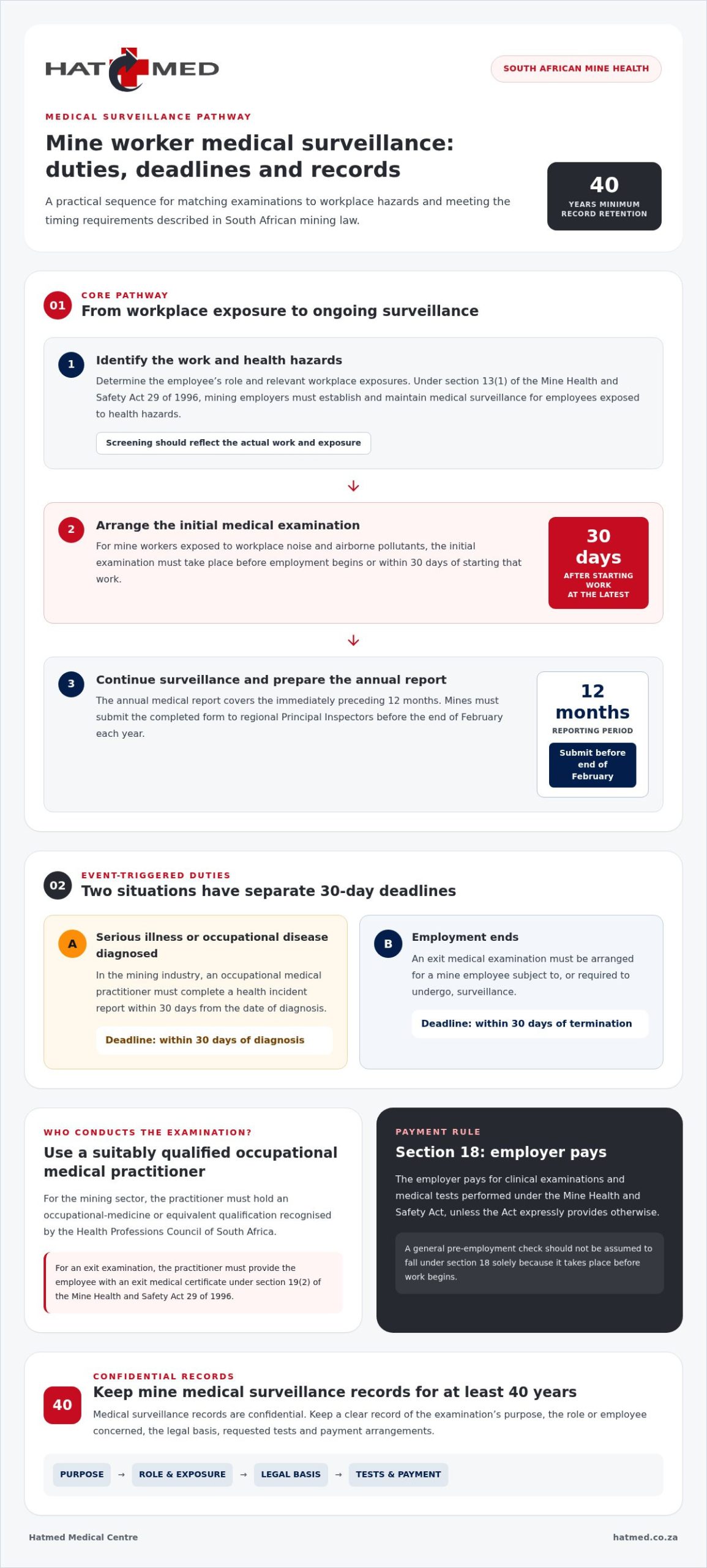
Examination costs are the charges for clinical examinations and medical tests arranged to assess an employee’s health. In mining, section 18 of South Africa’s Mine Health and Safety Act 29 of 1996 requires the employer to pay for examinations and tests performed under the Act, unless the Act expressly provides otherwise.
This rule applies to examinations and tests under the Mine Health and Safety Act, rather than automatically settling costs for every workplace screening. Employers should identify the legal purpose of an examination before booking it. For example, a mine worker’s medical surveillance examination under the Act falls within the employer payment rule. A general pre-employment check should not be assumed to fall under section 18 solely because it happens before work begins.
The distinction matters when preparing a budget. The examination’s purpose, the employee’s exposure to workplace hazards and the legal framework requiring it all help determine which cost rule applies. Employers should link each requested assessment to the employee’s actual duties. For example, screening for a specific workplace health hazard should reflect that exposure, rather than being treated as a generic check.
For examinations covered by section 18, the employer should arrange payment as part of organising the required clinical examination or medical test. Keep a clear record of the examination’s purpose, the employee or role concerned, the legal basis and the agreed payment arrangements. This creates a practical audit trail and helps separate statutory medical surveillance from other employment-related assessments. It also reduces confusion when an invoice covers more than one examination or test.
For other workplace assessments, employers should agree on the cost arrangement before booking. Consider why the examination is required, which tests are needed, whether it forms part of statutory surveillance and what the employer and employee have agreed. Mining-specific provisions are not a universal payment rule for every South African industry.
To arrange employee medical screening in South Africa, an employer should identify the role’s hazards and the examination needed, then choose an occupational health provider equipped to assess those risks. Before the appointment, clarify who pays, what the assessment covers and how results will be handled.
In practice, an employer can use this sequence:
- Define the purpose: identify whether the examination is statutory surveillance, pre-employment screening or another assessment.
- Match the assessment to the work: document the role and relevant workplace exposures.
- Confirm the cost basis: apply section 18 where the examination or test is performed under the Mine Health and Safety Act.
- Record the arrangement: retain the booking details, requested tests and payment responsibility.
These steps help employers distinguish the clear mining-sector rule from other screening arrangements. For employee medical screening in South Africa, identifying the applicable law and the examination’s purpose is the practical starting point for deciding who pays.
Legal medical surveillance requirements
Medical surveillance is the ongoing health assessment required for employees exposed to workplace hazards. South African rules set out employers’ duties, examination timing, reporting and record retention.
Medical surveillance requirements
Medical surveillance is a planned process for monitoring employees’ health risks related to workplace exposure. Under section 13(1) of South Africa’s Mine Health and Safety Act 29 of 1996, mining employers must establish and maintain surveillance for employees exposed to health hazards. The Occupational Health and Safety Act 85 of 1993 also makes medical surveillance a legal requirement in South Africa.
For mine workers exposed to workplace noise and airborne pollutants, the initial medical examination must take place before employment begins or within 30 days of starting that work. Under section 16(1), the annual medical report covers the immediately preceding 12 months. Mines must submit the completed annual medical report form to regional Principal Inspectors before the end of February each year.
When a serious illness or occupational disease is diagnosed in the mining industry, an occupational medical practitioner must complete a health incident report within 30 days from the date of diagnosis. Employers must also arrange an exit medical examination within 30 days from the date of termination for a mine employee subject to, or required to undergo, surveillance.
Conducting and certifying examinations
An occupational medical practitioner is a medical practitioner with a recognised occupational-medicine or equivalent qualification. According to the South African Legal Information Institute, the qualification must be recognised by the Health Professions Council of South Africa.
This qualification matters in the mining sector because the practitioner conducting an exit examination must provide the employee with an exit medical certificate under section 19(2) of the Mine Health and Safety Act 29 of 1996. Employers should ensure the examination and certificate relate to the employee’s medical surveillance requirements and work history. A general medical check should not be confused with the specific occupational examination required for a mine role.
Consent, confidentiality and medical records
Confidentiality means protecting an employee’s medical information from unnecessary disclosure. Under section 13(8) of the Mine Health and Safety Act 29 of 1996, South African mines must retain each mine worker’s medical surveillance records as confidential records for at least 40 years.
Consent means an employee agrees to take part in a medical examination. Before arranging one, employers can explain its purpose, the relevant workplace exposure and how the assessment relates to the role. Keep examination records separate from general employment paperwork, and restrict access to people who need the information for their duties. These steps support the statutory confidentiality obligation in mining.
Applicants and screening results
Applicant screening assesses health in relation to a particular job’s duties and hazards. Consider the result alongside the role’s actual requirements, rather than treating it as a complete answer about an applicant’s suitability. For example, a finding relevant to exposure in a mine may have a different bearing on a role without that exposure.
For current mine employees, medical incapacity decisions must ensure procedural and substantive fairness. This includes employees who qualify as persons with disabilities under the Employment Equity Act 55 of 1998 as amended. That stated fairness requirement concerns current employees; it should not be presented as a blanket rule about every applicant. Employers should base screening decisions on job-related findings and document how they relate to the work.
What tests are included in an occupational medical examination in South Africa?
An occupational medical examination assesses an employee’s health in relation to their work and workplace exposures. Its scope should reflect the assessment’s purpose and the hazards linked to the role, rather than an assumed checklist that applies to every job.
For South African mines, the legal context identifies workplace noise and airborne pollutants as exposures relevant to initial examinations. Start by identifying which exposure applies to the employee. A worker exposed to noise and one exposed to airborne pollutants may need different assessments because the health risks differ.
A job title alone is not enough to choose tests. Employers should describe the employee’s actual tasks, materials and working conditions, then link each relevant hazard to the examination requested. For example, if airborne pollutants are present, that exposure should be a central consideration, rather than treating the appointment as a general health check.
A practical preparation sequence helps make the appointment relevant:
- Describe the work: record the role’s tasks and the workplace conditions the employee may encounter.
- Identify exposures: note whether noise, airborne pollutants or another health hazard is relevant.
- State the examination purpose: distinguish an initial assessment from ongoing medical surveillance or an exit examination.
- Clarify the requested assessment: ensure the examination addresses the stated role and exposure, rather than adding unrelated tests.
For an initial mine examination involving workplace noise and airborne pollutants, timing also matters. The examination must take place before employment begins or within 30 days of starting work involving those exposures. That requirement helps employers plan the assessment around the employee’s start date and actual work conditions.
Medical surveillance is an ongoing process, not simply a one-off appointment. In mines, the annual medical report under section 16(1) of the Mine Health and Safety Act 29 of 1996 covers the immediately preceding 12 months. The assessment and its recorded findings should relate to the worker’s surveillance and exposure history during that period.
Interpret results in context. A finding matters because of its relationship to the employee’s health, exposure and duties, not simply because a test produced a result. Keep the examination’s purpose clear and handle related medical information confidentially, particularly when it forms part of mining surveillance records.
Employees can ask which workplace exposure the examination addresses to understand why it is being arranged. Employers can document the role, exposure and examination purpose to plan employee medical screening in South Africa without assuming every worker needs the same tests.
Who may conduct and certify occupational medical examinations in South Africa?
An occupational medical practitioner is a medical practitioner with a recognised occupational-medicine qualification or equivalent. According to the South African Legal Information Institute, in South Africa’s mining sector that qualification must be recognised by the Health Professions Council of South Africa.
This definition sets a specific qualification standard for mining-sector occupational medical practitioners. Being a medical practitioner alone is not enough: the occupational-medicine or equivalent qualification, and its recognition by the Health Professions Council of South Africa, also matter. Employers arranging a mine examination should identify the practitioner’s occupational-medicine credentials and ensure the assessment reflects the worker’s role and exposure.
The sector matters. This definition concerns South Africa’s mining sector and is not a universal rule for every workplace examination. Employers should identify the examination’s purpose, the industry involved and any specific occupational requirements. For example, mine employees undergoing surveillance should be assessed within the applicable mining framework, rather than assuming that any general medical appointment fulfils that need.
Certification is the formal record issued after an examination. Under section 19(2) of South Africa’s Mine Health and Safety Act 29 of 1996, the occupational medical practitioner conducting a mine employee’s exit examination must provide an exit medical certificate to that employee. This connects the certificate to both a particular examination and the practitioner conducting it.
The qualification and certificate answer different questions. The qualification identifies the relevant professional standard in mining; the exit certificate records the outcome of a specified examination. Employers should avoid treating a certificate from another appointment as a substitute for the exit medical certificate required under section 19(2). Keeping the examination type and its purpose clear helps prevent that mix-up.
Before arranging a mining-sector examination, employers can take these practical steps:
- Identify the assessment: establish whether it is an initial, surveillance or exit examination.
- Match the professional qualification: for mining, check that the practitioner meets the occupational-medicine or equivalent qualification definition, recognised by the Health Professions Council of South Africa.
- Explain the work context: provide the role and relevant workplace exposures so the examination addresses the employee’s circumstances.
- Record the required output: for an exit examination, ensure the occupational medical practitioner provides the employee’s certificate under section 19(2).
Employees can clarify which examination they are attending and whether it is an exit assessment. These details help distinguish a routine appointment from an occupational examination linked to mining work and its associated certification.
What are employers’ and employees’ rights regarding consent, confidentiality, and medical records?
Consent means an employee agrees to take part in a medical examination. Before an appointment, employers should explain its purpose, the work-related concern and what the assessment involves. For example, an employee screened for workplace noise exposure should understand why that exposure matters and which examination is planned. Clear information helps employees take part with an understanding of the process.
Confidentiality is the protection of personal health information from unnecessary disclosure. In South African mines, section 13(8) of the Mine Health and Safety Act 29 of 1996 requires medical surveillance records for each mine worker to be kept confidential for at least 40 years. This is a specific mining requirement. It should not be presented as the retention period for every workplace or every type of medical record.
A medical record is information documented or collected during an employee’s health assessment. Employers can clarify record handling by deciding who needs access, where records will be kept and how examination information will be separated from routine employment documents. For instance, a manager may need a work-related outcome, while detailed clinical information should remain protected as confidential medical material.
Employees can ask what information the examination will produce, who will receive it and how it relates to their role. Employers should explain these points before arranging the assessment and avoid collecting information unrelated to its stated purpose. For example, a mining employee attending surveillance should be told how the assessment relates to workplace hazards and how the record will be handled.
Good record management also supports the employer’s responsibilities. A practical process should identify the employee, examination date, assessment purpose and applicable workplace exposure. For mine surveillance, the employer must preserve the records as confidential for at least 40 years under section 13(8). Keeping a clear distinction between clinical records and employment decisions helps limit unnecessary circulation of sensitive details.
Before the examination, both parties can use these steps:
- Explain the purpose: connect the assessment to the role or identified workplace exposure.
- Describe information handling: tell the employee who will receive relevant results and where records are maintained.
- Limit access: share health information only with people who need it for a defined work-related task.
- Apply the correct retention rule: retain mine surveillance records confidentially for at least 40 years.
For an appointment linked to pre-employment screening, discuss the assessment’s purpose and how its information will be handled. Explore pre-employment medical examinations as part of planning a clear screening process.
Hatmed Medical Centre: General Practitioner Consultations
Hatmed Medical Centre offers General Practitioner Consultations for people seeking support with general health concerns alongside workplace medical requirements. A GP consultation may be a helpful next step when an employee needs to discuss a health issue or ongoing care. It does not replace legally required occupational medical surveillance.
For specific examination needs, Hatmed Medical Centre also provides Immigration Medical Examinations and Seafarers / SAMSA Medical Examinations. Chronic Disease Management supports people managing a long-term condition as part of their broader healthcare. Choose an appointment based on whether you need general medical care, a specific examination or ongoing condition management.
Contact Hatmed Medical Centre to discuss which service best fits your healthcare needs.
Take the next step with confidence
For employers considering employee medical screening in South Africa, the next step is to match the appointment to its purpose. A workplace requirement, a personal health concern and an examination for a specific travel or work-related process are different needs. Clarifying which applies helps you choose an appropriate starting point.
Hatmed Medical Centre offers General Practitioner Consultations for general health concerns, as well as Immigration Medical Examinations and Seafarers / SAMSA Medical Examinations for those specific requirements. These services suit people who need a GP consultation or one of these examinations, rather than a separate statutory occupational surveillance programme.
If you’re ready to discuss your healthcare needs, contact Hatmed Medical Centre. Taking that first step can help you move forward with greater clarity and support.
Frequently Asked Questions
What types of employee medical screening are required in South Africa?
The required screening depends on the employee’s work, health hazards and the assessment’s purpose. Examples include pre-employment examinations, medical surveillance for employees exposed to workplace hazards, and exit examinations for certain mine employees. Employers can start by identifying actual duties and exposures, then arrange an assessment suited to those risks. A generic health check may not address hazards specific to the job.
What does South African law require for occupational health medical examinations?
Employers must arrange medical surveillance where applicable laws require it for employees exposed to health hazards. For example, mining employers have specific duties under the Mine Health and Safety Act. Document the role, relevant exposure and examination purpose, then keep associated records organised and confidential. This links the assessment to workplace risk rather than treating it as an unrelated medical appointment.
Which laws govern employee medical screening in South Africa, including the Occupational Health and Safety Act?
The Occupational Health and Safety Act 85 of 1993 and the Mine Health and Safety Act 29 of 1996 govern relevant medical surveillance duties. The Occupational Health and Safety Act makes medical surveillance a legal requirement, while the Mine Health and Safety Act sets additional requirements for mines. Employers should identify their industry and the employee’s exposure before applying a provision, as a mining-specific rule may not apply to another workplace.
When must employers conduct pre-employment, periodic, and exit medical examinations in South Africa?
For mine employees exposed to workplace noise and airborne pollutants, an initial examination must take place before employment begins or within 30 days of starting that work. An exit examination is required within 30 days after termination for a mine employee subject to, or required to undergo, surveillance. The annual medical report covers the immediately preceding 12 months. These mining-specific timings should not be assumed to apply to every industry.
Which employees need medical screening based on workplace hazards or industry?
Employees exposed to workplace health hazards are the main group requiring medical surveillance under the relevant rules. In mining, employers must establish and maintain surveillance for employees exposed to health hazards. Workplace noise or airborne pollutants, for example, may be relevant exposures when assessing a mine role. Consider actual duties and conditions, since a job title alone may not reveal the hazards an employee encounters.
How much does employee medical screening cost in South Africa?
There is no single cost for every examination: the purpose, scope and required tests affect the price. For examinations and medical tests performed under the Mine Health and Safety Act, the employer pays unless the Act expressly provides otherwise. For other assessments, the price depends on the case and is provided after a quote request. Factors include the examination type and tests needed.
What are the risks and penalties for employers who fail to provide required medical surveillance?
Failing to provide required surveillance can leave an employer without evidence that relevant workplace health risks were monitored. In mining, omissions may also affect required reports and confidential record-keeping. Employers can reduce administrative gaps by recording identified hazards, examinations arranged, reports submitted and medical records retained. The consequences depend on the legal duty and circumstances, so do not assume a single penalty applies to every failure.