

For a South African visa application, the medical certificate is available for collection 5 days after the examination. A medical clearance for a visa may form part of the paperwork for foreign workers and students, alongside the required supporting documents.
Preparing for an immigration medical examination can feel like a lot to organise, especially when you’re also gathering application paperwork. Knowing what the examination involves and what to bring can make the process clearer.
This guide explains how medical certificates fit into visa applications, what to expect at an examination, and which documents to bring. You’ll also find practical advice on preparing for an appointment, including bringing your passport, spectacles if you use them, and relevant previous medical records. Use these details to plan your next steps with confidence.
Key Takeaways
- Understand how a South African Home Affairs medical certificate fits into your visa application and allow sufficient time for its collection.
- Know what the visa medical examination involves, so you can adequately prepare for the appointment and its clinical checks.
- Note that all required medical reports, including the standard Medical Report (BI-811) alongside medical and police clearances, must be dated within six months of submission.
- Organise supporting paperwork carefully, including any required vaccination evidence or a recent doctor’s report for prescription medication.
- Learn why medical screening requirements can differ between visa types and specific immigration pathways.
Home Affairs medical certificates
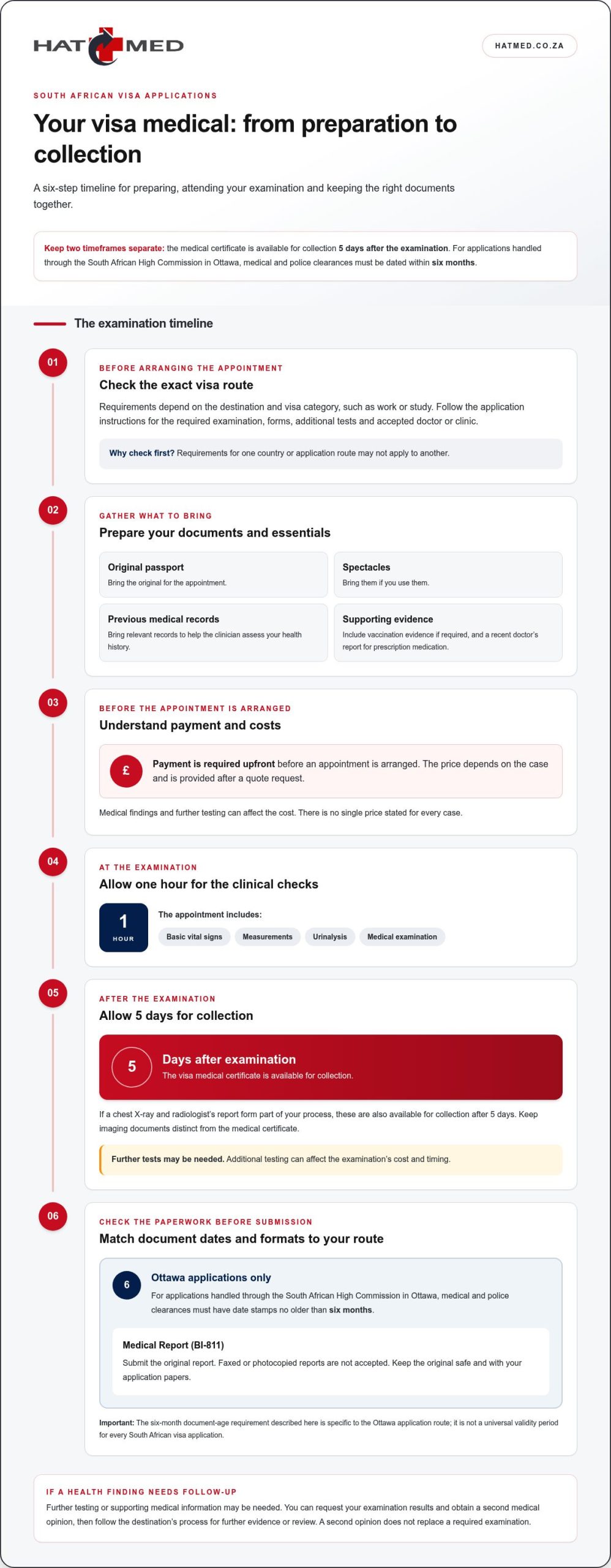
A South African visa medical certificate is available for collection 5 days after the examination. For applications handled by the South African High Commission in Ottawa, medical and police clearances must carry date stamps no older than six months. These timeframes are different: one concerns collection, whilst the other concerns document age.
Applicants should distinguish the medical certificate from the examination appointment and any associated imaging. The chest X-ray and radiologist’s report are also available for collection 5 days after the examination. Plan around that collection period before submitting an application, particularly if other documents need to be assembled at the same time.
For Ottawa applications, the medical report is identified as form BI-811. Its date must fall within the six-month period specified for the application. The original report is required; faxed or photocopied reports are not accepted. Keep the original safe after collection, and avoid treating a scan or photocopy as a replacement.
Keep these details separate when planning your paperwork:
- Collection: allow 5 days after examination for the visa medical certificate.
- Imaging documents: the chest X-ray and radiologist’s report are available after 5 days.
- Ottawa document age: medical and police clearances need date stamps no older than six months.
- Ottawa medical form: submit the original BI-811, not a faxed or photocopied version.
The six-month validity rule above applies to applications handled through the South African High Commission in Ottawa. It is not a universal validity period for every South African visa application. The application route matters, so match the document’s date and format to that route’s instructions. Even a recently issued certificate may be too old if its date falls outside the relevant period.
Before the examination, note the date you attend and the 5-day collection interval. After collection, check that the documents are complete and readable, and keep the original BI-811 together with your application papers if applying through Ottawa. If your application includes a chest X-ray report, keep it with the medical paperwork rather than confusing it with the certificate itself.
In short, the medical clearance for a visa takes 5 days to collect after examination. For Ottawa applications, medical and police clearances must be dated within six months; the collection period does not extend that document-validity window. Organising these dates and originals separately helps prevent a medical certificate, imaging report or supporting form from being mistaken for another document.
Medical examination for foreigners working or studying in South Africa
A visa medical examination supports an application, but the required checks depend on the purpose and destination. For South African applications, allow time for the appointment and any follow-up tests.
Examination components and costs
A South African visa medical appointment includes basic vital signs, measurements, urinalysis and a medical examination. The appointment lasts one hour. Payment is required upfront before an appointment is arranged, so include this step in your plans.
The price depends on the case and is provided after a quote request; medical findings and further testing can affect the cost. A chest X-ray and radiologist’s report may also form part of the process, and these are available for collection 5 days after examination.
Destination and visa requirements
Medical requirements vary with the destination country and visa category, such as work or study. The application instructions determine which examination, report or additional tests are needed; requirements for one country may not apply to another.
No single country list can cover every application. Before booking, check the requirements for your exact visa stream and destination, especially if the application specifies a particular form or examination.
Approved doctors and clinics
The accepted doctor or clinic depends on the destination’s instructions. Some visa processes direct applicants to designated medical practitioners; others specify the required report and tests. Follow the instructions for your application rather than assuming a routine consultation will meet its requirements.
If you’re applying for a South African visa from overseas, use the medical documentation and submission rules for your application route. For an examination in South Africa, an immigration medical assessment can be a practical step.
How long does medical clearance for a visa take, and how long are results valid? The South African visa medical certificate, chest X-ray and radiologist’s report are available for collection 5 days after examination. For applications handled through the South African High Commission in Ottawa, medical and police clearances must have date stamps no older than six months.
If an examination identifies a health condition, further testing or supporting medical information may be needed. Additional tests can affect the examination cost and timing, so keep a record of the requirements and results.
A medical finding does not automatically determine whether you can appeal or seek another opinion. You can request your examination results and obtain a second medical opinion, then follow the destination’s process for further evidence or review. A second opinion does not replace a required examination.
Bring your original passport, spectacles if you use them, and relevant previous medical records. These help the clinician assess your health history and complete the examination. If you take prescription medication, bring a recent doctor’s report. Missing documents can delay submission.
Documents to bring
Organise your medical and visa paperwork separately. Examination documents help the clinician assess your health; application documents support your visa file. Requirements vary by application route, so the Ottawa-specific instructions below apply to applications through the South African High Commission in Ottawa.
For the examination, bring your original passport, spectacles if you use them, and relevant previous medical records. These provide identification and useful health-history details. If you take prescription medication, include a recent doctor’s report. Submission may be delayed until the report is received.
For Ottawa applications, organise the medical paperwork carefully. The Medical Report (BI-811) must be dated no older than 6 months. Submit the original BI-811: faxed or photocopied reports are not accepted. The High Commission also does not accept photocopied, faxed or certified copies of medical and police certificates, so keep originals together for submission.
Build the rest of your application file around these specific items:
- Police clearance: include certificates for countries where you lived for at least 12 consecutive months after turning 18 during the preceding five years.
- Police report date: original fingerprinted police reports must be issued within six months.
- Application form: complete DHA-1738 in black ink.
- Bank statement: provide a current-month statement reflecting a three-month-to-date account record, the account holder’s name and available balance.
- Passport pages: present a passport with at least THREE (3) unused blank visa pages.
Some supporting documents depend on your travel history or age. A vaccination certificate is required if you transit through a yellow fever belt country. Applicants aged 17 and under must include a long-form birth certificate with their application. Keep these items with the relevant application papers, rather than amongst clinical records.
Before submitting, compare each paper against its purpose, date and format. For example, the BI-811 is the medical report, while a chest X-ray and radiologist’s report are separate examination documents. For Ottawa applications, distinguish original certificates from copies, and keep the date requirements visible while organising the file. That simple sorting step helps prevent an outdated report or incorrect document format from being overlooked.
A medical clearance for a visa involves more than completing an examination. For an Ottawa application, check the original-document rules, BI-811 date, police certificate period, passport pages and any relevant supporting evidence together. If prescription medication is involved, place the recent doctor’s report with the medical papers before submission.
Which visa types require medical clearance in South Africa?
No single visa category determines every medical requirement. The application route and instructions for the specific visa category establish which medical documents are needed. Work and study applicants should use the checklist for their exact application, rather than assume one set of requirements applies to both.
Medical clearance for a visa may involve a medical report, an examination or supporting test results. Treat these as separate requirements: an application that asks for a report may also require examination evidence, while another route may specify different documents. Before arranging the examination, match each item to the applicable checklist.
For a visitor intending to stay in South Africa for more than 90 days, the relevant visa should be selected from the visa options listed by the South African High Commission in Ottawa. That stay-length rule helps identify the visa route, but it does not by itself establish which medical papers that category requires. The relevant application instructions remain the guide to its medical documents.
Use this practical sequence to establish what applies:
- Identify the purpose: note whether the application is for work, study or a visit.
- Choose the route: use the visa category that matches that purpose and intended stay.
- Read the category’s checklist: record whether it names a medical report, examination or other medical evidence.
- Separate medical documents: distinguish the certificate from any chest X-ray or radiologist’s report.
For example, a student and a prospective employee should not assume their application paperwork is identical. Each should follow the medical requirements attached to the chosen category. The same applies to a visitor staying beyond 90 days: selecting a relevant visa is a separate step from meeting any medical-document requirement.
Applicants using the South African High Commission in Ottawa should pay close attention to document age and format. Medical and police clearances must have date stamps no older than six months. The Medical Report (BI-811) must also be submitted as an original, not as a fax or photocopy. These Ottawa instructions concern the application route and should not be treated as a universal rule for every visa category.
Before booking, note the exact name of your visa category and the medical items listed for it. Arrange the examination around those requirements, including any separately named imaging or report. This keeps your application focused on the documents its route requires, without assumptions based on a different visa type.
Which countries require visa applicants from South Africa to undergo a medical exam?
There is no single medical-examination rule for every South African travelling overseas. The destination country sets its own requirements, and the visa category can change which checks or documents apply. Work, student and visitor visas may have different instructions, even for the same destination.
Start with the destination’s official immigration guidance for your exact visa category. Look for information on medical examinations, health certificates or medical reports. Check whether it names a required form, examination type, practitioner or testing process. These details determine what to arrange in South Africa before submitting your application.
Use this checklist to make your research practical:
- Confirm the destination: use the country named on your application, not a transit point.
- Identify your visa category: distinguish work, study, residence and visitor applications.
- Read the health instructions: note each examination, certificate and test requested.
- Check the submission rules: record whether documents must be originals, and note their required dates.
- Arrange the required assessment: bring the destination’s forms and instructions to the appointment.
A destination may, for example, specify a medical report for one visa category and different evidence for another. Requirements may also distinguish between an examination and supporting tests. Do not assume a certificate accepted for one application will meet another country’s requirements.
Timing matters, too. Allow time for the appointment, any requested testing and preparation of reports before your application deadline. If the destination sets a document-age limit, compare it with your planned submission date. A certificate completed too early may no longer meet the application’s timing rule.
Separate visa medical requirements from entry or transit health documents. For instance, a vaccination certificate may be required when transiting through a yellow fever belt country. This is a distinct document requirement, not proof that every traveller to that destination needs a full medical examination.
South African applicants can make a simple record of the destination, visa category, required examination, forms, document format and timing rules. Use the destination authority’s instructions as the deciding reference, then bring those details to your medical appointment. This avoids relying on another applicant’s checklist, which may relate to a different visa or country.
If your destination requires an examination in South Africa, take the next step in preparing for your visa medical.
For applications through the South African High Commission in Ottawa, applicants must submit the original Medical Report (BI-811); faxed or photocopied reports are not accepted. The South African High Commission in Ottawa states that visa processing takes 8 weeks when all requirements are met.
Hatmed Medical Centre: General Practitioner Consultations
Hatmed Medical Centre offers Immigration Medical Examinations for people preparing visa paperwork in South Africa. Bring the relevant application forms and instructions so the examination can be aligned with the documents your visa route requires.
For broader medical guidance, a General Practitioner Consultation gives you an opportunity to discuss your health concerns. Hatmed Medical Centre also provides Chronic Disease Management to support people managing an ongoing condition, as well as Seafarers / SAMSA Medical Examinations for occupational medical requirements.
To arrange an immigration examination or general consultation, contact Hatmed Medical Centre or visit hatmed.co.za.
Take your next step with confidence
Plan medical clearance for visa requirements alongside your preparations for moving, working or studying across borders. Once you understand the requirements for your application, organise your appointment and personal health information. A clear plan can help you approach the process calmly and keep your wellbeing in view during a busy period of change.
Medical clearance for visa applicants is one part of preparing for an international move. Hatmed Medical Centre provides Immigration Medical Examinations to support the medical side of your plans. Bring your questions and relevant information so your needs can be discussed in context.
Contact Hatmed Medical Centre to discuss your next step. Thoughtful preparation can help you move forward with confidence.
Frequently Asked Questions
What does medical clearance for a visa mean?
It means completing the health assessment and providing the medical documents required for a particular visa application. This clearance supports the application but is separate from the immigration decision. Depending on the destination and visa category, you may need an examination, a specific report or both. For example, work visa requirements may differ from those for a visitor visa, so follow the instructions for your own application.
What medical tests are required for visa clearance, such as TB screening or chest X-rays?
Tests depend on the destination and visa category. A South African visa examination can include vital signs, measurements, urinalysis and a medical examination; a chest X-ray and radiologist’s report may also be required. Some medical clearance for visa applications requires TB screening. Hatmed Medical Centre provides immigration examinations, including UK TB screening. Use the destination’s instructions to identify the tests and reports required for your category.
How do I book and complete a visa medical examination in South Africa?
First, identify your destination and visa category, then organise the relevant forms and medical instructions. Contact Hatmed Medical Centre to arrange an Immigration Medical Examination and explain which destination’s requirements apply. The appointment includes a medical examination and basic checks. Payment is required upfront before an appointment is arranged, so include this step in your planning for medical clearance for visa applications.
What documents and vaccination records should I bring to a visa medical appointment?
Bring your original passport, spectacles if you use them, and relevant previous medical records. If you take prescription medication, include a recent doctor’s report. Check the vaccination-document requirements if your journey includes transit through a yellow fever belt country. Keep your visa forms and health records organised separately to distinguish the documents needed for the examination from those supporting your visa application.
How much does visa medical clearance cost in South Africa, and are fees refundable?
The examination price depends on the case, including medical findings and whether further testing is needed; it is provided after a quote request. Refundability is not determined by one visa rule. It depends on the payment and cancellation terms that apply to the appointment, so read those terms before paying. If further tests are needed, plan for them as separate cost considerations.