
Colour vision can be a key consideration for deck and bridge-watchkeeping eligibility. In South Africa, the merchant navy eyesight standards for bridge watchkeepers are considered as part of a seafarer medical assessment, alongside factors such as distance vision, binocular vision and visual fields. A colour-vision result matters, but it is only one part of the overall picture.
If you’re concerned that colour blindness, glasses or previous eye surgery could affect your plans, it’s reasonable to seek clear answers before taking the next step. This article explains how eyesight is assessed and what these factors may mean for your eligibility.
You’ll also learn why unaided distance vision is considered, how binocular vision and visual fields relate to watchkeeping, and what to understand about eye surgery. This can help you prepare for a Seafarers / SAMSA Medical Examination with a clearer picture of the issues involved.
Key Takeaways
- Understand why binocular vision and a full field of vision in each eye matter for safe watchkeeping.
- Learn how colour perception is assessed and why colour blindness can affect deck eligibility.
- See what factors related to corrective eye surgery may be considered during a medical assessment.
- Find out how unaided distance vision is assessed for deck and navigation roles, and how to prepare for the eyesight checks.
Binocular vision and visual field requirements
Binocular vision and visual fields are distinct parts of an eyesight assessment. Both help assess how well you see clearly across the area around you.
Binocular vision
Binocular vision means using both eyes together to form a single view. The stated eyesight criteria from Indian Maritime University require good binocular vision. For a prospective watchkeeper, this relates to judging where objects are in space, such as a vessel’s position relative to a buoy.
This differs from reading a distance-vision chart with each eye separately. Someone may see clearly through either eye alone but have difficulty combining the views. The assessment therefore considers how the eyes work together, not just how sharply one eye reads a line.
The merchant navy eyesight standards for bridge watchkeepers must be understood in the context of the authority and role being assessed. Indian Maritime University’s criteria are an Indian example, not a South African rule. In South Africa, the relevant seafarer medical assessment considers how eyesight findings apply to the intended duties.
Visual field requirements
A visual field is the area a person can see while looking straight ahead, including objects to either side. Indian Maritime University’s stated criteria require a full field of vision in each eye. This differs from central clarity: reading a line on a chart does not, by itself, show how well you see to the sides.
Peripheral awareness can help a bridge watchkeeper notice activity outside the direct line of sight, such as movement approaching from one side. A limitation in one eye may affect the combined field, even if the other eye sees well. That is why the stated criterion refers to each eye individually.
Binocular vision and visual-field findings are considered alongside other eyesight information; they are not interchangeable measures. A visual-field concern and difficulty combining the images from both eyes, for example, are different issues. The medical assessment considers these findings in the context of the seafarer’s role and applicable South African requirements, rather than treating an Indian university criterion as a local standard.
Can You Join Merchant Navy if You are Colour Blind?
Colour perception is relevant to bridge watchkeeping because navigation relies on distinguishing coloured signals. The stated Indian Maritime University criteria require normal colour vision for nautical science and marine engineering, tested with Ishihara. They do not establish a separate STCW threshold for South African watchkeepers.
Colour perception and Ishihara testing
Colour perception is the ability to distinguish colours. The stated Indian criteria assess it with an Ishihara chart. A result can affect whether a candidate meets the criteria for a particular course or role.
The Ishihara test assesses colour vision during Merchant Navy medical examinations. Indian Maritime University criteria require normal colour perception for nautical science and marine engineering. This test concerns colour recognition, while a visual-acuity test measures clarity of sight. They assess different aspects of vision.
For South African candidates, don’t treat Indian course criteria as local eligibility rules. A seafarer medical assessment considers eyesight in relation to the intended duties and applicable requirements. If you have concerns about colour perception, seek an assessment for the seafarer role rather than assuming an Indian course standard decides South African eligibility.
STCW colour vision requirements
The specific STCW colour-vision requirement for South African bridge watchkeepers cannot be established from the criteria described here. Colour-vision criteria can depend on the course and assessment context, so they should not be assumed to apply universally.
A failed colour-vision or visual-acuity test means the result does not meet the criterion being applied; it can affect the medical fitness decision for the intended role. Colour perception and visual acuity are separate measures, so a result in one does not describe the other. In a Seafarers / SAMSA Medical Examination, these eyesight findings are considered as part of the seafarer assessment.
Difficulty distinguishing colours raises a different assessment issue from difficulty reading a distance-vision chart. Neither result alone determines fitness for every maritime role. Criteria can differ by duty and assessment context, so it’s important to distinguish Indian course requirements from South African medical assessment when planning your next step.
Is LASIK, PRK & Eye Surgery Allowed in Merchant Navy Recruitment?
Corrective eye surgery may be considered under specific recruitment criteria, but surgery alone does not establish medical fitness. The relevant conditions depend on the country and assessment route.
An eyesight restriction can affect a medical certificate and the duties for which a seafarer is considered fit. An appeal may prompt a review, but it does not automatically remove a restriction or establish fitness.
In South Africa, the relevant route is a seafarer medical examination. India’s Directorate General of Shipping (DG Shipping) approval requirements apply to the Indian recruitment criteria described here, not automatically to South African certification.
Corrective eye surgery and medical approval
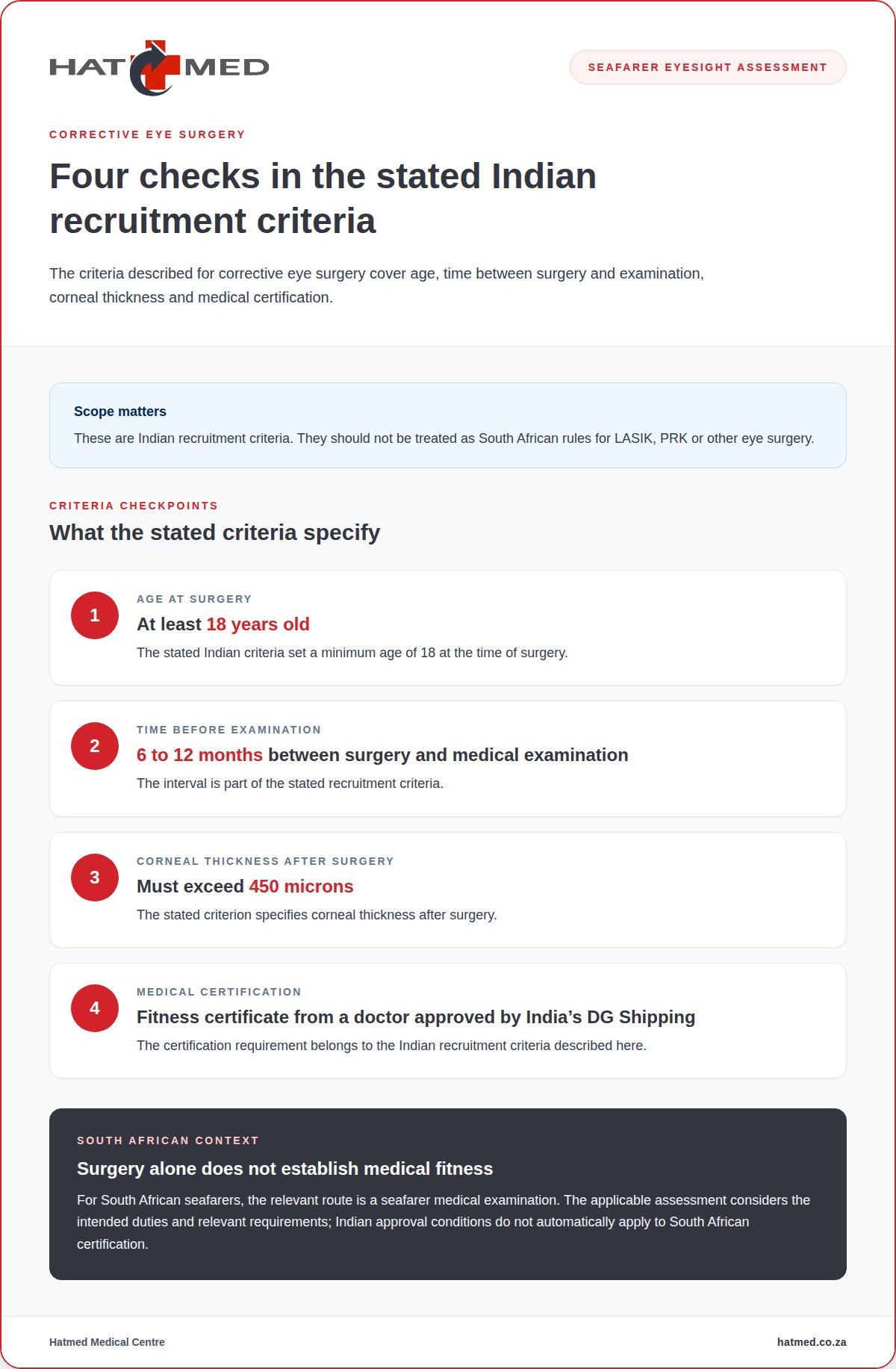
Corrective eye surgery changes the eye to reduce refractive error, and its timing and outcome can matter during medical approval. Under the stated Indian recruitment criteria, candidates must be at least 18 years old at surgery, with 6 to 12 months between surgery and the medical examination.
Those criteria also require corneal thickness after surgery to exceed 450 microns. Applicants must produce a medical fitness certificate from a doctor approved by India’s Directorate General of Shipping. These are Indian requirements; they should not be treated as South African rules for LASIK, PRK or other eye surgery.
For South African seafarers, the medical assessment considers eyesight findings in the relevant local context. A previous operation is one part of the medical history, alongside current vision and examination results.
Maritime eye examinations
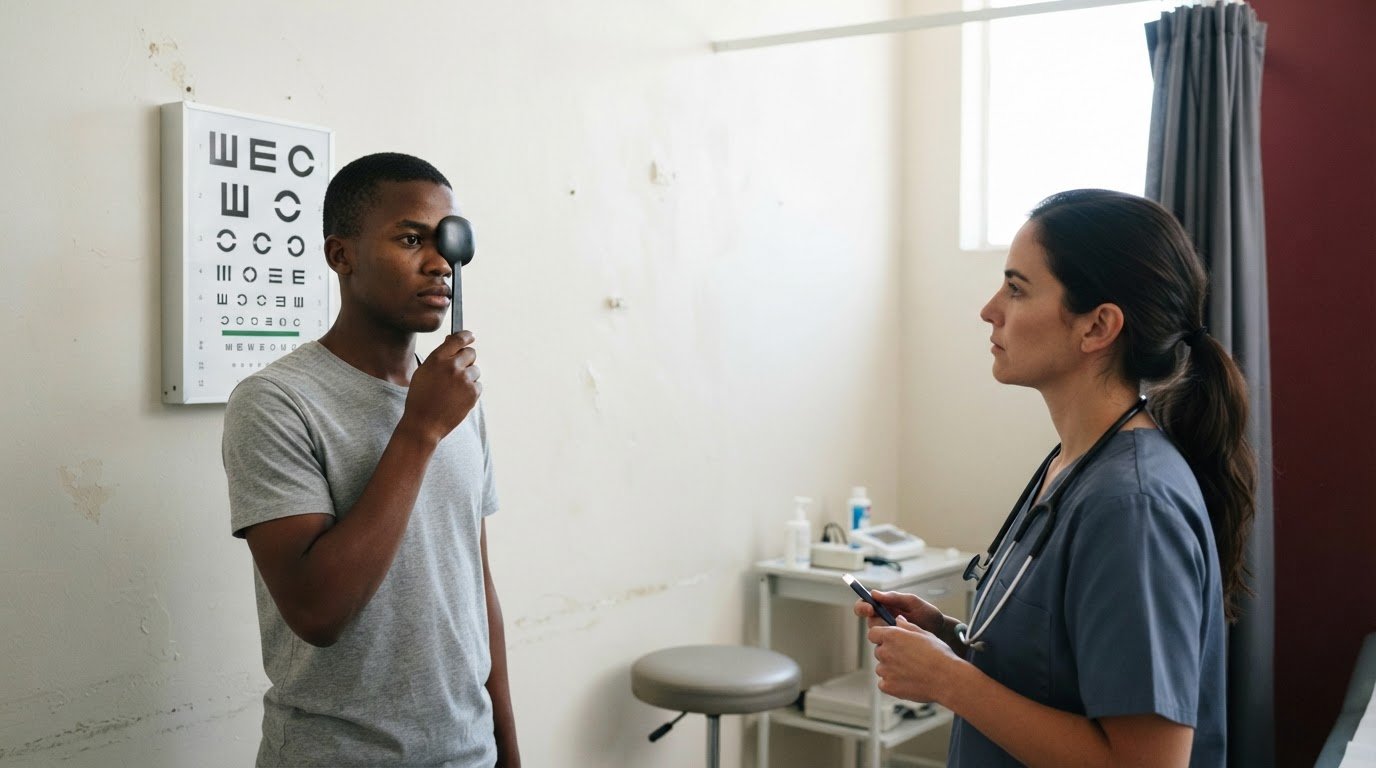
A maritime eye examination assesses distinct aspects of sight rather than relying on a single result. The criteria described here include distance vision measured with a Snellen chart placed six metres away and colour vision assessed using an Ishihara chart.
These checks answer different questions: the Snellen chart measures distance clarity, while Ishihara plates assess colour perception. They can therefore identify different eyesight concerns. The stated Indian criteria also consider surgery history and post-operative measurements, including a corneal-thickness threshold.
For a South African seafarer, a Seafarers / SAMSA Medical Examination is the relevant assessment route. The certificate decision depends on the findings considered during that examination, not on an Indian approval condition being applied automatically.
Deck and navigation staff unaided distance vision
Unaided vision is measured without glasses or contact lenses. The stated Indian Maritime University benchmark for deck courses is 6/6 in the better eye and 6/9 in the other.
Indian course figures shouldn’t be treated as a universal standard for every South African maritime role. The role and assessment context matter.
Unaided distance vision standards
Unaided distance vision describes how clearly each eye sees distant objects without corrective lenses. It matters for deck and navigation duties, where seeing details at a distance can be relevant to the work.
For Indian Merchant Navy deck courses, the stated requirement is 6/6 in the better eye and 6/9 in the other eye. These are separate results for each eye, not a combined score. A result that meets one eye’s figure does not replace the requirement for the other.
Unaided eyesight standards for deck courses
The Indian Maritime University’s stated deck-course standard sets a specific unaided distance-vision benchmark. Candidates need 6/6 in the better eye and 6/9 in the other eye.
This is a course entry criterion, not a figure to assume applies to every seafarer role in South Africa. For example, a deck-course applicant and an employed lookout may be assessed under different role requirements. Keep this distinction in mind when interpreting the Indian figures.
Standards across deck roles and duties
Eyesight criteria relate to the role or course being assessed, so one figure shouldn’t automatically be applied to cadets, deck ratings, officers and lookout duties alike. The stated 6/6 and 6/9 benchmark specifically concerns Indian deck courses.
For a South African candidate, the applicable assessment must reflect the intended duties. A course threshold from India does not, by itself, establish the standard for every South African deck post. The role matters when interpreting an eyesight result.
Unaided and corrected visual acuity
Unaided acuity is measured without lenses, while corrected acuity describes vision with glasses or contact lenses. The Indian deck-course figures above are explicitly unaided: 6/6 in the better eye and 6/9 in the other.
Glasses or contact lenses can improve clarity whilst worn, but that result is not an unaided measurement. The stated Indian course figures don’t provide a corrected threshold for South African deck officers. For guidance based on a seafarer assessment, discuss your seafarer eyesight assessment.
Hatmed Medical Centre
Hatmed Medical Centre provides Seafarers / SAMSA Medical Examinations for people seeking a seafarer medical assessment in South Africa. If you’re unsure how colour perception, distance vision or previous eye surgery relates to your maritime plans, this examination is a relevant next step. It provides an opportunity to discuss your eyesight concerns as part of the wider medical assessment.
Indian course benchmarks can explain particular eyesight criteria, but they shouldn’t be assumed to determine South African eligibility. The role and applicable assessment context matter. Bring details of your eye history and any corrective surgery to inform the medical discussion.
For an assessment that considers your seafarer medical needs, contact Hatmed Medical Centre.
Take the next step towards your seafarer medical assessment
Use what you’ve learnt about the merchant navy eyesight standards for bridge watchkeepers to prepare to discuss your intended duties and eye history. If you’ve had corrective surgery, have concerns about colour perception, or rely on glasses, explain this during your medical assessment. It gives the examination a practical starting point and keeps the discussion focused on requirements relevant to your circumstances.
Hatmed Medical Centre provides Seafarers / SAMSA Medical Examinations, as well as General Practitioner Consultations and Immigration Medical Examinations. These services address different healthcare needs, so choose the one that fits your next step. For a seafarer medical assessment, discuss your eyesight concerns and how they relate to the examination with the team.
Contact Hatmed Medical Centre about a seafarer medical assessment. Taking that step can help you move forward with a clearer understanding of your medical pathway.
Frequently Asked Questions
What is the Eyesight Requirement for Merchant Navy?
There isn’t one eyesight figure that applies to every maritime role or assessment route. Criteria may consider distance clarity, colour perception, how the eyes work together and the visual field. For example, an Indian deck-course benchmark is not automatically the applicable requirement for a South African seafarer. The relevant role and assessment context determine how an eyesight result is considered.
What are the STCW eyesight standards for merchant navy bridge watchkeepers?
Don’t assume an Indian course benchmark is an STCW eyesight threshold for South African bridge watchkeepers. Indian Maritime University’s figures relate to its stated course criteria and don’t automatically establish South African medical requirements. A deck-course applicant and a serving watchkeeper, for example, may be assessed in different contexts. Consider the applicable South African seafarer medical assessment for the duties involved.
How are visual acuity and colour vision tested for seafarer medical certification?
Distance visual acuity can be assessed using a Snellen chart placed six metres away, while colour perception can be assessed with an Ishihara chart. These tests measure different aspects of sight. Reading chart letters assesses distance clarity, whereas identifying Ishihara patterns assesses colour vision. A result from one test shouldn’t be treated as a result for the other.
What eyesight standards apply to merchant navy watchkeepers in South Africa?
South African watchkeepers should be assessed against the requirements that apply to their seafarer medical examination and intended duties. Indian course figures can provide context, but they shouldn’t be assumed to determine South African eligibility. For a local seafarer assessment, Hatmed Medical Centre provides Seafarers / SAMSA Medical Examinations. The examination offers a relevant setting to consider eyesight as part of your medical requirements.