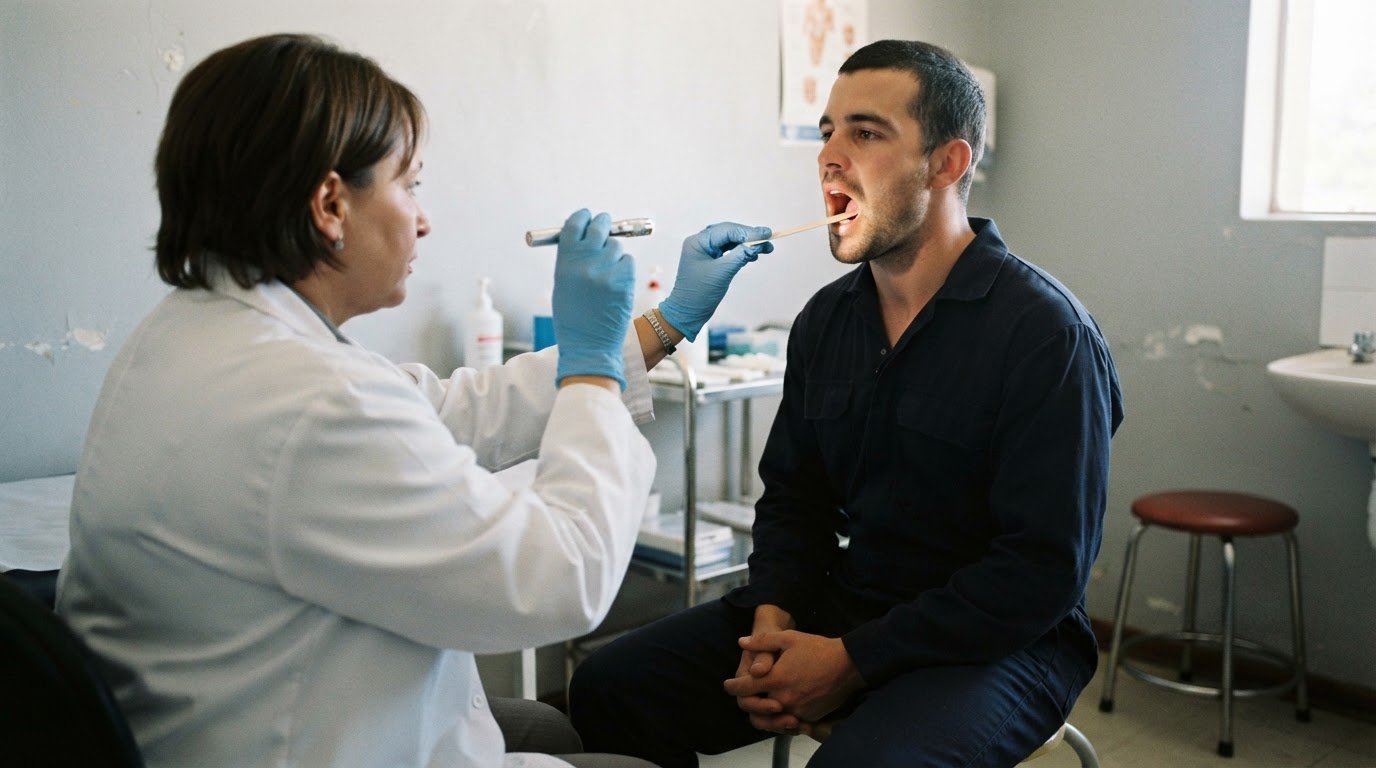

The certificate you need depends on where you’ll work and whether your role is offshore or vessel-based. In South Africa, offshore oil rig medical clearance protocols can involve an OEUK medical for work on UK or North Sea installations, while seafarers and certain vessel-based offshore workers may need an ENG1; neither certificate replaces the other.
It’s understandable to expect one offshore medical to cover every job, but the destination and role determine which clearance applies. An assessment may look beyond general fitness, including medical history, vision, hearing, cardiovascular health, lung function, mobility and mental wellbeing.
This guide explains how to distinguish the main certificates, what physical and mental health screening may involve, and how results can affect fitness for offshore work. It also explains where a Seafarers / SAMSA Medical Examination fits in South Africa, helping you identify the appropriate next step for your role.
Key Takeaways
- Identify whether your offshore role calls for an OEUK medical or an ENG1, and why one certificate cannot replace the other.
- Understand the physical checks an offshore medical may include, from medical history and vision to lung function and mobility.
- Learn how mental wellbeing and the stability of a health condition can form part of fitness-for-work considerations.
- See how a Seafarers / SAMSA Medical Examination at Hatmed Medical Centre may support your medical assessment needs.
What offshore medical certificate do you need?
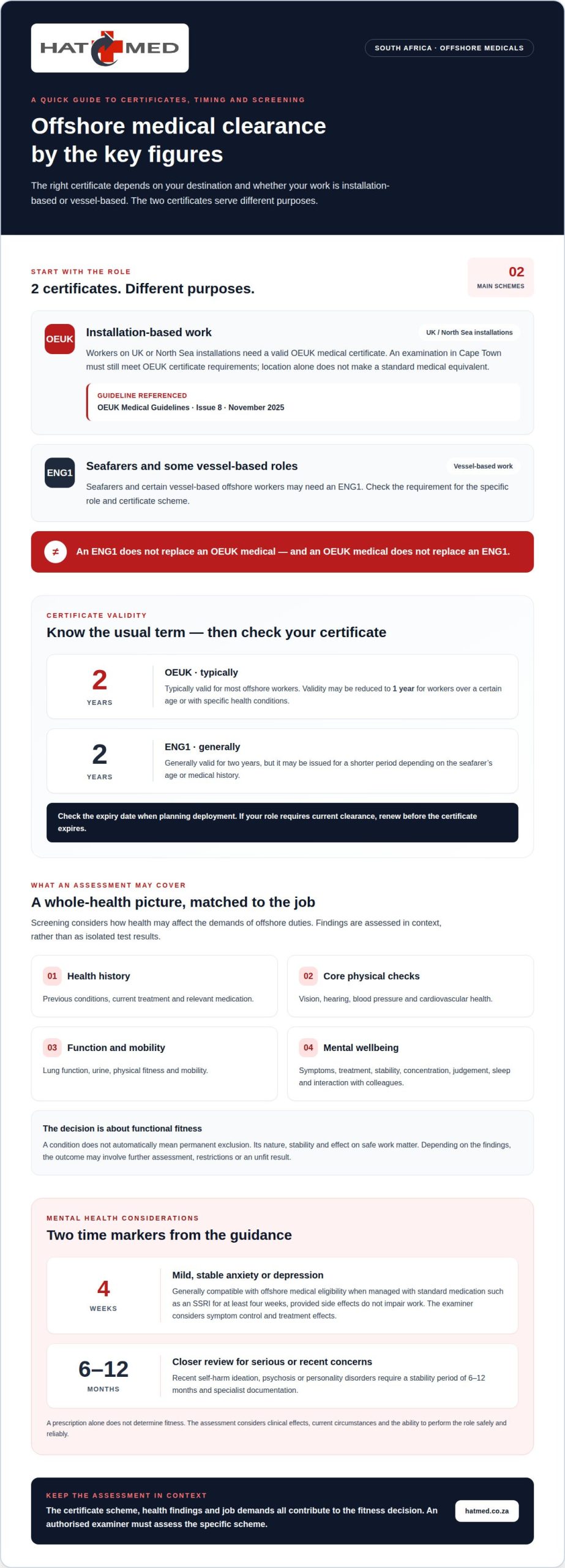
The required certificate depends on your destination and whether your role is vessel-based or installation-based. An OEUK medical and an ENG1 serve different purposes, so identify the certificate your role requires before booking an examination.
Medical history and physical checks
A medical history review and physical examination assess how your health may affect offshore duties. The examination can cover previous conditions, current treatment, vision, hearing, blood pressure, cardiovascular health, lung function, urine, physical fitness and mobility.
These checks help identify health factors that may need further assessment or affect fitness for work. Be ready to discuss relevant medical history and medication with the examining practitioner. A condition does not automatically mean permanent exclusion; its nature, stability and impact on your ability to work matter.
Offshore examinations and fitness assessments
An offshore medical examination checks whether your health supports the demands of the specific role and work environment. For UK or North Sea installations, workers need a valid OEUK medical certificate; the OEUK Medical Guidelines referenced for examinations are Issue 8, dated November 2025.
An OEUK examination in Cape Town must still meet the requirements for an OEUK certificate. The location does not make a standard examination equivalent to that certificate. Examination length depends on the checks required, while fees depend on the certificate and any additional tests; pricing is provided after a quote request.
Fitness standards and authorised examiners
Fitness standards are assessed against the certificate scheme and the worker’s health and job demands. The examiner must be authorised for the specific certificate scheme; a general medical examination alone does not establish OEUK or ENG1 clearance.
Conditions that affect cardiovascular health, breathing, mobility or safe performance may lead to restrictions, further assessment or an unfit result. If an examination does not result in clearance, the outcome and certificate scheme determine the next assessment or appeal route. A failed examination does not, by itself, mean permanent exclusion.
Certificate validity and renewal
An OEUK medical certificate is typically valid for two years for most offshore workers. Its validity may be reduced to one year for workers over a certain age or with specific health conditions, so check the certificate’s expiry date when planning deployment.
An ENG1 is generally valid for two years, but may be issued for a shorter period depending on the seafarer’s age or medical history. Renew the certificate before it expires if your role requires current clearance; an ENG1 does not replace an OEUK medical, or vice versa.
Medical screening protocols
South Africa’s offshore oil rig medical clearance protocols rely on a coherent assessment record, not isolated test results. The provider considers whether findings fit the worker’s clinical picture and the demands of the intended duties. If an investigation produces an unexpected result, its context and reliability matter before it is treated as a barrier to clearance.
Good preparation supports a more complete examination. An account of current treatment can help explain results that differ from earlier records. If clinical information is unclear, the examiner may need further evidence before reaching an outcome. This helps distinguish a temporary issue from a finding that needs ongoing review.
Some clearance cases involve more than one medical professional. In these cases, the assessment depends on bringing relevant clinical information together, rather than viewing one test in isolation. For example, a report from another clinician can add context to a finding that needs specialist interpretation. The link between each finding and the final fitness decision should remain clear.
For international assignments, South Africa’s offshore oil rig medical clearance protocols must be considered alongside the certificate scheme required for the project. An operator’s administrative requirements can also affect how a completed medical assessment is recorded and submitted. Keeping the clinical assessment separate from deployment paperwork helps avoid mistaking an administrative step for a medical finding.
The final record should make the assessment outcome clear to the worker and relevant to the role. If the examiner identifies a restriction or requests further information, the reason should relate to the findings and duties being assessed. This gives the worker a clearer basis for discussing the next clinical step and helps the relevant parties interpret the assessment consistently.
Mental health screening and fitness considerations
Mental health screening considers whether a condition or treatment could affect safe, reliable offshore work. An assessment may explore current symptoms, treatment, stability and effects on concentration, judgement, sleep or interaction with colleagues. These factors matter offshore, where workers live and work away from their usual support and may face demanding routines. The focus is functional fitness, not diagnosis alone.
Mild, stable anxiety or depression managed with standard medication, such as an SSRI, for at least four weeks is generally compatible with offshore medical eligibility when side effects do not impair work. The examiner considers symptom control and how treatment affects the person’s ability to perform their duties. A prescription alone does not show whether someone is fit or unfit; its clinical effect and the worker’s circumstances matter.
More serious or recent concerns can need closer review. Recent self-harm ideation, psychosis or personality disorders require a stability period of 6-12 months and specialist documentation. This helps establish the person’s current condition and treatment progress. The period and documentation form part of the stated assessment considerations; they shouldn’t be read as a finding that every person with such a history is permanently barred from offshore work.
For international offshore roles, mental health findings are considered within the medical certificate scheme and the demands of the job. A clinician may weigh current symptoms, recent treatment changes, medication effects and relevant specialist information when assessing functional impact. Depending on the findings, the outcome may be clearance, a restriction or further review. Clear, accurate information about treatment and stability helps the examination reflect the worker’s current health rather than an incomplete history.
What medical fitness standards apply to offshore oil rig workers in South Africa?
There isn’t one certificate standard for every offshore role in South Africa. Fitness is assessed against the certificate required for the destination and the worker’s duties. For example, UK and North Sea installations require a valid OEUK medical certificate, while an ENG1 applies to seafarers and certain vessel-based roles. These certificates assess different work contexts, so their standards should not be treated as interchangeable.
OEUK fitness considerations connect medical findings with the demands of offshore work. Lung function, cardiovascular health, mobility and overall physical capacity can inform the assessment. For example, the OEUK thresholds described for spirometry include an FEV1 of at least 60% predicted and an FVC of at least 75% predicted. These figures are assessment criteria, not a complete measure of fitness by themselves.
Body mass index can also affect the result. Workers with a BMI above 40 are generally considered unfit for offshore work under the OEUK thresholds described. This is a specific threshold, not a substitute for reviewing the wider medical picture. The assessment also considers how health affects a worker’s ability to carry out duties safely and reliably.
A medical finding may lead to clearance, restrictions or further review, depending on its practical impact and the certificate scheme. A restriction can define work limitations, while further assessment can clarify how a condition affects the role. An unfit outcome applies to the assessment and current circumstances; it does not automatically mean permanent exclusion from every offshore position.
For South African workers joining international projects, the destination and role determine which standard applies. An OEUK assessment, for example, is relevant to UK or North Sea installation work, not a universal offshore certificate. Matching the examination to the required certificate helps ensure it addresses the right criteria before a deployment decision is made.
Hatmed Medical Centre
Hatmed Medical Centre offers medical care relevant to seafaring and ongoing health needs. Its Seafarers / SAMSA Medical Examinations are for those who need a seafarer medical assessment, while General Practitioner Consultations can address health questions or medical conditions affecting work.
For someone managing a chronic condition, ongoing care can help keep treatment and health concerns in view. The certificate required for an offshore role still depends on the destination and job, so distinguish a seafarer examination from an OEUK medical requirement before proceeding.
To discuss a relevant medical assessment or health concern, contact Hatmed Medical Centre about your next step.
Plan your next medical step with confidence
Before arranging an offshore medical, match the examination to the role and the organisation requiring clearance. This gives your health assessment a clear purpose and helps you discuss relevant medical history, treatment and supporting records with the practitioner. South Africa’s offshore oil rig medical clearance protocols may involve requirements set by an international destination, so start by identifying the intended role.
Hatmed Medical Centre offers General Practitioner Consultations, Immigration Medical Examinations and Seafarers / SAMSA Medical Examinations. These services meet different medical needs; an immigration or seafarer examination is not an offshore certificate unless it matches the clearance required for your role.
If you need help with a medical assessment or a health concern affecting your plans, contact Hatmed Medical Centre to discuss an appropriate next step. With the right assessment in view, you can approach your offshore plans with greater clarity.
Frequently Asked Questions
Which medical examinations are required for offshore medical clearance in South Africa?
The required examination depends on your role and the certificate requested for the assignment. Offshore installation work linked to the UK or North Sea may require an OEUK medical, while seafarer duties may call for an ENG1 or a Seafarers / SAMSA Medical Examination. These are not interchangeable by default. For example, a vessel-based position and an installation role can have different certificate requirements.
What steps does a medical provider follow to obtain offshore medical clearance in South Africa?
The provider first establishes which certificate and role are being assessed, then reviews the worker’s medical history and carries out the relevant examination. The assessment may include tests needed to interpret a health concern or complete the applicable medical scheme. The practitioner then records the findings and fitness outcome. For example, ongoing treatment may require relevant clinical information to explain its effect on the worker’s duties.
How much does an offshore medical examination cost in South Africa?
The price depends on the case and is provided after a quote request. Cost factors include the certificate required, the scope of the examination and any additional tests needed to assess the worker’s health. A straightforward assessment may differ from one requiring further investigation or supporting clinical information. Request a quote based on the specific certificate and examination required, rather than relying on a general figure.
What offshore medical standards do South African employers follow, such as OGUK or OEUK?
There is no single offshore certificate for every South African employer; requirements depend on the role, destination and operator. Oil & Gas UK rebranded to OEUK in 2022, and OEUK standards apply to relevant UK or North Sea installation work. Employers may request a certificate matching their project’s requirements. An ENG1 or SAMSA seafarer examination serves a different purpose and should not be assumed to replace OEUK clearance.