

What if the medical fitness certificate for work your employer requests isn’t the same as a routine check-up? The assessment should relate to the role, so booking a general medical appointment without checking the requirements could leave you with the wrong documentation.
It’s understandable to have questions before an examination: does your employer require one, what might it involve, and how will your health information be handled? The right assessment depends on the job and the employer’s instructions, so confirm what’s needed before you book.
This guide explains what a work fitness certificate is for, how a job-related assessment can differ from a general check-up, and what you may be asked to provide. You’ll also find practical ways to prepare, including checking whether you should bring an employer questionnaire, job description or relevant medical information. Hatmed Medical Centre offers pre-employment medical examinations, and can be one provider to consider once you’ve confirmed the assessment your employer requires.
Key Takeaways
- A medical fitness certificate for work relates to an assessment of your ability to perform specified work; check why your employer has requested one.
- The assessment may include a discussion of your health history and work duties, depending on the request and your circumstances.
- Before choosing a provider, ask whether they can address the employer’s requirements and what documentation they provide.
- Prepare by confirming the request, arranging the relevant assessment and checking what to bring, such as identification and relevant medical information.
- Hatmed Medical Centre offers pre-employment medical examinations; confirm the assessment scope before booking.
What is a medical fitness certificate for work, and when might you need one?
A medical fitness certificate for work is documentation of a clinical assessment that considers a person’s ability to perform specified work. It relates to the duties and requirements described in the assessment request; it isn’t a universal pass that confirms someone is suited to every job. The assessment and any documentation depend on the request, the person’s circumstances and the clinician’s findings.
This is different from a routine check-up, which looks at general health rather than a particular role. A visa medical or seafarer examination is arranged for a different purpose and may follow its own requirements. If you’re unsure which assessment you need, ask your employer before booking. Hatmed Medical Centre offers pre-employment medical examinations, but it’s still sensible to confirm that the requested assessment matches the service you’re arranging.
Why might an employer request a work fitness assessment?
An employer may request a pre-employment assessment to consider how a person’s health relates to the duties of a role. The relevant questions can differ: the demands of a physically active job may not be the same as those of a desk-based position, for example. The employer’s request should clarify the assessment’s purpose and scope.
Before making an appointment, ask your employer or HR contact what the assessment needs to address, what documentation they require and whether they have a particular form or instructions. This helps you avoid booking a general check-up when a job-related assessment is needed, or arranging an assessment that doesn’t meet the stated request.
There is also an important fairness dimension. South Africa’s landmark court case on pre-employment medicals concerned unfair discrimination linked to HIV status. It’s a reminder that medical information and testing in recruitment require careful handling; a work assessment should be connected to the job, not treated as an unrestricted health enquiry.
Is there one standard certificate for every job?
No. Don’t assume every employer uses the same form or requests the same examination. The role, workplace risks and employer’s instructions can all affect what’s appropriate. A certificate or report prepared for one purpose may not satisfy a different request. For safety-critical duties such as transport and fleet operations, employers frequently align medical clearances with specialised safety programmes provided by organisations like Driving Sense.
Keep employer-specific instructions separate from any applicable legal or occupational requirements. Those requirements can depend on the work involved, and they may change. If an employer refers to a regulation or mandatory assessment, ask which requirement applies and check it against current, authoritative South African guidance before booking. The provider can then confirm whether they can address the request and what documentation they may provide.
What may a medical fitness assessment for work involve?
There isn’t a fixed checklist that applies to every appointment. The clinician considers the employer’s request alongside your individual circumstances to decide what the assessment needs to address. This may include discussing your health history and the duties you’re expected to perform, but those are examples, not guaranteed parts of every assessment.
Ask your employer or HR contact for the assessment instructions before booking. Share them with the provider so they can confirm whether the requested assessment is appropriate and what information or documentation to bring. If you’re unsure what a medical fitness certificate for work will cover, ask the provider to explain the proposed scope rather than assuming every certificate involves the same examination.
How do job duties relate to the assessment?
A clear description of the role helps put the clinical discussion in context. For example, explaining the essential tasks and any relevant workplace demands may help the clinician understand what the employer has asked them to assess. Avoid relying on a job title alone, as it may not describe the actual responsibilities.
Bring the employer’s written instructions or job description if available, and describe the work accurately. The clinician assesses you as an individual in relation to the request; neither the assessment nor its outcome should be treated as predetermined. The employer’s request can guide the discussion, but it doesn’t replace the clinician’s professional judgement.
What if you have a health condition or need adjustments?
Having a health condition doesn’t automatically determine whether you’re fit for a particular role. If you’re comfortable doing so, discuss relevant health information directly with the assessing clinician, including ongoing treatment or any adjustments you believe may be helpful. This gives the clinician context to consider your individual situation in relation to the work being assessed.
If you manage a long-term condition, you may also find it useful to discuss your ongoing care separately from the work assessment. Hatmed Medical Centre offers chronic disease management, although this is distinct from a pre-employment examination. The clinician can explain what the assessment covers and what information may be included in any documentation, so you can understand the process before proceeding.
If you’re arranging a pre-employment assessment, you can consider Hatmed’s pre-employment medical examinations. Confirm the employer’s request and the assessment scope with the practice before booking.
Comparing work medical fitness certificate providers
Before arranging a medical fitness certificate for work, start with the employer’s request, then check that a provider can address it. A familiar-sounding certificate name alone doesn’t confirm that the assessment or paperwork will meet the employer’s needs. Compare providers by their relevant assessment experience, ability to work from the role details and clarity about documentation.
| What to compare | What to confirm |
|---|---|
| Employer requirements | Can the provider review the requested form, instructions and role details before you book? |
| Relevant experience | Does the practice offer pre-employment medical assessments relevant to the request? |
| Documentation | What documentation may be provided, who receives it, and how are results communicated? |
| Preparation and records | What should you bring, and how will relevant medical information or records be handled? |
Use the answers to identify a provider whose service fits the request, not simply the first available option. Hatmed Medical Centre offers pre-employment medical examinations and may be one practice to consider. Confirm the assessment scope and documentation with the provider before making an appointment.
What should you confirm with the employer first?
Ask which assessment or form is required, what the clinician needs to know about the role, and who should receive the completed documentation. Check whether the employer has provided specific instructions or a job description to share. A generic certificate may not meet every employer’s requirements, so get the request in writing where possible and clarify any unclear points with your HR contact.
What should you ask a medical provider?
Explain the employer’s request and ask whether the practice offers a relevant pre-employment assessment. Before booking, check what information to bring, how to prepare, what documentation may be issued and how results are shared. Ask how medical records are handled and whether the employer receives the information directly or you do. Confirm any arrangements with both parties rather than assuming a particular process or turnaround.
Choosing a provider who can address the request doesn’t guarantee a favourable fitness decision or a particular certificate. The clinician assesses the individual and makes a clinical judgement; the purpose of comparing providers is to help ensure the requested assessment is understood and appropriately arranged. For businesses operating internationally or seeking an example of dedicated occupational care in Australia, Persona Health provides comprehensive medical assessments and workplace injury management services.
How to prepare for a work medical fitness assessment
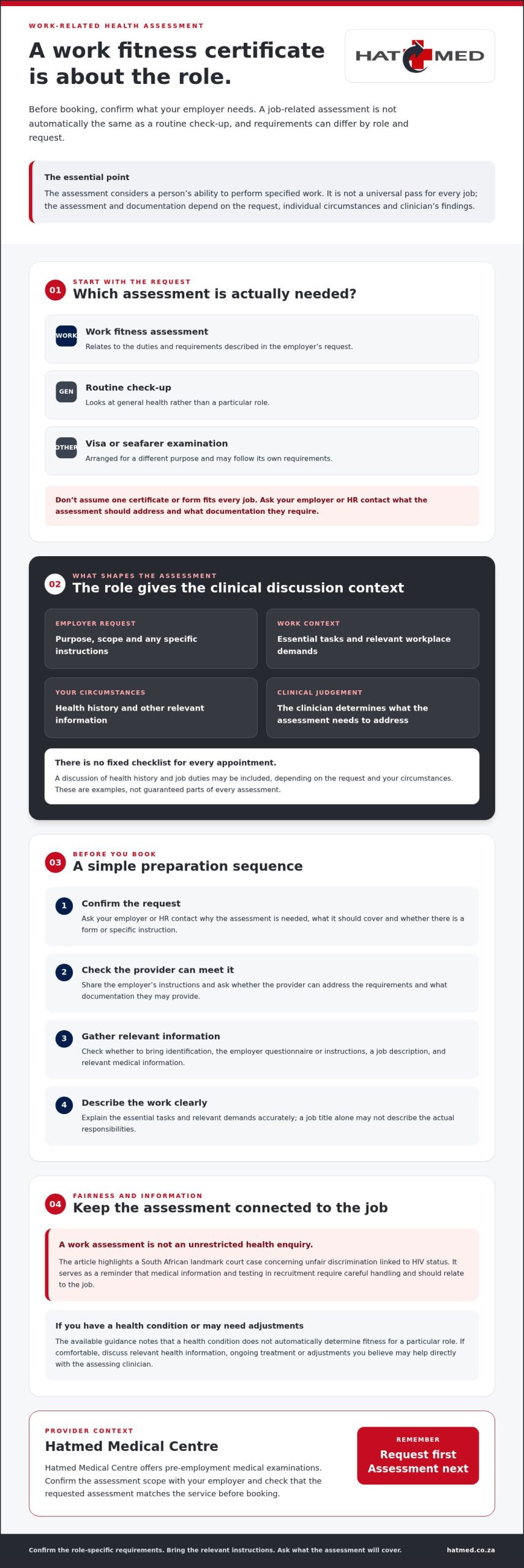
A little preparation can help you and the clinician make the appointment more focused. Use this sequence before attending:
- Confirm the request. Check with your employer which assessment or form is needed, whether there are instructions for the clinician and who should receive the completed documentation.
- Book the relevant assessment. Share the employer’s request with the provider before arranging an appointment. Ask whether the practice can address it and what you should do to prepare.
- Gather your information. Bring identification, the employer’s instructions or form, and a role description if available. Prepare an accurate account of relevant health history and medication, and check with the provider whether anything else is needed.
During the appointment, answer questions honestly and as fully as you can. If an instruction or question is unclear, ask for clarification rather than guessing. A medical fitness certificate for work reflects a clinical assessment, so complete and accurate information helps the clinician consider your individual circumstances. It doesn’t guarantee a particular fitness decision or that a certificate will be issued.
What information should you have ready?
Alongside your identification and the employer’s request, have the role description ready if you have one. Think through relevant health history and the medication you currently take so you can explain these clearly. You don’t need to assume which documents are required: contact the provider in advance to confirm whether to bring supporting medical information or any other paperwork.
What happens if the clinician needs more information?
The clinician may need to discuss something further or consider whether another step is clinically appropriate. Before leaving, ask what information is outstanding, what happens next and whether you or the employer should coordinate it. Check how to provide any requested details and how you’ll be informed of the outcome. Don’t assume a completion date, certificate or fitness decision; these depend on the assessment and any follow-up needed.
If you’re arranging a pre-employment assessment, ask Hatmed about its pre-employment medical examinations. Share the employer’s instructions when enquiring and confirm what to bring and what documentation may be provided.
Arrange a pre-employment medical assessment with Hatmed
Before arranging an appointment, make sure you know what the employer is asking for. Check the requested assessment and any forms or role information, then ask the practice whether its service can address that request and what documentation may be provided. This helps you choose an assessment for the stated purpose, rather than assuming a general check-up or a standard medical fitness certificate for work will meet every requirement.
Hatmed Medical Centre offers pre-employment medical examinations. Whether this is the right option depends on the employer’s instructions and the scope Hatmed Medical Centre confirms for the assessment. The examination doesn’t guarantee a certificate, a particular fitness outcome or employment, so use your enquiry to clarify the service before you proceed.
When might Hatmed Medical Centre be an option?
Consider asking Hatmed Medical Centre about its pre-employment medical examinations if you need an assessment connected with a job application. Explain what the employer has requested and share any relevant instructions or role details. The practice can clarify whether its confirmed service scope suits that request. Check current appointment details directly with Hatmed Medical Centre, and ask what information you should provide before arranging an appointment.
What are the next steps for employees and employers?
Employees can gather the employer’s request, relevant forms and role details, then contact the practice to discuss arranging the appropriate assessment. Employers can help by giving clear information about the role and providing the documentation they want the clinician to review. Both parties should agree on what documentation is needed and how it should be handled, rather than leaving those details until after the assessment.
As you make arrangements, keep the process straightforward: understand the request, confirm the assessment scope with the practice, and prepare the information the clinician may need. If you’re an employee, ask any questions that will help you feel ready. If you’re arranging assessments for a workplace, provide clear instructions and confirm the process with the practice directly.
For a calm first step, Contact Hatmed Medical Centre to discuss a pre-employment medical assessment and whether its service suits the employer’s stated requirements.
Take the next step with confidence
The right medical fitness certificate for work starts with understanding what the employer needs, not assuming every role requires the same assessment. Confirm the requested scope, check that the provider can address it, and prepare relevant information so the clinician can assess your circumstances in context.
Hatmed Medical Centre offers pre-employment medical examinations and general practitioner consultations. If you’re considering an assessment, share the employer’s instructions and ask the practice whether its service matches the request, what to bring and what documentation may be provided. The clinician’s assessment determines the outcome, so no particular certificate or fitness decision can be promised in advance.
Contact Hatmed to discuss a pre-employment medical assessment and confirm the next steps. With the requirements clear and the right information ready, you can approach the process in a more informed and confident way.
Frequently Asked Questions
Is a medical fitness certificate required for every job in South Africa?
No, there isn’t one universal medical certificate requirement for every job in South Africa. Whether an assessment is appropriate can depend on the role, its requirements and any applicable legislation. Ask the employer why it’s requested, what assessment they need and which requirements they rely on. If the request refers to a legal or occupational rule, check the current requirement with an authoritative source before booking.
Can an employer require a medical fitness assessment before hiring me?
An employer may request an assessment in certain circumstances, but pre-employment medical testing isn’t a blanket requirement for every position. Section 7 of South Africa’s Employment Equity Act restricts medical testing, with exceptions that include testing justified by the job’s inherent requirements or required by other legislation. Ask the employer to explain the purpose and scope of the request. For advice about your specific circumstances, consult an appropriate legal or employment professional.
What does a medical fitness examination for work involve?
The clinician determines the assessment scope from the employer’s instructions and your individual circumstances. You may be asked about your health history and the duties of the role, but there isn’t a guaranteed checklist or set of tests for every appointment. Share the employer’s form or role description if available, and ask the provider what the assessment may involve. The clinician’s findings, not a predetermined result, inform any documentation provided.
Can I be declared fit for work if I have a chronic condition?
Having a chronic condition doesn’t automatically determine whether you’re fit for a particular role. The clinician considers your individual circumstances in relation to the work being assessed; only the assessment can establish its outcome. Tell the clinician about relevant health information and treatment, and raise any adjustments you think may help you perform the role. If you’re unsure what to share, ask the clinician directly and discuss your concerns with them.
What should I bring to a work medical fitness assessment?
Bring identification, the employer’s request or form, and a role description if you have one. It’s also useful to prepare a clear account of relevant health history and current medication. Ask the provider before your appointment whether they need additional documents, such as relevant medical information or letters. Requirements can vary with the requested assessment, so confirming what to bring helps you arrive prepared without assuming every provider asks for the same paperwork.
How long does it take to receive a medical fitness certificate for work?
There isn’t a set timeframe that applies to every medical fitness certificate for work. Timing may depend on the requested assessment, the clinician’s findings and whether further information or follow-up is needed. Ask the practice about its current process and when you might receive an update, rather than relying on a general estimate. If your employer has a deadline, mention it when arranging the assessment, but don’t assume a particular completion date.
Does a medical fitness certificate guarantee that I will get the job?
No, a certificate doesn’t guarantee employment or a particular hiring decision. It documents the outcome of a clinical assessment for the stated purpose; the employer makes its recruitment decision separately. Nor can a provider promise a favourable fitness outcome before the clinician assesses you. To understand how the documentation will be used, ask the employer who will receive it and how it relates to the role’s requirements.