

Your maritime career doesn’t start at the gangway. It begins in a doctor’s consulting room. For many seafarers, the pressure of a looming vessel deployment is often matched by the stress of finding an authorised SAMSA approved doctor who understands the weight of a “fit for duty” stamp. It’s completely natural to feel anxious about a minor health quirk or a tight deadline, especially when your livelihood depends on a single piece of paper and a clear bill of health.
We understand that you need more than just a routine check-up; you need a steady partner to help you manage these regulatory requirements. This guide provides everything you need to know about securing your medical certificate and meeting the latest fitness requirements for 2026. We’ll walk you through the current eyesight and hearing standards, explain how to prepare for your appointment, and show you how to ensure your documentation meets international compliance standards. By the end of this article, you’ll have a clear, methodical path toward your next successful deployment at sea.
Key Takeaways
- Understand why consulting an authorised SAMSA approved doctor is a legal necessity under the Merchant Shipping Regulations to ensure your certification is valid for sea.
- Learn what to expect during the comprehensive physical assessment, from cardiovascular checks to respiratory and musculoskeletal fitness evaluations.
- Discover how South African maritime medicals align with international STCW frameworks and compare to global standards like the Norwegian or UK ENG1 certificates.
- Use our checklist to organise your discharge book, identification, and medical history reports before your appointment to ensure a smooth, efficient process.
- Gain peace of mind by understanding how a methodical, regulatory-focused medical environment helps you meet tight vessel deployment deadlines without unnecessary stress.
What is a SAMSA Approved Doctor?
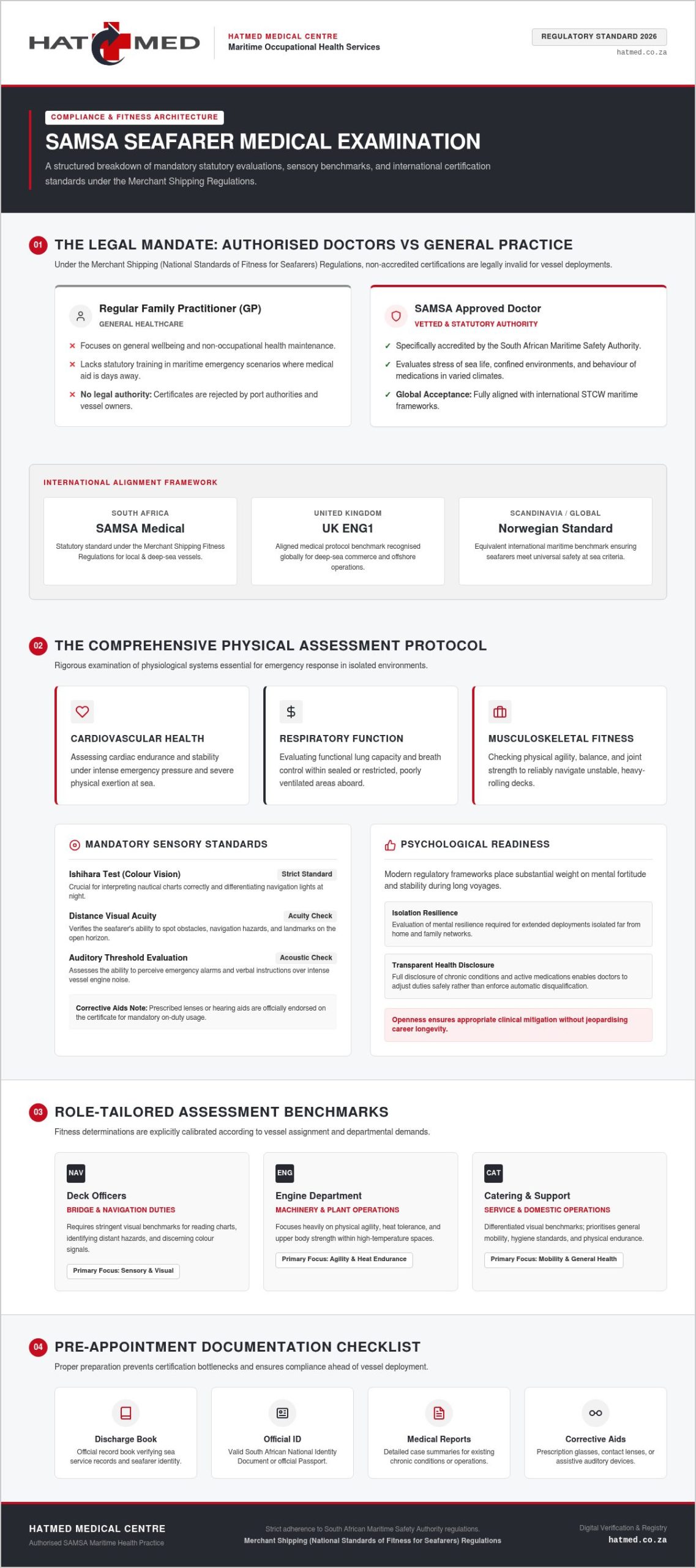
A SAMSA approved doctor is a medical practitioner who has been specifically vetted and authorised by the South African Maritime Safety Authority to perform occupational health assessments for seafarers. This designation isn’t just a title; it’s a legal requirement. Under the Merchant Shipping (National Standards of Fitness for Seafarers) Regulations, any medical certificate used for professional maritime work must be issued by one of these designated professionals. If your certificate doesn’t come from an authorised source, it won’t be recognised by port authorities or vessel owners.
You might wonder why your regular family GP can’t simply sign off on your fitness. While your local doctor is excellent for general health, they often lack the specific regulatory training required to assess the unique demands of life at sea. A SAMSA approved doctor acts as a vital gatekeeper for the safety of life and property. They don’t just look at your current health; they evaluate your ability to handle the physical rigours of an emergency in environments where medical help could be days away. Their role is to ensure that you aren’t just healthy, but “fit for sea” in every sense of the word.
The Authority of SAMSA in Maritime Health
SAMSA serves as the primary regulator for all South African maritime activities, ensuring that every seafarer meets strict international safety benchmarks. This oversight is crucial because it ensures that whether you’re working on a local coastal tug or a deep-sea tanker, you meet a universal standard of health. These examinations are mandatory for anyone seeking to work on a vessel, regardless of their rank or department. A SAMSA approved doctor is the only professional authorised to issue a valid seafarer medical certificate that complies with national law.
Why Specialised Accreditation Matters
Accredited doctors undergo specific training to understand the maritime work environment, which is vastly different from a standard office or factory. They understand how certain medications or chronic conditions might behave under the stress of sea life or in different climates. By consulting an authorised practitioner, you ensure your documentation is ironclad and will be accepted by international port authorities. Choosing a non-approved practitioner isn’t just a waste of your time; it’s a risk to your career. Uncertified documents lead to rejected deployments and can cause significant delays in your professional journey. Working with a specialist ensures that your assessment is methodical, accurate, and fully compliant with global standards.
The Seafarer Fitness Examination Process
The medical examination for a seafarer is far more rigorous than a standard physical. When you visit a SAMSA approved doctor, they conduct a comprehensive assessment designed to ensure you can safely perform your duties under challenging maritime conditions. This process isn’t meant to be intimidating; rather, it’s a methodical way to protect your health and the safety of your crewmates. The doctor will focus heavily on your cardiovascular health, respiratory function, and musculoskeletal fitness. These areas are critical because life at sea often involves physical exertion in confined or unstable spaces where your body must respond reliably.
During the consultation, your practitioner will review the standards listed on the SAMSA official website to ensure every physiological benchmark is met. It’s vital that you provide a transparent disclosure of any chronic conditions or current medications. Being open about your health history doesn’t necessarily mean you’ll fail; instead, it allows the doctor to manage your fitness safely and suggest necessary adjustments. The final determination of “fitness for duty” is often tailored to your specific role. A deck officer requires different visual benchmarks than a member of the catering staff, whilst an engineer’s physical requirements focus heavily on agility and strength in high-temperature environments.
Eyesight and Hearing Standards
Sensory health is paramount for safety at sea. You’ll undergo the Ishihara test to check for colour vision deficiencies, which is essential for reading charts and identifying navigation lights correctly. Distance acuity is also measured to ensure you can spot hazards on the horizon. Hearing tests are equally vital, as you must be able to hear alarms and verbal commands over the constant ambient noise of a vessel’s engines. If you wear corrective lenses or hearing aids, your SAMSA approved doctor will note this on your certificate, ensuring you remain compliant whilst using these aids on duty.
Mental Health and Psychological Readiness
Modern maritime medicals now place a significant emphasis on psychological readiness. Your doctor will assess your mental resilience for long periods spent away from home and the isolation that can sometimes accompany life at sea. Managing stress and anxiety is a core part of operational safety, as a clear mind is just as important as a healthy heart when navigating a vessel. If you’re preparing for your next deployment, you might consider booking your Seafarer Medical Examination with a team that understands these unique pressures and provides a supportive, professional environment.
SAMSA vs. International Medical Standards
Many seafarers feel uncertain about whether a South African medical certificate will be accepted once they cross international borders. It’s a valid concern, especially when your next contract is on a vessel flagged in the United Kingdom or Norway. The good news is that South Africa’s maritime health standards are deeply integrated into the global system. When you consult a SAMSA approved doctor, the certificate you receive is designed to meet rigorous international benchmarks. This ensures your documentation is respected by port authorities and employers across the globe, giving you the peace of mind to focus on your upcoming voyage.
STCW Compliance and Global Recognition
The strength of the South African certificate rests on our nation’s status on the International Maritime Organization (IMO) “White List”. This status confirms that South Africa fully complies with the Standards of Training, Certification and Watchkeeping (STCW). The STCW framework is the international benchmark for maritime health and training. Because of this compliance, certificates issued by a SAMSA approved doctor are widely accepted for international commercial crew and superyacht positions. Whilst you should always check the specific requirements of your vessel’s flag state, a South African medical is a robust and globally recognised document that proves you meet the highest safety standards.
Choosing Between Different Maritime Medicals
Seafarers often ask how a SAMSA medical compares to the British ENG1 or other international seafarer medical fitness certificates. In many cases, the physical examination requirements are nearly identical because they all stem from the same international safety goals. However, obtaining your medical in South Africa offers distinct advantages in terms of cost and accessibility. You don’t always need to seek out an ENG1 equivalent if your flag state recognises STCW-compliant medicals from White List nations. Many professional seafarers working on foreign-flagged vessels still prefer using a local practitioner because it allows for a more personal, unhurried assessment in a familiar environment. It’s about finding a balance between meeting regulatory demands and ensuring you’re genuinely healthy and ready for the challenges of life at sea.
Preparing for Your Appointment: A Checklist
Preparation is the key to a stress-free medical examination. Arriving at the clinic with everything in order allows your SAMSA approved doctor to focus on your health rather than administrative delays. Think of this appointment as a collaborative step in your career journey. By organising your documents and following a few simple health tips, you ensure the process remains methodical and efficient, helping you meet those tight vessel deployment deadlines with confidence.
What to Bring to the Clinic
To complete your file, you must bring several physical items. These are non-negotiable for regulatory compliance and ensure that your certificate is processed without hitches. Please ensure you have the following ready:
- Your original Passport or National ID for identity verification.
- Your Seafarer’s Discharge Book.
- Your previous Seafarer Medical Certificate to show health continuity.
- Your Seafarer Number or details of your current training centre.
- A comprehensive list of any chronic medications you are currently taking.
If you have undergone recent surgeries or manage a long-term illness, bring the relevant specialist reports. Having these documents ready helps your SAMSA approved doctor understand your health history without needing to request further information from external providers, which could otherwise delay your deployment.
Practical Tips for a Smooth Exam
Small choices on the morning of your exam can impact your results. Avoid caffeine, nicotine, and energy drinks before your appointment; these can temporarily raise your blood pressure and heart rate. If you wear prescription glasses or contact lenses, bring them with you. The eyesight test is a critical part of the assessment, and the doctor needs to verify your vision both with and without corrective aids. Additionally, ensure you arrive well-hydrated. Proper hydration is essential for the pathology tests, such as urine samples, that form part of the standard screening process.
Managing Pre-Exam Anxiety
It’s normal to feel a bit of “white coat syndrome,” but remember that your practitioner is a steady ally in your maritime career. Their goal isn’t to find a reason to “fail” you. Instead, they are there to ensure you can safely navigate your work environment. If you have health concerns, discuss them openly with your doctor. Even if a condition is identified, the result isn’t always a total disqualification. In many cases, a doctor might issue a “fit with restrictions” certificate. This allows you to continue your work whilst managing your health appropriately under professional guidance.
If you’re ready to secure your certification, you can book your SAMSA Medical Examination with a team that values your time and peace of mind.
Expert SAMSA Medicals with Hatmed
Hatmed Medical Centre has served the community for over 30 years, building a reputation as a steady and dependable ally for those in demanding professions. Professional seafarers choose our facility because we provide more than just a signature on a form. When you consult a SAMSA approved doctor at our centre, you benefit from a clinical environment that prioritises your long-term career health. We understand that maritime life is physically and mentally taxing; therefore, our assessments are designed to support your wellness far beyond the initial examination.
Methodical and Patient-Centric Care
We believe that a medical examination shouldn’t feel like a conveyor belt. Our GPs take an unhurried approach, ensuring that every regulatory requirement is met with precision whilst maintaining a warm, supportive atmosphere. This methodical pace allows for clear communication, helping you understand your health profile without the stress of a rushed appointment. Our organised environment is tailored for busy professionals who value their time and peace of mind. If you are looking for ongoing health support, you might find our comprehensive guide to finding a general practitioner helpful for managing your primary healthcare needs between voyages.
National Support for the Maritime Industry
Our expertise extends across the full spectrum of regulatory and occupational health assessments. We serve as a reliable national centre for seafarers who require a high standard of professional decorum and medical accuracy. Many of our patients also find value in our specialised knowledge regarding visa medical certificates in South Africa, which is often a secondary requirement for those travelling internationally for vessel deployments. By integrating these services, we offer a holistic path forward for your maritime career.
Our team is committed to your welfare, combining decades of experience with a modern, patient-centric philosophy. We don’t just see you as a patient; we see you as a partner in health. To ensure you are fully compliant and ready for your next contract, contact Hatmed to book your SAMSA medical examination today and experience a professional, reliable approach to maritime certification. Working with a SAMSA approved doctor who understands the industry ensures your journey at sea starts with the best possible medical foundation.
Secure Your Future at Sea
Navigating the requirements for your maritime medical doesn’t have to be a source of stress. By understanding the rigorous standards set by the South African Maritime Safety Authority and preparing your documentation in advance, you’ve already taken the most important steps toward a successful deployment. Your health is your most valuable asset on the water; a valid certificate is simply the professional recognition of your readiness to serve. Consulting a SAMSA approved doctor ensures that your examination is legally compliant, globally recognised, and conducted with the clinical precision your career deserves.
At Hatmed Medical Centre, we’ve spent over 30 years supporting seafarers through a methodical and efficient clinical environment. Our certified practitioners are here to act as your steady partners, providing the thorough assessments required for international STCW compliance whilst ensuring you feel supported throughout the process. When you’re ready to take the next step in your professional journey, we invite you to Book Your SAMSA Medical Examination with Hatmed. We look forward to helping you maintain your wellness for many years of successful service at sea. Safe travels on your upcoming voyage.
Frequently Asked Questions
How long is a SAMSA seafarer medical certificate valid for?
A standard SAMSA seafarer medical certificate is typically valid for two years for individuals over the age of 18. If you are under 18, the validity is usually limited to one year. However, your SAMSA approved doctor may issue a certificate with a shorter duration if you have a medical condition that requires more frequent monitoring. It’s essential to check your certificate’s expiry date well before your next vessel deployment to avoid any administrative delays.
Can any GP perform a maritime medical examination?
No, a standard GP consultation isn’t sufficient for maritime certification. Only a SAMSA approved doctor who has been specifically authorised by the South African Maritime Safety Authority can perform these examinations. These practitioners have the specialised training required to assess your fitness against strict maritime safety regulations. Using a non-authorised doctor will result in a certificate that isn’t recognised by port authorities or international vessel owners, potentially halting your career progress.
What happens if I fail my SAMSA medical exam?
Failing the exam doesn’t always mean the end of your maritime career. If you don’t meet the primary standards, the doctor might issue a “fit with restrictions” certificate or declare you “temporarily unfit” whilst you seek treatment. You also have the right to an evaluation by a medical review panel if you disagree with the finding. Openly discussing your health history with your practitioner often helps in finding a manageable path forward.
Is the SAMSA medical the same as the ENG1 medical?
Whilst the SAMSA medical and the UK’s ENG1 medical serve the same purpose, they are issued by different national authorities. Both standards comply with the international STCW framework, meaning a certificate from a SAMSA approved doctor is widely accepted on many foreign-flagged vessels. However, some specific employers or flag states may strictly require an ENG1. Always verify the specific medical requirements of your vessel’s flag state before booking your appointment to ensure total compliance.
Do I need to fast before my SAMSA medical appointment?
You generally don’t need to fast before a standard maritime medical examination. However, it’s wise to avoid heavy meals, excessive caffeine, or sugary drinks immediately before your appointment, as these can temporarily affect your blood pressure and heart rate readings. If your specific role or health history requires additional blood glucose or cholesterol testing, your clinic will advise you in advance if fasting is necessary for those specific pathology tests.
Are there specific eyesight requirements for deck officers?
Yes, deck officers must meet higher eyesight standards compared to other crew members. You’ll need to pass the Ishihara test for colour vision to ensure you can identify navigation lights and charts correctly. There are also specific requirements for distance acuity and near vision. If you wear glasses or contact lenses, you must bring them to the exam, and your certificate will indicate that corrective lenses are required whilst you are on duty.
Can I get a SAMSA medical if I have a chronic condition like diabetes?
You can often obtain a medical certificate with a chronic condition like diabetes, provided it is well-managed and stable. Your doctor will need to see recent specialist reports and evidence that your condition doesn’t pose a risk to shipboard safety. The practitioner’s goal is to ensure you can safely perform your duties even in remote environments. In some cases, a shorter validity period or specific operational restrictions may be applied to your certificate.
How much does a SAMSA medical examination cost in South Africa?
The cost of a maritime medical examination varies depending on the complexity of the assessment and whether additional pathology tests are required. Because fees are subject to change and depend on individual health needs, it’s best to contact your chosen medical centre directly for current pricing. When budgeting, remember that this specialised assessment includes regulatory compliance checks that go beyond a standard GP visit, reflecting the expertise of the authorised practitioner.