

Imagine standing on the dock with a career-defining contract in your hand, only to realise your paperwork doesn’t meet the latest South African maritime standards. For many professionals, the quest to secure a valid medical certificate for seafarers feels more like navigating a storm than a simple health check-up. It’s a high-stakes moment where your career depends on a single piece of paper, and the pressure to meet every regulatory requirement can feel overwhelming.
We understand that the uncertainty surrounding SAMSA versus ENG1 requirements, or the worry about meeting strict hearing and vision standards, can be genuinely stressful. You want to focus on your career at sea, not get lost in a sea of confusing regulations. This guide offers a clear, step-by-step path to navigating the SAMSA medical examination process and securing your maritime fitness certification with confidence. We’ll walk you through the essential steps, from finding an accredited practitioner to understanding the 2026 validity rules, so you can step onto your next vessel fully prepared for the journey ahead.
Key Takeaways
- Understand the updated SAMSA regulations for 2026, including the transition to a two-year validity period for most maritime personnel.
- Discover the specific clinical steps required to secure a medical certificate for seafarers, ensuring you meet the necessary vision and hearing standards.
- Clear up the confusion between SAMSA and ENG1 requirements to ensure your certification is recognised by the correct maritime authorities and flag states.
- Access practical advice on preparing for your appointment to manage examination anxiety and ensure all your documentation is in order.
- Learn how a supportive, patient-centric assessment can help you maintain your health and ensure a successful deployment on your next contract.
Understanding the Medical Certificate for Seafarers: The SAMSA Standard
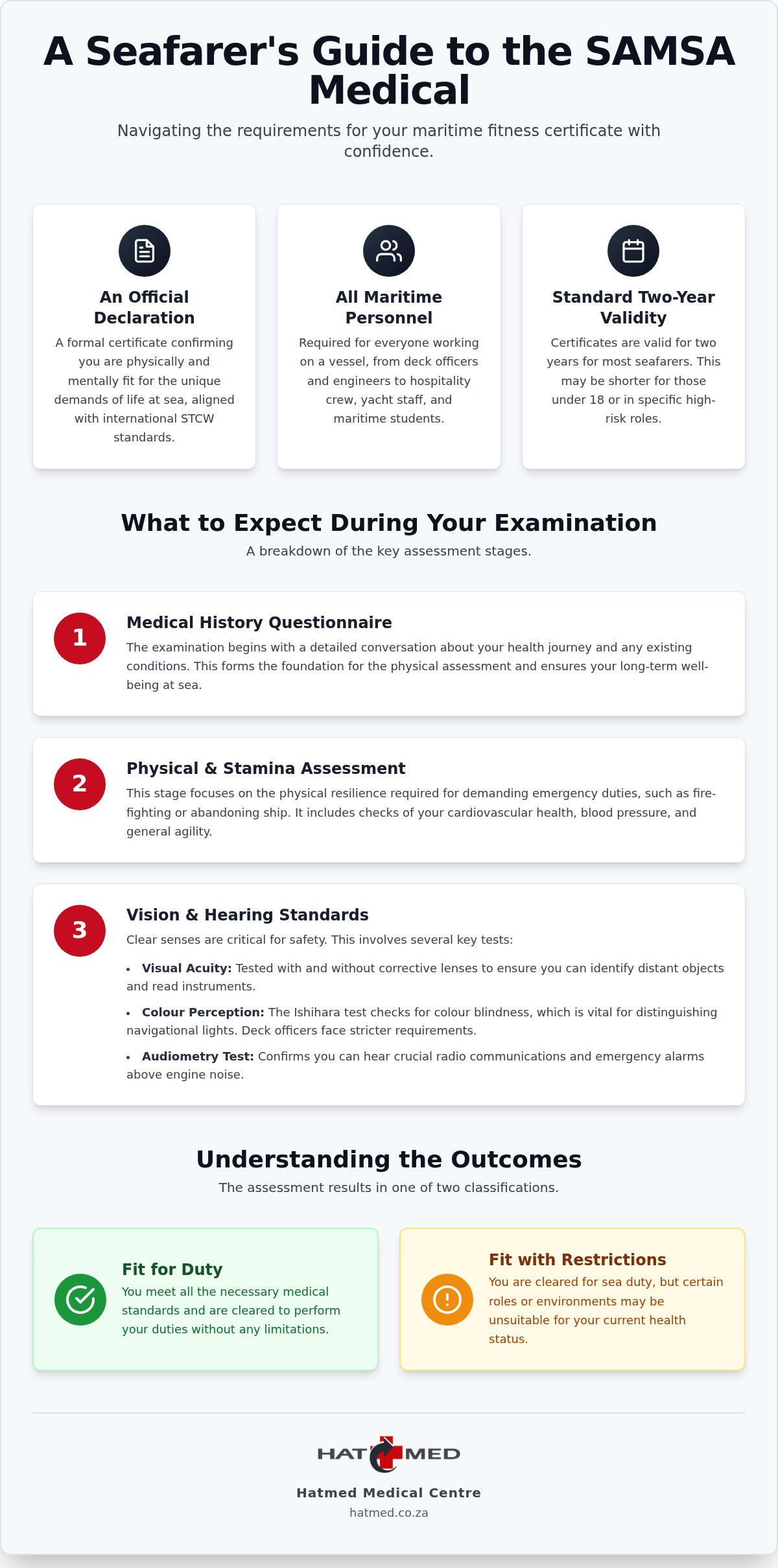
A medical certificate for seafarers is more than a simple health clearance. It’s a formal declaration that you’re physically and mentally capable of handling the unique demands of life at sea. In South Africa, the South African Maritime Safety Authority (SAMSA) oversees these standards to ensure every crew member can perform their duties without risking themselves or their shipmates. These regulations aren’t arbitrary; they align with the international standards for seafarer medicals established under the STCW Convention. This alignment ensures that your South African certification carries weight across global waters.
For most adult seafarers, the certificate remains valid for two years. However, if you’re under 18 or working in specific high-risk roles, this period might be shorter. It’s always best to check your specific requirements before your current one expires. Keeping your certification up to date isn’t just about ticking a box; it’s about ensuring your own well-being whilst you’re away from immediate land-based medical facilities.
The Legal Requirement: Why You Cannot Sail Without It
Safety at sea is a collective effort. If a medical emergency occurs mid-ocean, the consequences are far more severe than on land. This is why ship owners face significant legal liability if they employ crew without valid documentation. A medical certificate for seafarers acts as a safeguard, proving you’ve been assessed by a SAMSA-accredited practitioner. Simply put, the SAMSA medical certificate is the primary document required for South African maritime compliance.
Who Exactly Needs a Seafarer Medical Certificate?
Whether you’re a seasoned deck officer or part of the catering staff, if you’re working on a vessel, you likely need this certification. It applies to everyone from engineers to hospitality crew on luxury yachts. Even students just starting their journey at maritime academies must undergo this assessment before they can begin their practical training. Whilst requirements might differ slightly between coastal operations and deep-sea international voyages, the core need for a fitness assessment remains the same for all maritime personnel. We see this assessment as a partnership, helping you stay fit for the long-term career you’ve chosen.
What to Expect During Your Seafarer Fitness Examination
Walking into a clinical environment for a professional assessment can feel daunting, but the process is designed to be supportive. When you arrive for your medical certificate for seafarers, the examination begins with a detailed medical history questionnaire. This document forms the foundation of our conversation, allowing us to understand your health journey and any existing conditions. Our goal is to ensure you can safely perform your duties whilst maintaining your long-term well-being.
The final outcome of the assessment usually falls into two categories: “Fit for Duty” or “Fit with Restrictions”. Being “Fit with Restrictions” doesn’t necessarily mean your maritime career is over; it simply means certain roles or environments might not be suitable for your current health status. We focus heavily on the physical stamina required for emergency duties at sea, such as fire-fighting or abandoning ship. These are physically taxing tasks that demand a high level of cardiovascular health and agility.
Vision and Colour Perception Standards
Clear sight is non-negotiable on a vessel. We test your visual acuity both with and without corrective lenses to ensure you can identify distant objects and read fine print on instruments. A critical component is the Ishihara test, which checks for colour blindness. This is vital for navigation, where distinguishing between red and green lights can prevent collisions. Keep in mind that deck officers face stricter colour vision requirements than engine room staff because of these navigational responsibilities. You can review the full SAMSA Seafarer Medical Certificate Standards to see the exact benchmarks for your specific rank.
Hearing, Respiratory, and Cardiovascular Checks
The maritime environment is noisy and physically demanding. We use audiometry tests to confirm you can hear radio communications and emergency alarms over the hum of the engines. We also monitor lung function and blood pressure, as these are key indicators of your ability to handle the stress of life at sea. If you have concerns about these tests, our team at Hatmed Medical Centre is here to guide you through the process with care and expertise.
- Physical Mobility: You’ll need to demonstrate the ability to navigate steep ladders and move through confined spaces safely.
- Cardiovascular Health: Steady blood pressure ensures you can handle the physical exertion of emergency drills without risk.
- Respiratory Function: Healthy lung capacity is essential for wearing breathing apparatus if a situation requires it.
Comparing Maritime Medicals: SAMSA vs ENG1 vs PEME
Choosing the right medical assessment is the first step toward a successful deployment. Whilst the medical certificate for seafarers issued by SAMSA is the cornerstone of South African maritime health, it’s not the only standard you’ll encounter. Different flag states and employers have specific requirements that can lead to confusion. Understanding these distinctions ensures you don’t waste time or resources on the wrong certification. Always check your employment contract or letter of intent before booking, as the requirements for a local tugboat differ significantly from those of an international superyacht or a luxury cruise liner.
SAMSA Certificates for South African Flagged Vessels
The SAMSA certificate is the primary legal requirement for anyone working on South African flagged vessels. It’s the gold standard for our local maritime industry, facilitating work in our busy ports and coastal waters. This certificate proves you meet the national safety criteria set by the South African Maritime Safety Authority. If you’re preparing for a role on a foreign vessel that requires specific entry documentation, you might also need to consult our visa medical certificate South Africa guide to ensure all your paperwork aligns. Local compliance is straightforward, but it’s the foundation upon which your global career is built.
International Equivalents and Cruise Line Requirements
For those looking toward international horizons, the ENG1 is the UK Maritime and Coastguard Agency (MCA) standard. It’s often requested for crew on UK-flagged superyachts. The good news for South African seafarers is that the UK MCA recognises the SAMSA medical certificate as an equivalent to the ENG1. This recognition simplifies the process for local professionals seeking global opportunities. However, the cruise industry often adds another layer of complexity through the Pre-Employment Medical Examination (PEME).
Cruise lines frequently require more extensive testing than a standard medical certificate for seafarers. You might need additional blood tests, chest X-rays, or specific vaccinations depending on the company’s policy. These companies have their own proprietary forms that must be completed by an accredited doctor. We always advise seafarers to provide their specific company medical forms to us beforehand. This proactive step allows us to review the requirements and ensure every necessary test is scheduled, preventing any last-minute delays to your departure date. We view this as a collaborative effort to get you to sea safely and efficiently.
- SAMSA: Required for South African vessels; recognised as an ENG1 equivalent by the UK MCA.
- ENG1: The specific UK standard often cited in superyacht job descriptions.
- PEME: Company-specific assessments for cruise lines that often include extra clinical tests.
Step-by-Step: How to Prepare for Your SAMSA Medical Exam
Arriving prepared for your assessment is the best way to avoid unnecessary delays or the need for a follow-up appointment. Many people experience “white coat hypertension”, where blood pressure spikes simply due to the stress of being in a clinical setting. We recommend arriving at the centre at least fifteen minutes early to settle in and find your composure. Practising calm, rhythmic breathing whilst you wait can help your body relax, ensuring your readings reflect your true health status. Securing a medical certificate for seafarers is a collaborative process, and your transparency helps us support your career goals.
If your specific contract requires a PEME that includes blood glucose or cholesterol tests, you’ll need to fast for several hours before your appointment. We’ll confirm these specific requirements when you book your session. It’s also vital to be honest about any chronic conditions or medications you’re currently taking. Open disclosure allows us to work as your partner in health, finding ways to manage your condition so you can remain fit for duty without compromising safety at sea. To ensure your documentation is handled with expert care, you can book your seafarer medical examination with our professional team.
Essential Documents and Items to Bring
Having your paperwork organised before you arrive prevents administrative hurdles. Please ensure you have the following items ready for your practitioner:
- Identification: Your valid Passport or National ID document.
- Maritime Records: Your Seaman’s Discharge Book and any previous medical certificates you’ve held.
- Vision Aids: If you use prescription glasses or contact lenses, bring them along for the vision test. We need to assess your sight both with and without these aids.
- Medical Reports: If you’re currently being treated for a chronic condition, bring a recent report from your treating specialist to help us understand your management plan.
Health Preparation and Lifestyle Factors
Small lifestyle choices in the days leading up to your exam can significantly impact your results. For example, your hearing is sensitive; we advise avoiding loud noises, such as concerts or heavy machinery, for at least 24 hours before your audiometry test. This ensures your ears have had time to “rest” and provide an accurate baseline.
On the morning of your exam, stay well-hydrated by drinking plenty of water, but try to avoid excessive caffeine or nicotine. Both substances are stimulants that can artificially raise your heart rate and blood pressure. In the weeks leading up to your appointment, maintaining a light exercise routine can also help ensure your cardiovascular fitness meets the required maritime standards. These simple steps demonstrate your commitment to a long and healthy career amongst the global maritime community.
Professional Seafarer Medicals at Hatmed Medical Centre
At Hatmed Medical Centre, we’ve established ourselves as a centre of excellence for maritime and occupational health. We understand that your career at sea is a significant commitment, and we treat every assessment as a partnership. Instead of a cold, detached process, we offer a supportive environment where you’re a partner in your own health journey. Our goal is to ensure you’re fit for duty whilst providing the reassurance and guidance you need to maintain your long-term well-being. This patient-centric approach ensures that obtaining a medical certificate for seafarers is a positive, empowering step toward your next contract.
To make your visit even more convenient, we offer the ability to combine your maritime exam with other essential health needs. Many seafarers find this the perfect time to update their adult vaccinations, ensuring they meet the health requirements of various international ports in one organised visit. Our commitment to national maritime safety is reflected in our rigorous yet fair assessments, designed to protect both the individual seafarer and the wider maritime community.
Expert SAMSA-Approved Practitioners at Your Service
Our doctors possess a deep understanding of the unique physical and mental stresses associated with life on a vessel. This expertise allows us to provide a methodical and organised examination flow that respects the clinical standards set by SAMSA. We don’t just tick boxes; we look at the whole person. If you’re managing a chronic condition, our practitioners work with you to find management strategies that help you remain fit for duty. This collaborative effort ensures that your health is managed proactively, reducing the risk of medical issues whilst you’re far from shore.
Seamless Booking and Efficient Certification
We value your time and peace of mind. The pace of our clinic is unhurried yet highly efficient, reflecting the composed nature of a professional medical environment. We guide you through each step of the process, ensuring that your certification is handled with the precision required for maritime compliance. Because your deployment dates can be unpredictable, we always encourage seafarers to book their assessments well in advance of their contract start date. This avoids last-minute stress and ensures all your paperwork is ready for your next deployment. Schedule your seafarer medical examination with Hatmed today and experience a clinical environment that truly understands the maritime life. Our team is ready to act as your reliable ally, helping you secure the medical certificate for seafarers you need to sail with confidence.
Set Sail with Confidence and Compliance
Securing your maritime fitness doesn’t have to be a source of anxiety. By understanding the updated 2026 SAMSA standards and preparing your documentation in advance, you’ve already cleared the most significant hurdles. Whether you’re navigating the differences between SAMSA and ENG1 or managing a chronic condition to stay fit for duty, the right preparation ensures a smooth clinical experience. A valid medical certificate for seafarers is your passport to global opportunities, proving you’re ready for the physical and mental demands of life at sea.
At Hatmed Medical Centre, we’re proud to be your trusted partner in maritime health. Our SAMSA-aligned medical assessments are delivered in a supportive and professional clinical environment by experts who truly understand the unique challenges of your profession. We’re here to help you navigate the regulations with ease and precision. Book your professional SAMSA medical examination at Hatmed Medical Centre today to ensure you’re fully compliant for your next deployment. We look forward to supporting your continued success on the water.
Frequently Asked Questions
How long is a medical certificate for seafarers valid in South Africa?
A SAMSA medical certificate for seafarers is typically valid for two years for adults. This validity period aligns South Africa with international maritime standards, reducing the administrative burden on crew members. However, if you are under 18 years of age or working in specific high-risk roles, the duration might be shorter. It is always best to check the expiry date on your current document well in advance of your next contract deployment.
Can I still get a SAMSA medical certificate if I wear glasses?
Yes, you can successfully secure your certification whilst wearing glasses or contact lenses. During the examination, we assess your visual acuity both with and without your corrective aids to ensure you meet the safety standards for your rank. It is essential to bring your current prescription spectacles or lenses to your appointment. Your certificate will simply note that corrective lenses must be worn whilst you are performing your duties at sea.
What happens if I fail my seafarer medical examination?
Failing doesn’t necessarily mean the end of your career. In many cases, a practitioner might issue a “Fit with Restrictions” result or a temporary “Unfit” status until a specific health issue is managed. We often work with seafarers to create a management plan for chronic conditions or suggest lifestyle changes. If you disagree with the outcome, there is a formal appeal process through SAMSA to have your case reviewed by an independent medical referee.
Is a SAMSA medical certificate the same as an ENG1?
Whilst they are issued by different authorities, the UK Maritime and Coastguard Agency (MCA) recognises the SAMSA medical certificate as equivalent to the ENG1. This means South African seafarers can usually work on UK-flagged vessels using their local SAMSA documentation. However, you should always verify the specific requirements of your employer or flag state, as some international cruise lines or superyacht companies might still insist on a specific ENG1 or PEME assessment.
What specific blood tests are required for a seafarer medical?
A standard SAMSA examination primarily requires a urinalysis to check for glucose and protein levels. Specific blood tests, such as those for cholesterol, liver function, or glucose, are not always mandatory for the basic certificate but are frequently required for Pre-Employment Medical Examinations (PEME) requested by cruise lines. If your employer has provided a specific medical form, please share it with us beforehand so we can arrange any necessary laboratory work for you.
Do I need to be vaccinated to receive my maritime medical certificate?
Vaccinations are not a legal prerequisite for the medical certificate for seafarers itself, but they are often essential for your actual deployment. Many international ports and specific maritime roles require proof of protection against yellow fever, hepatitis, or other diseases. We recommend reviewing your travel itinerary with our team during your medical. This allows you to update any necessary vaccinations conveniently in a single visit, ensuring you are fully compliant for your voyage.
Can a private GP issue a SAMSA medical certificate?
Only medical practitioners who are specifically accredited by the South African Maritime Safety Authority (SAMSA) can issue these certificates. A standard consultation with a non-accredited private GP will not be accepted for maritime compliance. At Hatmed Medical Centre, our practitioners are fully authorised to conduct these specialised assessments. Choosing an accredited facility ensures that your examination follows the correct legal framework and that your documentation is valid for your professional sea service.
What should I do if my seafarer medical certificate expires whilst I am at sea?
If your certificate expires whilst you are on a voyage, it generally remains valid until the next port of call where a SAMSA-accredited doctor is available. This extension is usually limited to a maximum of three months under international regulations. To avoid complications with port state control or your employer, we strongly advise scheduling your renewal examination during your leave periods. This proactive approach ensures you never find yourself in a position where your legal fitness is questioned.