
Operating machinery in ambient temperatures exceeding 40°C demands a level of physical resilience that goes far beyond routine maritime duties. If you spend your working life surrounded by extreme acoustic noise, steep trunk ladders, and high-pressure systems, you know the daily physical demands of the engine room. It’s entirely natural to feel anxious as your certificate renewal approaches, particularly when faced with complex statutory notices or worrying whether a shift in your hearing threshold or blood pressure reading might stall your career. Securing clear guidance shouldn’t be stressful, which is why understanding the official SAMSA medical fitness standards for marine engineering officers is essential before you book your clinical assessment.
In this clinical guide, we unpack the exact physical, sensory, and cardiovascular benchmarks required under South African maritime regulations, from audiogram cut-offs to metabolic health indicators. You’ll learn how to prepare your medical records in advance, manage ongoing prescriptions safely, and navigate conditional clearances or specialist referrals with complete confidence. Here is your roadmap to meeting statutory requirements and safeguarding your health at sea.
Key Takeaways
- Understand the precise clinical thresholds set by SAMSA medical fitness standards for marine engineering officers, including audiometric decibel limits and machinery space agility criteria.
- Discover why sensory demands for engine personnel differ from bridge watchkeepers, specifically regarding colour vision classification and distance visual acuity.
- Learn how unmanaged hypertension, elevated BMI, and metabolic conditions are assessed to protect against sudden incapacitation in high-heat engine environments.
- Follow a practical preparation checklist for your statutory examination to ensure all essential treatment histories, optical prescriptions, and specialist letters are fully organised.
- Gain clarity on the formal pathways for managing conditional clearances, surveillance reviews, and independent statutory appeals.
Overview of SAMSA Medical Fitness Standards for Marine Engineering Officers
Working deep within a vessel’s hull places extraordinary strain on the human body. As an engineering officer, your workspace consists of steel gratings, steep vertical ladders, and unyielding mechanical systems. To ensure that technical crew can manage these demanding responsibilities safely, the South African Maritime Safety Authority sets strict physical criteria. The primary objective of the SAMSA medical fitness standards for marine engineering officers is to confirm that technical personnel can perform routine maintenance and emergency interventions without endangering themselves, their crewmates, or the vessel.
The Statutory Framework Under SAMSA and STCW Conventions
Maritime medical certification in South Africa is governed primarily by the Merchant Shipping (Training, Certification and Safe Manning) Regulations, 2021 alongside Marine Notice MN 22-21. These legal provisions align national requirements directly with global STCW Convention standards, specifically Section A-I/9. Under this framework, regulatory physical evaluations cannot be completed by ordinary healthcare providers. Instead, examinations must be carried out by designated medical practitioners accredited by SAMSA, as formally listed in Marine Information Notice MIN 03-26. This statutory oversight guarantees that every issued certificate carries full legal validity across domestic waters and international ports alike.
Operational Demands Unique to the Engine Room Environment
Unlike bridge watchkeeping personnel who spend long hours observing horizons, engine officers must manage severe occupational stressors while on duty:
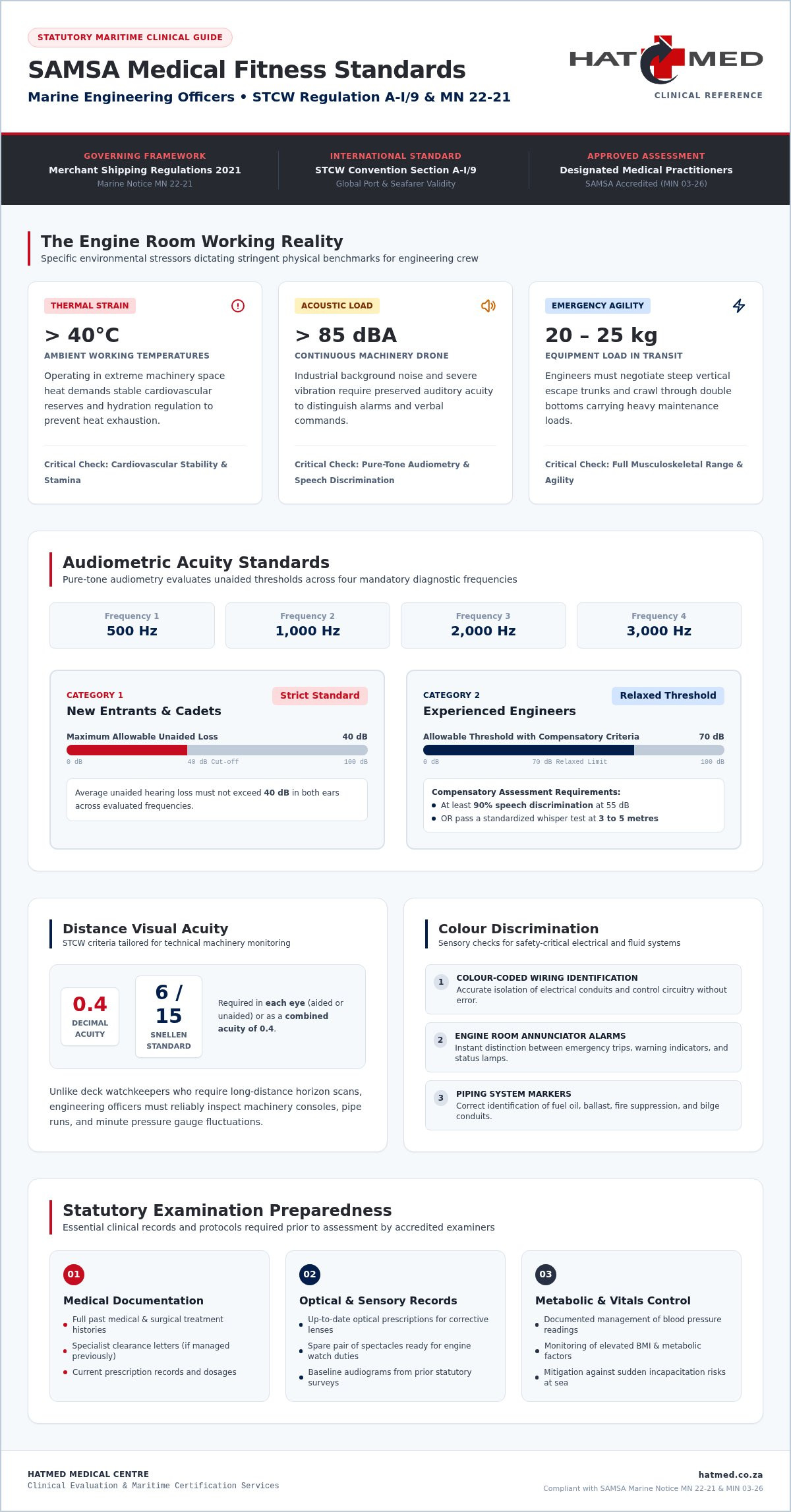
- Thermal and Cardiovascular Strain: Temperatures in machinery spaces frequently exceed 40°C. Working in such high heat requires excellent cardiovascular stamina and stable hydration regulation to avoid heat exhaustion.
- Rapid Emergency Response: During sudden auxiliary failures, blackout recoveries, or steering gear jams, engineers must negotiate steep escape trunks and confined double bottoms while handling heavy equipment weighing 20 to 25 kg.
- Acoustic and Spatial Pressures: Continuous background noise exceeding 85 dBA, combined with intense industrial vibration and extended watch rotas, demands sustained concentration and psychological composure under isolating conditions.
Meeting the SAMSA medical fitness standards for marine engineering officers confirms your readiness to handle these rigorous working realities. It provides genuine peace of mind that your physical resilience matches the technical challenges of your maritime profession.
Sensory, Physical Agility, and Physiological Benchmarks
Working in a ship’s engine room requires distinct physical capabilities that differ significantly from deck watches. Rather than surveying long distances at sea, engineers must detect minute gauge fluctuations, trace colour-coded wiring, and discern warning signals above machinery roar. Navigating the SAMSA medical fitness standards for marine engineering officers means demonstrating that your sensory perception and functional movement can withstand these harsh industrial realities.
Hearing Acuity and Pure-Tone Audiometry Thresholds
Acoustic safety is paramount in spaces dominated by auxiliary generators, purifiers, and propulsion engines. Pure-tone audiometry evaluates your hearing thresholds at 500 Hz, 1,000 Hz, 2,000 Hz, and 3,000 Hz. For new entrants and cadets, the average unaided hearing loss must not exceed 40 dB in both ears. If you’re an experienced engineer, SAMSA allows a relaxed threshold of up to 70 dB, provided you demonstrate at least 90% speech discrimination at 55 dB or pass a whisper test at 3 to 5 metres. These tests confirm that you can hear audible engine alarms and safety commands even through ambient drone.
Vision and Colour Discrimination Criteria
Visual standards reflect internal technical duties under global IMO seafarer medical fitness regulations:
- Distance Vision: Engineering officers require distance visual acuity of at least 0.4 (Snellen 6/15) in each eye, aided or unaided, or a combined acuity of 0.4.
- Near and Intermediate Vision: You must read small instrumentation dials, control consoles, and wiring schematics (standard N8 to N12 at 30 to 50 cm). If you wear spectacles or contacts, you must carry a spare pair on board.
- Colour Vision: Ishihara plate testing checks that you satisfy CIE Colour Vision Standard 1, 2, or 3. Accurate colour perception ensures you can safely distinguish live three-phase wiring, control-panel LEDs, and fluid pipe markings.
Physical Mobility, Balance, and Confined Space Agility
Machinery spaces present unique mobility hurdles. You must easily negotiate 60-degree engine trunk ladders, duck beneath low steam lines, and pass through narrow escape hatches. Examiners evaluate your balance and joint mobility to ensure you can move securely across rolling steel plates in heavy seas. You’ll also need the functional upper-body strength to lift roughly 20 to 25 kg, which is crucial for manually dogging watertight doors, lifting spare parts, or donning a self-contained breathing apparatus during an emergency. If you’d like guidance on these evaluations, you can explore the dedicated maritime health services at Hatmed Medical Centre to prepare thoroughly for your clinical assessment.
Chronic Conditions, Disqualifying Illnesses, and Medication Protocols
Working in confined, high-temperature machinery compartments presents real physiological challenges. Because remote watchkeeping offers limited access to emergency medical intervention, examiners must carefully evaluate sudden incapacitation risks. Complying with the SAMSA medical fitness standards for marine engineering officers requires proving that chronic health conditions remain thoroughly controlled and stable under rigorous operational stress.
Cardiovascular Health, Blood Pressure, and Metabolic Control
Cardiovascular strain peaks when climbing machinery casings or managing emergency breakdowns in ambient heat. For unrestricted certification, resting blood pressure must not exceed 140/90 mmHg. Readings at or above 160/100 mmHg result in temporary unfitness while therapy is adjusted. Body mass index also plays an important operational role. A BMI between 30.1 and 34.9 kg/m² requires cardiovascular risk scoring and functional agility assessments. A BMI of 35 kg/m² or greater necessitates deferral, as excessive bulk compromises rapid egress through narrow hatchways. For metabolic conditions like diabetes, insulin dependency generally precludes unrestricted worldwide watchkeeping. Well-managed Type 2 diabetes treated with metformin or lifestyle adjustments can secure conditional approval, provided your HbA1c remains stable below 7.5% to 8.0%.
Respiratory Function, Hernias, and Musculoskeletal Stability
Physical integrity is essential when managing heavy valves and emergency apparatus:
- Respiratory Disease: Unstable asthma or severe chronic obstructive pulmonary disease disqualifies candidates because machinery spaces expose engineers to hot vapours, oil mists, and emergency firefighting smoke.
- Hernias: Inguinal and large umbilical hernias are disqualifying until surgically corrected. Heavy lifting during sea voyages introduces an unacceptable danger of strangulation.
- Musculoskeletal Health: Recurrent joint dislocations or untreated spinal injuries compromise your capacity to climb steep vertical ladders safely during heavy swells.
Prescription Medications and Prohibited Therapeutic Classes
Maintenance drugs must never dull cognitive alertness or reduce physical reaction speeds. The South African Maritime Safety Authority strictly excludes therapies that induce sedation or bleeding vulnerabilities. Psychotropic medications, including benzodiazepines, antipsychotics, barbiturates, and chronic narcotic analgesics, are incompatible with safety-critical watchkeeping duties. Long-term oral anticoagulants are similarly restricted due to traumatic haemorrhage risks far from shore. If you take routine medications for hypertension or metabolic health, bringing detailed treatment records to your evaluation ensures our team can assess whether your regimen aligns with statutory guidelines. Partnering with experienced practitioners who understand the SAMSA medical fitness standards for marine engineering officers helps turn complex chronic disease management into a safe, sustainable maritime career.
Step-by-Step Guide to Your SAMSA Medical Examination
Arriving thoroughly prepared transforms what can feel like an intimidating statutory hurdle into a smooth clinical consultation. When you understand the documentation and physical criteria ahead of time, meeting the SAMSA medical fitness standards for marine engineering officers becomes straightforward and manageable. A methodical approach ensures your accredited examiner has everything required to confirm your fitness without administrative hold-ups.
Clinical History and Documentation Assembly
Gathering your paperwork before your appointment prevents avoidable certification delays. Make sure to pack:
- Identity and Maritime Credentials: Bring your original South African National Identity Document or Passport, Discharge Book, and expiring medical fitness certificate.
- Vision Care Documentation: If you wear corrective spectacles or contact lenses, bring your latest optometry prescription along with your mandatory primary and spare pairs.
- Medical Summaries and Prescriptions: For any past surgical operations, hospitalisations, or ongoing therapies, provide an official treating doctor’s summary detailing your diagnosis, stability, and exact prescription dosages.
Pre-Assessment Physiological and Lifestyle Optimisation
A few practical lifestyle measures taken in the days leading up to your clinical evaluation can protect your baseline readings. Avoid loud machinery spaces, concerts, or personal earphones for at least forty-eight hours prior to your visit. This simple rest period prevents temporary acoustic threshold shifts from distorting your pure-tone audiometry results. On the morning of the exam, steer clear of excess caffeine, nicotine, and high-sodium meals to prevent artificial spikes in your resting blood pressure. Drink plenty of water so your routine urinalysis accurately reflects kidney function without concentrated protein or glucose artefacts.
Navigating Specialist Consultations and Conditional Certificates
Should an examiner discover a borderline reading or unmanaged condition, you won’t necessarily face a career-ending permanent failure. Practitioners frequently issue temporary deferrals or conditional passes, such as geographic service restrictions or shortened six-month review periods. If you disagree with an adverse determination, Section 10 of the regulations grants you the legal right to request an Independent Medical Appeal Board through SAMSA. For long-term health preservation, maintaining regular general practitioner consultations ensures ongoing well-being, while dedicated chronic disease management keeps your clinical profile aligned with maritime fitness protocols year after year. When you’re ready to secure your seagoing clearance, book your SAMSA medical examination with our experienced clinical team.
Securing Your Maritime Medical Certificate Through Professional Clinical Evaluation
Undergoing a statutory medical assessment should feel like a constructive health partnership rather than an intimidating obstacle. By consulting an accredited general practitioner, you ensure total compliance with national maritime safety legislation while receiving clear clinical guidance. A comprehensive medical appointment brings diagnostic screening, physical evaluation, and regulatory certification together in a single, well-organised consultation designed around your working schedule.
The Clinical Examination Protocol in Practice
During your evaluation, the practitioner conducts a structured clinical assessment to confirm you satisfy the SAMSA medical fitness standards for marine engineering officers:
- Systematic Physical Examination: Your doctor performs a head-to-toe examination, palpating the abdomen and inguinal canals for early herniation, screening joint stability, and verifying full musculoskeletal range of motion.
- Neurological and Balance Assessment: Reflexes, pupil reactivity, and vestibular balance tests confirm that you can safely respond to sudden vessel motions in confined engineering flats.
- Integrated Diagnostics: Pure-tone audiometry, Ishihara colour perception, Snellen visual acuity, and automated urinalysis are completed on site to assess your sensory acuity and renal-metabolic baseline.
At the end of these checks, your physician reviews every finding with you directly. This transparent approach ensures you understand your clinical status and feel fully confident in the certification outcome.
Maintaining Long-Term Fitness for Marine Engineering Careers
Protecting your operational fitness requires continuous care that extends well beyond your appointment. High-noise machinery casings cause cumulative acoustic damage, making diligent use of hearing protection essential to preserve your audiometric baseline over decades at sea. In addition, balancing demanding watchkeeping shifts with regular cardiovascular exercise helps maintain healthy blood pressure and a safe body mass index.
Because standard SAMSA certificates for adult seafarers remain valid for two years, booking your renewal evaluation several weeks before the expiry date prevents interrupted sea time and lost voyages. If you are preparing for international mobilisations or joining foreign-flagged vessels, our clinical team can also help you review visa medical certificate requirements alongside your seafarer clearance. Aligning your routine healthcare with the SAMSA medical fitness standards for marine engineering officers protects both your physical well-being and your long-term maritime livelihood.
Chart Your Course to Confident Seagoing Compliance
Securing your clearance shouldn’t feel like an overwhelming barrier to your maritime ambitions. From demonstrating audiometric resilience amidst high machinery noise to maintaining steady cardiovascular health, thorough preparation puts you firmly in command of your professional journey. Complying with the SAMSA medical fitness standards for marine engineering officers isn’t merely about regulatory sign-off; it’s about safeguarding your vitality in one of the world’s most demanding operational workspaces.
When you’re ready for your renewal or initial evaluation, our clinical team is here to guide you forward. With SAMSA accredited medical practitioners, comprehensive on-site diagnostic screening, and dedicated occupational health expertise, we provide a supportive environment focused on your health and career longevity. Schedule your seafarers medical examination with Hatmed Medical Centre today, and return to sea with absolute confidence.
Frequently Asked Questions
What are the vision requirements for a marine engineering officer under SAMSA?
Engineering officers must achieve a distance visual acuity of at least 0.4 (Snellen 6/15) in each eye, or 0.4 combined, aided or unaided. Near and intermediate vision must allow you to read small machinery instrumentation, electrical schematics, and digital displays comfortably. If you require corrective lenses to meet these standards, statutory rules require you to carry at least one spare pair of spectacles or contact lenses while on duty at sea.
Can I pass the SAMSA medical examination if I have high blood pressure?
Yes, you can pass if your blood pressure is well controlled below the standard statutory threshold of 140/90 mmHg. If your initial reading exceeds 160/100 mmHg, the practitioner will record a temporary deferral while you stabilise your condition. Working closely with your doctor to establish an effective, non-sedating therapeutic regimen ensures you satisfy the SAMSA medical fitness standards for marine engineering officers without compromising shipboard safety.
How does SAMSA evaluate hearing loss for engine room officers?
Hearing acuity is objectively measured through pure-tone audiometry at frequencies of 500, 1,000, 2,000, and 3,000 Hz. Cadets and entry-level officers must demonstrate an unaided hearing threshold not exceeding 40 dB in both ears. For experienced seagoing engineers, regulations permit relaxation up to 70 dB, provided you achieve at least 90% speech discrimination at 55 dB to ensure critical machinery alarms remain clearly audible.
Is colour blindness an automatic disqualification for marine engineering personnel?
Total colour blindness is disqualifying, but mild colour deficiencies may be accepted if you satisfy CIE Colour Vision Standard 1, 2, or 3. Testing is conducted using Ishihara pseudoisochromatic plates. Because marine engineering officers regularly identify colour-coded electrical wiring, pipe contents, and illuminated alarm panels, preserving functional colour recognition is essential. When initial plate screening proves borderline, secondary lantern assessments may be arranged to determine operational safety.
What happens if an examining medical practitioner finds a temporary health issue?
If an examiner detects a treatable issue, such as unmanaged hypertension or a hernia, they issue a temporary unfitness notice rather than a permanent rejection. Your doctor will provide clear clinical recommendations, outlining necessary interventions or specialist reviews. Once the underlying concern resolves, you return for a re-assessment to secure your certificate. You also retain the statutory right to request an independent SAMSA appeal panel.
How long is a SAMSA seafarers medical certificate valid for engineering officers?
A standard SAMSA seafarer medical certificate remains legally valid for two years from the date of issue for adult seafarers aged 18 and older. For engineering cadets or crew under 18 years of age, validity is limited to one year. Examining practitioners may also issue certificates of shorter duration, such as six or twelve months, whenever a stable chronic condition requires periodic clinical monitoring.
Can seafarers with diabetes work as marine engineering officers on commercial vessels?
Yes, candidates with well-controlled Type 2 diabetes can successfully qualify, provided their HbA1c levels remain consistently under 7.5% to 8.0%. In accordance with the SAMSA medical fitness standards for marine engineering officers, individuals managed through lifestyle adjustments or metformin often obtain coastal or non-solo watchkeeping certification. Conversely, insulin-dependent diabetes is usually disqualifying for unrestricted worldwide voyages due to sudden hypoglycaemic risks in remote, high-heat machinery spaces.