

A professional medical assessment doesn’t follow one universal checklist. In South Africa, the steps depend on why the assessment has been requested and which requirements apply. It’s understandable to feel unsure about the examination, paperwork or what the outcome could mean for work or an application.
You can feel more prepared when you know what to expect. Hatmed Medical Centre’s clinicians provide assessments for different purposes, including pre-employment, executive, immigration and Seafarers/SAMSA medical examinations. The relevant requirements guide the process, which may include questions about your health, an examination or tests suited to the purpose.
This guide explains why assessments are requested, what may happen during your appointment and how to organise useful documents and health information beforehand. It also covers results and possible follow-up, so you can arrive prepared and know what questions to raise.
Key Takeaways
- A professional medical assessment is shaped by its stated purpose and the requirements set by the requesting organisation or authority.
- The appointment may include a discussion of your health history, an assessment and an explanation of possible next steps, depending on the examination.
- Pre-employment, executive, immigration and Seafarers/SAMSA assessments have different focuses and are not interchangeable.
- Prepare by bringing relevant documents, the requesting organisation’s forms and instructions, and any questions you want to raise.
- Assessment findings and the requesting organisation’s final decision are separate. What happens next depends on the process involved.
What is a professional medical assessment, and why might you need one?
A professional medical assessment is a clinician’s evaluation of your health in relation to a stated work-related or administrative purpose. The organisation or programme requesting it sets the purpose and relevant requirements, which guide what the clinician assesses. There is no universal checklist: what is appropriate for one assessment may not apply to another.
A professional medical assessment considers your health in the context of a specific requirement, so its scope depends on why it has been requested. It may include questions about your health and an examination, but the details vary. A physical examination can involve different methods, depending on what the clinician needs to assess. The appointment addresses its stated purpose; it does not replace broader healthcare when that is needed.
Which situations may call for a professional medical assessment?
An employer may request a pre-employment assessment in relation to a role. An executive assessment may provide a broader review of health for professional purposes. These are distinct assessment categories, and the reason for the appointment shapes its focus. Immigration and Seafarers/SAMSA medical examinations are also purpose-specific, with the relevant requirements guiding what is considered.
Travel health appointments serve a different need. They may cover health advice related to your itinerary and vaccination needs, helping you plan health preparations for your trip.
How does an assessment differ from a routine GP consultation?
A routine GP consultation addresses broader or immediate healthcare needs. You might discuss a new concern, review an ongoing health issue or seek advice about your wellbeing. A professional assessment, by contrast, focuses on questions linked to a stated requirement. The two serve different purposes: an assessment does not replace ongoing primary care, and a GP consultation does not automatically meet the requirements of a formal examination.
If you need continuing support alongside a specific assessment, a GP can help with your wider health needs. For more on ongoing primary care, read this guide to finding a general practitioner in South Africa. Knowing why you have been referred helps you understand what the appointment is meant to address and what questions to bring.
What happens during a professional medical assessment?
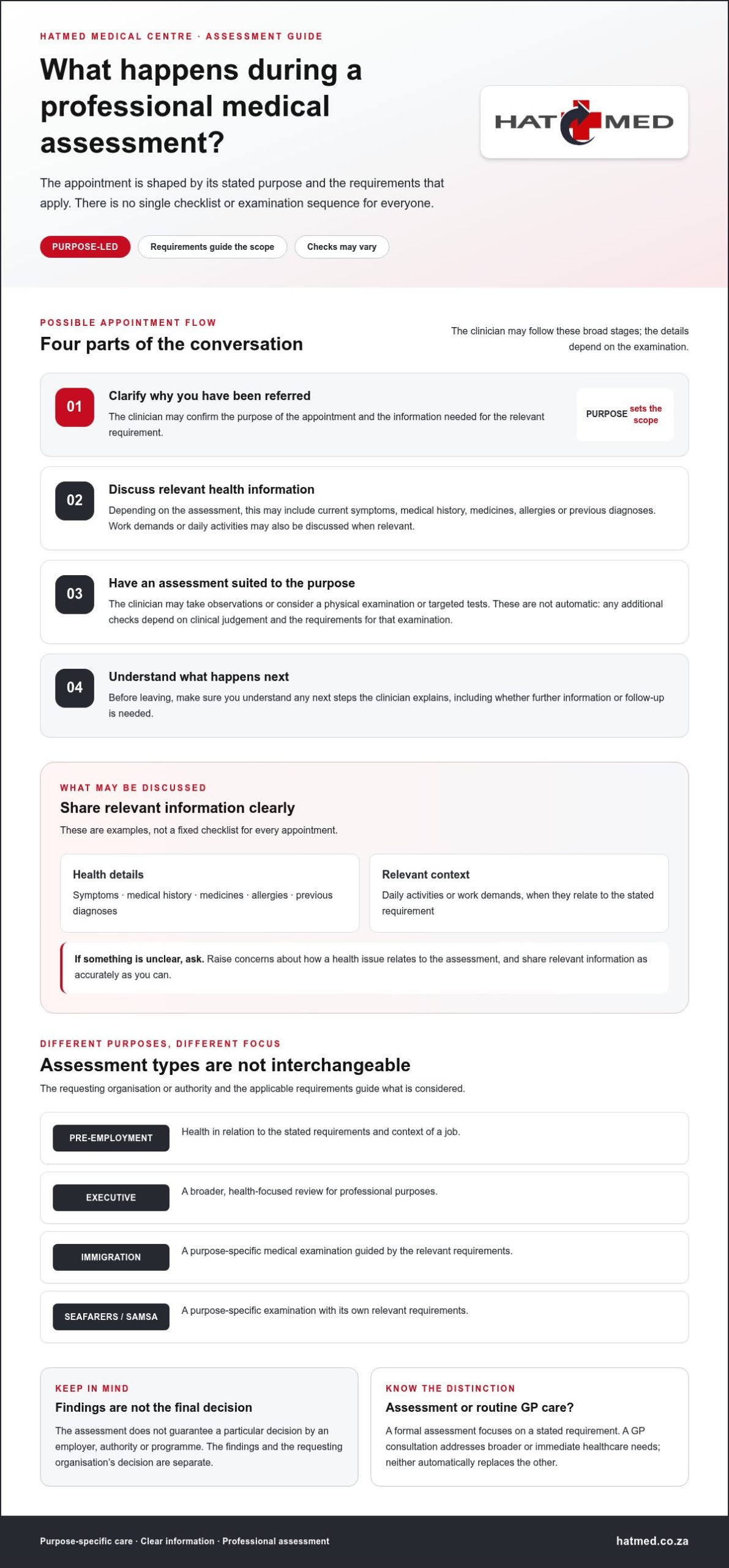
The appointment is guided by its purpose, so the clinician can focus on information relevant to the requirement. There is no single examination sequence for every assessment. The questions, checks and any tests depend on the type of assessment and the applicable requirements.
The clinician may begin by clarifying why you have been referred and what information is needed. They may then review relevant health details, carry out an assessment suited to the purpose and explain what happens next. Broadly, an assessment is a process to learn about a patient’s condition. In a professional assessment, its scope is shaped by the specific reason for the appointment.
What information might the clinician discuss?
Depending on the assessment, you may be asked about current symptoms, relevant medical history, medicines, allergies or previous diagnoses. If the purpose relates to a particular role, the clinician may also ask about daily activities or work demands relevant to the stated requirement. These are examples, not a fixed checklist for every appointment.
Share relevant information as accurately as you can, even if you are unsure whether a detail matters. If you do not understand a question, or you are concerned about how a health issue relates to the assessment, raise it during the consultation. A clear conversation helps the clinician understand your circumstances and explain the process.
Could an assessment include tests or a physical examination?
It may. Depending on the assessment’s purpose, the clinician could take observations or consider targeted tests or a physical examination. These are not automatically required for every person or assessment. Any additional checks depend on clinical judgement and the requirements for that examination.
Immigration and Seafarers/SAMSA medical examinations may follow different purpose-specific requirements. Use the current instructions supplied for your assessment, and consult the relevant official guidance if you need to understand what applies. Do not assume that a test included in one type of examination will also be part of another.
Before you leave, make sure you understand any next steps the clinician explains, such as whether further information or follow-up is needed. The assessment itself does not guarantee a particular decision by an employer, authority or programme. Hatmed provides medical assessments for different purposes, with information about its services available at Hatmed Medical Centre.
How do professional medical assessments differ by purpose?
The purpose of the appointment shapes what the clinician considers and which instructions or forms may apply. A professional medical assessment for a job is not interchangeable with one linked to an immigration application or seafaring work. Read the documents provided by the requesting organisation or authority to understand what information is needed, and bring any relevant forms to your appointment.
| Assessment type | Likely focus | Who sets the requirements? |
|---|---|---|
| Pre-employment | Health in relation to the stated requirements and context of a job | The employer’s relevant requirements and any applicable rules |
| Executive | A health-focused evaluation for professional purposes | The purpose of the assessment and any instructions provided |
| Immigration | Medical information relevant to an immigration application | The relevant application and authority requirements |
| Seafarers/SAMSA | Health assessment for the relevant seafaring purpose | The applicable seafarer assessment requirements |
What is different about employment and executive assessments?
A pre-employment assessment relates to a particular job’s stated requirements and context. These can differ between roles, so do not assume every employer requests the same checks or uses identical decision criteria. An executive assessment is also purpose-specific, but it is a health-focused evaluation rather than a promise about future health. In either case, the clinician assesses the information relevant to the stated purpose.
How do immigration and seafarer assessments follow separate requirements?
An immigration medical examination relates to the application and the requirements set by the relevant authority. A Seafarers/SAMSA examination is a separate assessment category, with its own applicable requirements. Forms and instructions can therefore affect what information you need to provide. For application-specific context, see the South African visa medical certificate requirements guide.
An assessment does not automatically mean you will pass or fail, receive approval or be ruled out. The clinician’s findings relate to your health and the assessment’s purpose; the employer, authority or programme applies its own process to reach a decision. If you are unsure what a form is asking for, raise that during the appointment so the relevant information can be discussed clearly.
How can you prepare for a professional medical assessment?
A little preparation can make it easier to give clear information and understand what the appointment involves. Use this checklist as a starting point, then follow any instructions supplied for your specific assessment.
- Confirm the purpose. Check whether the appointment is for pre-employment, executive, immigration, Seafarers/SAMSA or another stated reason.
- Gather relevant documents. Bring identification, the requesting organisation’s forms and any instructions you have received. Include previous medical information if it is relevant or requested.
- Note key health details. Write down current symptoms, relevant diagnoses, allergies and the names or details of medicines you take.
- Plan your questions. Make a note of anything you would like clarified about the appointment, possible results or follow-up.
What should you bring to an assessment?
Alongside identification and any required paperwork, consider bringing a list of your medicines and relevant medical information, such as details of previous diagnoses. If you routinely use glasses, hearing aids or another aid that may relate to the assessment, bring it with you. Use your appointment instructions to guide what is needed rather than assuming every assessment requires the same documents.
Do not stop prescribed medicines, change how you take them or alter your usual routine unless a clinician has advised you to do so. If you are unsure whether a medicine or health detail is relevant, note it down and raise it during the appointment.
What should you do before and during the appointment?
Before you attend, think through your medical history so you can describe it as accurately as possible. You do not need to memorise every detail. Notes can help you remember important dates, symptoms or treatments, especially if you feel nervous. During the consultation, ask for clarification if a question or instruction is not clear.
You might ask how the assessment relates to the stated requirement, how you will receive information about the outcome, and whether follow-up may be needed. The answers can depend on the type of assessment and the process set by the requesting organisation.
Hatmed’s clinicians provide examinations for different purposes. Find information about Hatmed’s medical assessment services and bring the relevant forms and instructions you have received.
What happens after a professional medical assessment?
After a professional medical assessment, the next step depends on why it was requested, the clinician’s findings and the process followed by the requesting employer, authority or programme. You may receive an explanation of the assessment and any recommended follow-up. If documentation is part of the process, its format and handling depend on the assessment type and applicable requirements.
It helps to distinguish clinical findings from the final decision. A clinician assesses health in relation to the stated purpose; an employer, authority or programme may then consider the relevant information as part of its own process. An assessment alone does not guarantee clearance, certification, employment or approval, and the timing of any decision can vary.
Can an assessment lead to further tests or follow-up?
It can, if the clinician considers more information or follow-up clinically appropriate. That might mean discussing a finding further or arranging an additional assessment, depending on the circumstances. A recommendation for follow-up does not, by itself, decide your professional eligibility or the outcome of an application.
If further steps are suggested, ask what is recommended, why it may be needed and how it relates to the original purpose of your assessment. You can also ask who will explain the next step and what information or documentation you may need. These questions can help you understand the process without assuming what the final decision will be.
How should you understand assessment results and certificates?
The documents provided, the way results are handled and any information shared can differ according to the assessment and applicable requirements. If you receive a certificate or report, ask what it is intended to address and whether it meets the original request. If you are unsure how or when it should be submitted, clarify the process with the requesting organisation or authority.
If an assessment raises a health concern that calls for ongoing support, discuss suitable follow-up with a clinician. For a relevant long-term condition, Hatmed’s guide to chronic disease management offers further information about continuing care.
It is natural to have questions while waiting for next steps. Hatmed’s clinicians provide assessments for different purposes and can explain the clinical process and what follow-up may be appropriate. A clear understanding of the assessment can help you discuss your concerns and the next steps.
Take your next assessment step with confidence
A professional medical assessment is shaped by its purpose, so the examination and information required can vary. Knowing why it has been requested, bringing relevant forms and health details, and asking questions during your appointment can help you feel prepared. Remember that clinical findings are distinct from the final decision made by an employer, authority or programme.
Hatmed provides pre-employment, executive, immigration and Seafarers/SAMSA medical examinations, alongside GP consultations and travel health services. Its clinicians can explain the assessment process and discuss relevant follow-up.
Arrange a professional medical assessment with Hatmed and approach your appointment with greater clarity and confidence.
Frequently Asked Questions
What is a professional medical assessment?
A professional medical assessment is a clinician’s evaluation of your health in relation to a stated work-related or administrative purpose. The reason for the assessment shapes what information is relevant and which requirements apply. For example, an employment assessment has a different purpose from one linked to an immigration application or seafaring work. It does not guarantee approval or substitute for ongoing healthcare if you need it.
How should I prepare for a medical assessment for work?
Start by confirming the assessment’s purpose and reading any instructions from your employer. Bring the organisation’s forms, identification and relevant health information, such as medicine details or previous diagnoses. Make a note of questions you want to ask. Share information honestly with the clinician, and do not stop prescribed medicines or change your usual routine unless a clinician advises you to. Requirements can differ between roles and assessments.
Can a medical assessment affect my job or visa application?
It may provide clinical information relevant to an employer’s process or an immigration application, but the assessment itself does not decide the outcome. The clinician’s findings are distinct from the decision made by the employer, authority or programme, which follows its own requirements and process. A medical assessment does not guarantee employment, fitness approval or visa approval. Read the requesting organisation’s instructions to understand how the assessment relates to your application.
Is a professional medical assessment the same as a routine check-up?
No. A professional medical assessment focuses on health questions related to a stated requirement, such as a job or application. A routine GP consultation is generally for broader or immediate healthcare needs, such as discussing a symptom or managing an ongoing condition. The two appointments serve different purposes. An assessment does not replace ongoing primary care, and a routine consultation may not meet the requirements of a specific examination.
What should I bring to a professional medical assessment?
Bring identification, the requesting organisation’s forms and any appointment instructions you have received. A list of medicines, relevant medical information and details of previous diagnoses may also be useful, depending on the assessment. If glasses, hearing aids or another routinely used aid may be relevant, bring them. The documents needed can vary, so use the instructions for your appointment rather than assuming every assessment has the same checklist.
What happens if a medical assessment identifies a health concern?
If a concern arises, the clinician may explain the finding and recommend further assessment or follow-up if clinically appropriate. Ask what the suggested next step is, why it may be needed and how it relates to the original purpose. A finding or recommendation does not by itself determine your eligibility for work or an application. If the issue needs ongoing care, discuss suitable support with a clinician.