

What if the best preventative healthcare plan isn’t a long checklist, but a conversation shaped around you? It’s understandable to be unsure which checks are relevant, whether you need them if you feel well, or how routine care differs from tests for symptoms. Prevention can help identify risks and support your health, but it can’t guarantee you’ll avoid illness or replace care when something feels wrong.
Your age, health history, family background and other risk factors can help determine which steps may make sense. In this guide, you’ll learn what preventative healthcare can and can’t do, how check-ups, screening and vaccinations fit into ongoing care, and what practical questions to raise with a healthcare professional. You’ll also find out how a GP can help connect your concerns with appropriate checks and follow-up, so you can take a proactive approach without relying on a one-size-fits-all plan.
Key Takeaways
- Preventative healthcare can support wellbeing and help identify some conditions earlier, but it can’t guarantee you’ll avoid illness.
- Screening is most useful when it’s clinically relevant to your circumstances; more tests don’t automatically mean better care.
- Your age, family history, medicines, existing conditions and lifestyle can all shape which prevention steps are worth discussing.
- Vaccinations, health conversations, risk-reducing habits and ongoing condition management can all contribute to a personal approach.
- A GP can help you discuss relevant checks and agree on follow-up, making prevention part of ongoing care rather than a one-off appointment.
What Does Preventative Healthcare Mean, and Who Is It For?
Prevention isn’t only for people who feel unwell. It can support people who feel healthy and those living with an existing condition. Preventative healthcare means taking steps to reduce health risks, support wellbeing or identify some conditions earlier. These steps can help you make informed decisions, but they can’t remove every risk or guarantee a particular outcome.
Prevention is broader than a check-up or a test. It may involve everyday habits, vaccinations, screening that suits your circumstances, and follow-up for existing health needs. The Preventive healthcare overview describes different levels of prevention, which can help explain how these approaches work together.
Does preventative healthcare only matter when you feel unwell?
No. Feeling well is reassuring, but it doesn’t rule out every health risk or mean there’s nothing to discuss. A GP conversation can help you consider your health history and whether advice, vaccination or screening is appropriate. The right checks and timing vary from person to person; the aim isn’t to follow the same appointment or testing schedule as everyone else.
How do primary, secondary and ongoing prevention differ?
These terms describe related aims, not a checklist everyone must complete:
- Primary prevention aims to reduce the chance of a condition developing. Vaccination is one example of an action that can help prevent certain infections.
- Secondary prevention involves suitable screening or other early identification. Screening may find signs of a condition before symptoms appear, but it can’t guarantee that every condition will be detected.
- Ongoing management supports someone who already has a health condition. It isn’t prevention in the strict sense, but it can sit alongside preventive care through regular review and appropriate follow-up.
These distinctions are useful, but real care doesn’t always fit into separate boxes. Someone managing a long-term condition may still benefit from vaccination or other steps to reduce additional risks. If you have symptoms, that’s different from screening: tell a healthcare professional so they can be assessed directly. A GP consultation can connect your concerns and history with relevant preventive advice and ongoing care.
What Can Preventative Healthcare Include in South Africa?
Preventative healthcare isn’t simply a collection of tests. In South Africa, useful prevention can include conversations with a GP, health-promoting habits, vaccinations, appropriate screening and support for existing conditions. Prevention brings together personal health advice, risk-reducing choices, suitable checks and follow-up, guided by your needs rather than a fixed checklist.
This patient-centred approach fits within primary healthcare, which the World Health Organization describes as including health promotion and disease prevention. A GP consultation can help connect questions about your health with relevant advice and ongoing care.
Which everyday health measures can support prevention?
Everyday choices may support health, although they can’t remove all risk or guarantee that illness won’t develop. Depending on your circumstances, useful topics to discuss could include balanced eating, regular movement, adequate sleep and avoiding tobacco. These aren’t tests or a pass-or-fail measure of your health; what feels manageable differs between people.
If an existing condition, medicines or other health concerns affect your choices, seek guidance tailored to you before making substantial changes. You can also ask a GP whether checks such as blood pressure, cholesterol or blood glucose measurements are relevant. These are examples, not a standard panel everyone needs.
Where do vaccinations, screening and chronic care fit?
Vaccination is one part of prevention. Which vaccinations may be appropriate depends on factors such as your health and circumstances, alongside current clinical advice. For more detail, read this guide to adult vaccinations in South Africa.
Screening generally means checking for a condition in someone who doesn’t have symptoms. If you have a symptom or a new concern, the assessment is different: tell a healthcare professional so it can be considered directly, rather than treating a screening test as the answer. The relevance and timing of screening depend on your circumstances and current clinical guidance; more testing isn’t automatically better care.
People living with ongoing conditions may also need continuing reviews and support. Chronic disease management isn’t screening, but it can sit alongside preventive steps as part of primary care. Explore chronic disease management to learn more about ongoing support. If you’d like to discuss which measures fit your health history, a GP consultation can be a practical place to start.
Preventative Healthcare Myths: What Screening Can, and Cannot, Do
Screening can be a helpful part of preventative healthcare, but it isn’t a complete health assessment or a guarantee that nothing is wrong. The value of a test depends on whether it’s appropriate for the person and the question being considered. A wider discussion of prevention and healthcare in South Africa can also help put individual decisions in context.
Screening estimates or detects selected risks; it doesn’t diagnose everything. A result may be reassuring, indicate a need for further assessment, or occasionally be misleading. A clinician interprets it alongside your circumstances and considers what, if anything, should happen next.
| Myth | Reality |
|---|---|
| More tests always mean better care. | Tests are most useful when there’s a clear clinical reason to do them. Unnecessary testing can produce findings that need clarification without necessarily improving care. |
| A normal screening result guarantees I’m healthy. | A result only speaks to what that test was designed to assess at that time. It can’t rule out every existing or future health problem. |
| Screening and diagnostic testing are the same. | The purpose depends on the situation. Screening is generally offered to someone without symptoms; diagnostic testing investigates a symptom, concern or finding. |
Myth: A screening test guarantees that I am healthy
Screening has a defined purpose and limitations. It may not detect a condition, or a result may suggest a concern that isn’t ultimately confirmed. That doesn’t mean the test was pointless; it means results need to be understood in context. If a screening result needs follow-up, a healthcare professional can explain whether further assessment is appropriate.
A recent check doesn’t replace attention to how you feel. If you develop new symptoms or something persists, arrange a clinical assessment rather than relying on an earlier normal result.
Myth: Preventive checks and diagnostic tests are the same
A routine check for someone who feels well has a different purpose from an investigation prompted by symptoms. The same type of test may be used in either situation, but the reason for doing it and how the result is interpreted can differ. Share your concerns with a GP so the next step is guided by your health context, not simply by the availability of a test.
For an individual discussion about appropriate checks and follow-up, a GP consultation can help you consider the options.
How to Make Preventative Healthcare Personal and Practical
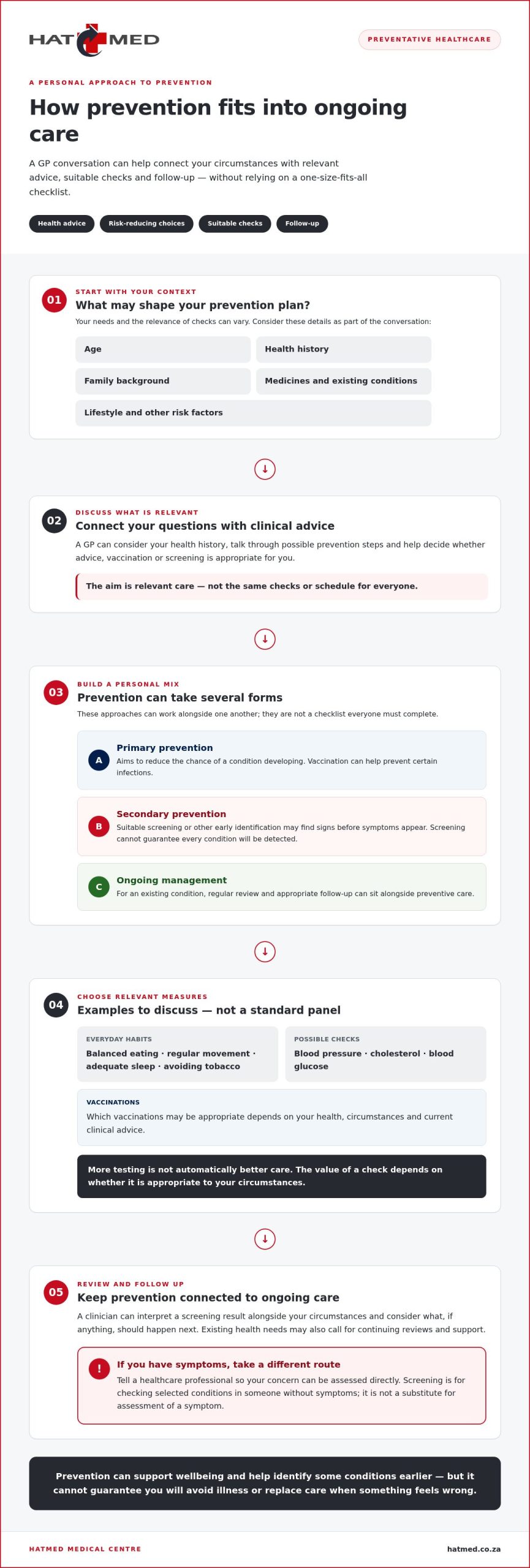
A useful prevention plan starts with what’s relevant to you, not a universal list of tests. In a GP conversation, you can work through a few clear steps: review your health history, share current concerns, discuss suitable preventive measures, then agree on what follow-up makes sense. Recommendations should reflect factors such as your age, health history and individual risks, alongside current South African clinical guidance.
You don’t need to arrive with every detail organised. A few notes can help you make the most of the appointment and ensure your key questions are covered.
What information should you bring to a prevention conversation?
Consider noting health conditions in your family, any changes or concerns you’ve noticed, and an up-to-date list of medicines and supplements. Mention existing conditions, even if they’re well managed. It can also help to describe your usual habits and any barriers you face, such as difficulty fitting movement into your routine or questions about dietary changes. This gives your GP a fuller picture and helps shape advice around your circumstances.
How can you plan checks without over-testing?
If a screening test or check is suggested, ask what it is intended to assess, what its limitations are and what might happen after different results. A helpful question is: “How could this result change my next steps?” That keeps the discussion focused on clinical relevance rather than testing for its own sake. You can also ask how the recommendation fits your age, health history and current guidance.
Keep a simple record of questions you want to raise, vaccinations you’ve received and any follow-up you and your GP agree on. This can help you pick up the conversation at a later appointment without setting a schedule for yourself based on general advice.
If you’re preparing for a trip, prevention may include travel-related health considerations. Read this guide to travel health advice as part of your preparation, and discuss personal questions with a GP.
For support in shaping a prevention plan around your circumstances, arrange a GP consultation with Hatmed Medical Centre.
How a GP Can Support Your Preventative Healthcare Journey
A GP can help turn general health advice into a plan that reflects your circumstances. In a consultation, you can discuss your health history, current concerns and possible risks, then consider whether checks, vaccinations or follow-up may be relevant. The aim isn’t to prevent every illness or find every health problem, but to make informed decisions together.
At Hatmed Medical Centre, GP consultations include routine check-ups and preventative medicine. Routine vaccinations and chronic disease management can also form part of ongoing primary care, depending on your needs. Prevention is not a one-off appointment: questions and priorities may change over time, so reviewing your plan can help keep care relevant.
What can a GP help you discuss?
Bring up anything you’d like to understand better, from family health history and lifestyle concerns to questions about existing conditions or medicines. A GP can help consider which preventive checks may be appropriate, discuss vaccination needs and explain what a result might mean. If further assessment or follow-up is needed, you can talk through the next steps together.
Your circumstances matter. Advice may differ according to your health history, age and individual risk factors, and a check that’s relevant for one person may not be useful for another. A GP can help you weigh the purpose and limitations of possible measures without treating prevention as a guarantee.
What is a sensible next step if you want to be proactive?
Start small. Before your next consultation, write down one or two priority questions, such as whether a particular check is relevant to you or which vaccinations to discuss. If you’re managing a long-term condition, note any changes or challenges you want help with. You can also keep a simple record of agreed actions and follow-up, so it’s easier to revisit them later.
Don’t wait for a routine check if you have a new or persistent symptom. Tell a healthcare professional so it can be assessed in the right context. Routine prevention and symptom-led care have different purposes, and one doesn’t replace the other.
For a personalised conversation about preventative healthcare, book a GP consultation with Hatmed Medical Centre. It’s a practical way to discuss your questions and consider a suitable next step with a healthcare professional.
Make Prevention Part of Your Ongoing Care
Preventative healthcare works best as a personal, ongoing conversation, not a universal list of tests. The right steps depend on your health history and circumstances, and screening can offer useful information without guaranteeing that every condition will be prevented or detected. Keeping track of your questions and agreeing on relevant follow-up can help you take a steady, informed approach.
At Hatmed Medical Centre, GP consultations include preventative medicine, with routine vaccinations and chronic disease management also supporting primary care. A GP can help you discuss your concerns and consider what may be appropriate for you.
Arrange a GP consultation to discuss your preventative healthcare and take a practical next step towards care that reflects your needs. You don’t have to work it all out at once; one conversation is a good place to begin.
Frequently Asked Questions
What is preventative healthcare?
Preventative healthcare means taking steps to reduce health risks, support wellbeing or identify some conditions earlier. It can include health advice, vaccination, screening that’s appropriate to your circumstances and follow-up for ongoing needs. It isn’t a promise that you’ll avoid illness or that every health problem will be found. A GP can help you understand which preventive measures may be relevant to your health history and concerns.
Is preventative healthcare only for people who feel healthy?
No. It can be useful both for people who feel well and for those managing existing health conditions. Feeling healthy doesn’t rule out every risk or mean preventive advice has no value. For someone with a long-term condition, preventive care may sit alongside ongoing management, for example by discussing relevant vaccinations or other health risks. The right approach depends on the person, rather than a standard list of tests for everyone.
What does preventative healthcare include in South Africa?
It can include conversations about your health, habits that support wellbeing, appropriate vaccinations, relevant screening and care for existing conditions. Checks such as blood pressure, cholesterol or blood glucose may be considered in some circumstances, but they aren’t a universal test panel. The need for a particular check and when to have it depend on individual factors and current clinical guidance. A GP can help you discuss what may suit you.
How often should I have preventative health checks?
There isn’t one check-up frequency that suits everyone. The timing and type of review can depend on your age, health history, existing conditions, family history and other risk factors. Some people may need follow-up for a specific health concern, whilst others may discuss prevention as part of a routine GP consultation. Ask what a suggested check is for and when it would make sense to review the plan again.
Can a screening test prove that I do not have a health condition?
No. A normal screening result can be reassuring about the specific issue the test was designed to assess, but it can’t rule out every existing or future health problem. Screening tests have limits, and some results may need further assessment to clarify what they mean. If you develop a new or persistent symptom after a recent check, discuss it with a healthcare professional rather than relying on that earlier result.
What is the difference between a screening test and a diagnostic test?
Screening is generally used to look for signs of a selected condition in someone who doesn’t have symptoms. Diagnostic testing investigates a symptom, concern or finding. The same type of test may have either purpose, depending on why it’s requested and the clinical context. A GP can explain what a proposed test is intended to assess, its limitations and what the possible results could mean for your next steps.
Does preventative healthcare include vaccinations and chronic disease care?
Yes, vaccination is one preventive measure, with suitability guided by your circumstances and current advice. Chronic disease care is ongoing management rather than prevention in the strict sense, but it can work alongside preventive steps. Hatmed Medical Centre provides routine vaccinations and chronic disease management, as well as GP consultations that include preventative medicine. Discuss your health needs with a GP to understand how these aspects of care may fit together for you.